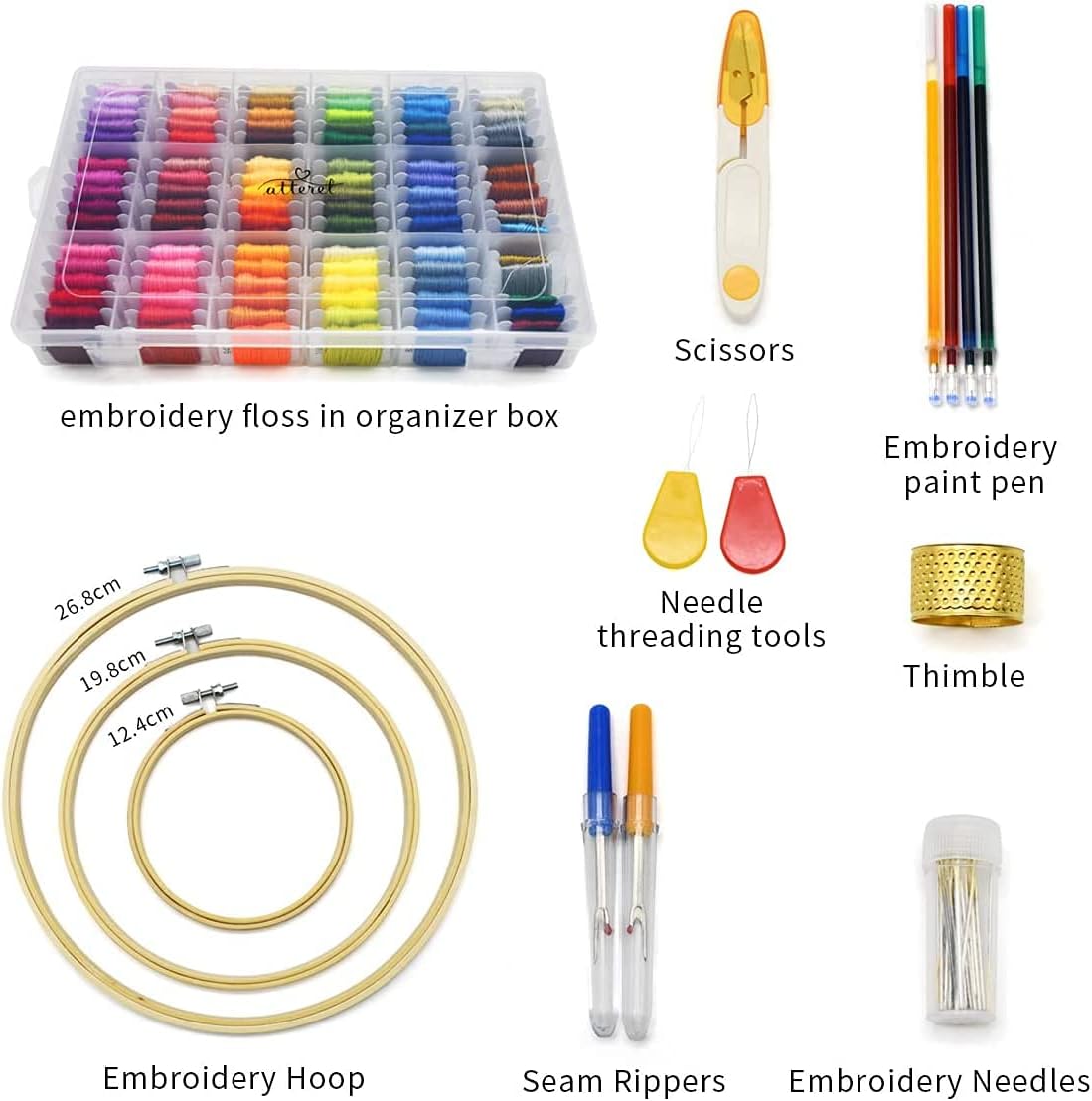
Embroidery floss — the stranded cotton thread sold in small bundles called skeins — looks deceptively simple until you’re forty projects in and staring at a tangled drawer of colours you can no longer identify. At that point, the logic behind DMC’s numbering system stops being trivia and starts being essential infrastructure. DMC (a French thread manufacturer whose initials stand for Dollfus-Mieg et Compagnie) produces the most widely distributed embroidery thread in Australia, and their numeric colour system — over 500 codes, each tied to a specific dye formula — is effectively the industry’s shared language. Whether you’re buying your twelfth skein or your five-hundredth, understanding how that system works, how to store thread so it’s actually usable, and how to evaluate kit value against buying singles will save you real money and real frustration. This guide covers all three.
How DMC’s Colour Numbering System Actually Works — and Why It Matters
DMC’s numbering system is not sequential by colour family. That surprises most intermediate embroiderers who assume, say, all the blues cluster in one number range. They don’t. The numbers were assigned historically, as dye lots were developed, which means 336 (a deep navy) sits nowhere near 3750 (a slightly softer navy) in numerical order even though they’re visually close siblings.
What the system does give you is absolute reproducibility. Every DMC skein worldwide — whether you buy it at Spotlight in Parramatta or order from a UK supplier — is dyed to the same published formula. The Artists Network embroidery buying guide notes this consistency as one of DMC’s most commercially significant attributes: a pattern published in 1987 calling for DMC 326 will match a skein purchased in 2026. For pattern designers and anyone following published charts, this matters enormously.
The practical implications for your buying decisions:
- Colour cards are worth owning. The DMC Colour Card (the 2024 edition is the current printed reference) shows actual thread samples, not printed ink approximations. Screens and catalogues shift colour; the physical card doesn’t. If you’re building a serious stash, the ~$30–$45 AUD cost of a colour card pays for itself the first time it prevents a wrong-skein purchase.
- Variegated and specialty lines use different code structures. DMC Color Variations (the multi-toned skeins) use a 4000-series prefix; Light Effects (metallic and luminescent threads) use a letter prefix (E for Effect). If you’re sourcing these from separate suppliers, the code structure tells you immediately what you’re handling.
- Discontinued codes create stash traps. DMC periodically retires colour codes, and retailer stock doesn’t always update fast. Maker and Student’s intermediate embroidery Q&A series flags this as a frequent frustration for Australian buyers: a colour appearing in a US pattern may have been discontinued in the Australian retail supply chain, making local sourcing unreliable.
Kits vs. Singles: The Value Maths for Australian Buyers
Here’s where the decision gets genuinely interesting, and where most intermediate embroiderers leave money on the table.
By the numbers (May 2026 AU retail):
| Format | Typical AU price | Skeins/colours included | Cost per skein |
|---|---|---|---|
| DMC 36-skein starter kit | $30–$38 AUD | 36 | ~$0.86–$1.05 |
| DMC singles (Spotlight/Lincraft) | $1.50–$2.20 AUD | 1 | $1.50–$2.20 |
| 100-skein sampler box (mixed brand) | $45–$65 AUD | 100 | $0.45–$0.65 |
| Premium Anchor singles (specialty retailer) | $2.50–$3.50 AUD | 1 | $2.50–$3.50 |
The headline number — kit cost per skein is roughly half the singles price — is real, but the maths only holds if you actually use what’s in the kit. The Craft Council of Australia’s 2025 retail landscape report notes that starter and value kits are among the highest-margin embroidery SKUs for Australian retailers precisely because they shift colour choices away from the buyer. A 100-skein sampler box at $0.55/skein is excellent value if you needed those 100 colours; it’s expensive storage if you needed 20 specific colours and ended up with 80 you’ll never use.
The decision rule here is simple: If you’re building a general stash for freehand or original work, kits offer genuine savings. If you’re following a specific published pattern, buy singles to match the called codes exactly — the kit may not include them, and you’ll end up buying singles anyway on top of the kit spend.
Freight reality for Australian buyers: The Craft Council report and Jackson’s Art Supplies’ published thread range notes both point to the same pattern — Australian embroidery supply is heavily concentrated in Spotlight and Lincraft for mass-market DMC, with specialist online retailers (including Thread Studio, Australian Needle Arts, and the embroidery section of dedicated fibre suppliers) covering specialty threads, Anchor, Cosmo, and Madeira ranges. US and UK suppliers offer extraordinary colour depth, but with current freight and import costs, the landed price on a $25 USD thread order frequently exceeds the local equivalent once postage is calculated. For anything under about $80 AUD in thread value, buying local is almost always the better financial decision.
Storage Systems: What Actually Works at Intermediate Scale
Storage is the area where intermediate embroiderers most consistently under-invest, then regret it. At the beginner stage, a zip-lock bag is fine. At 100+ skeins, it becomes a project tax — the time spent untangling and searching eats into every session.
The three systems that consistently get good reports from working embroiderers:
1. Bobbin/card winding systems. Winding floss onto small plastic or cardboard bobbins (sold in packs of 50–100) and storing them in a divided box is the most widely used intermediate system. The DMC-branded plastic bobbins allow you to write the colour code directly on the bobbin, which is the critical feature. Owners consistently report that unlabelled bobbins become unusable within six months as visual memory fades. The cost is low — a 100-pack of bobbins runs $8–$15 AUD — but the time investment in winding is real. Factor roughly 2–3 minutes per skein to wind properly.
2. Ring binder systems with floss cards. Floss is looped through a punched card, the card labelled with the DMC code, and the cards stored in a ring binder with plastic sleeves. This approach, favoured by pattern-followers who work from charts, allows direct colour matching against a colour card and easy identification of gaps in a collection. The system scales well to 500+ colours without becoming unwieldy. The limitation is that thread stored this way is less protected from light than bobbin boxes.
3. Zip-seal bags in a project box. For embroiderers who prefer to work project-by-project rather than maintaining a permanent stash, pulling the required skeins for each project into a labelled zip-seal bag is efficient and low-overhead. The disadvantage is that this approach doesn’t build a reusable reference collection — every new project requires re-sourcing.
What the research and aggregated reviews suggest to avoid: Loose storage in jars or baskets, however photogenic, consistently creates tangling and colour-code loss problems at intermediate stash sizes. Maker and Student’s embroidery Q&A series specifically notes this as the number-one storage regret reported by embroiderers in the 12–24 month experience window.
Getting the Most Thread Per Dollar: Specific Buying Strategies
A few non-obvious tactics that experienced buyers use:
Buy grey-range colours in larger quantities. Neutrals — the off-whites, ecrus, taupes, and soft greys — appear in an outsized proportion of patterns and designs. DMC 3866 (a warm near-white), 822 (a warm buff), and the Ecru code are workhorses. Buying these in multi-skein lots when you find them discounted makes sense; they won’t go unused.
Understand the difference between stranded cotton and other thread types before buying a kit. Standard DMC floss is a six-strand cotton thread that you typically split into two or three strands for fine work. Kits pitched at “beginners” sometimes include non-separable threads (perle cotton or tapestry wool) alongside stranded floss — the uses are completely different. Reading the kit contents carefully before purchase prevents buying the wrong product type.
Colour matching across dye lots is less of a problem with DMC than with hand-dyed threads — but it’s not zero. DMC’s industrial dyeing process is highly consistent, but embroiderers working on large projects report occasional subtle lot-to-lot variation in some colours, particularly in the mid-tone ranges. The Artists Network embroidery guide recommends buying all the thread needed for a single project at the same time when working large pieces. For stash-building, it’s a non-issue.
The Anchor vs. DMC comparison. Both brands are widely available in Australia; both produce high-quality stranded cotton. The critical operational point — flagged in Jackson’s Art Supplies’ thread range notes — is that Anchor and DMC colour codes are not interchangeable. Anchor 148 is not the same colour as DMC 148. Conversion charts exist (DMC publishes one; Anchor publishes one), but they’re approximations, not exact matches. If you’re following a DMC pattern, buy DMC. If you’re following an Anchor pattern, buy Anchor. Mixing mid-project creates visible colour inconsistencies.
The Decision Framework
If you’re an intermediate embroiderer building or reorganising a stash in 2026, the decision sequence looks like this:
If you follow published patterns: Prioritise singles over kits, match DMC codes exactly, invest in a physical colour card, and buy project quantities all at once. Storage via bobbin box or ring binder with labelled cards.
If you work freehand or experimentally: A kit provides genuine per-skein savings and a good colour range starting point. Supplement with singles in the specific colours your work gravitates toward. Bobbin winding is worth the time investment at this scale.
If you’re evaluating whether to buy locally vs. internationally: For orders under $80 AUD in thread value, Australian retail (Spotlight, Lincraft, or specialist online suppliers) almost always wins on total landed cost. Above that threshold, and particularly for specialty threads not stocked locally, international sourcing becomes worth calculating.
The colour code is only useful if you can read it six months later. Buy the bobbins. Label everything. The system pays for itself faster than you’d expect.