Watercolour paint is, at its simplest, finely ground pigment — the actual colour-making particle — suspended in a binder (usually gum arabic) that helps it stick to paper and re-activate when wet. The critical variable that separates a $15 student set from a $120 professional one is how much pigment is actually in each pan or tube. A paint with high pigment load (sometimes called pigment concentration) gives you rich, transparent colour in a single brushstroke. A low-load paint is mostly filler and binder — you’ll get a pale, chalky wash no matter how long you scrub at the pan. If you’ve ever wondered why your colours look muddy or washed-out compared to work you see online, pigment load is almost certainly part of the answer. This guide breaks down how to read set specifications before you spend, maps the Australian retail landscape from student to professional tier, and ends with a clear decision rule so you leave knowing exactly which set matches your current stage.
Why Pigment Load Is the Number That Actually Matters
Every watercolour tube or pan carries a label, and once you can decode it, the price-per-pan question answers itself. Three label elements tell you almost everything:
Single-pigment vs. mixed-pigment colours. Pigment codes follow an international system: PB (pigment blue), PR (pigment red), PY (pigment yellow), PBk (pigment black), and so on, followed by a number. A colour labelled PB29 is a single pigment — ultramarine blue, specifically. A colour labelled PB29, PW6 is a mixed pigment (ultramarine cut with titanium white to make it more opaque or reduce cost). Single-pigment paints mix more cleanly and predictably. According to Artists Network’s guide on reading watercolour labels, multi-pigment paints are not automatically inferior — some historic hues like sap green are intentionally blended — but when you see three or four pigment codes on a student-range pan, that’s usually a sign of cost reduction, not colour-science.
Lightfastness rating. This is the paint’s resistance to fading under light exposure. The ASTM (American Society for Testing and Materials) scale used by most major brands runs from I (excellent) to V (very fugitive — fades quickly). Professional-grade sets almost exclusively use ASTM I and II pigments. Student sets sometimes include ASTM III and IV pigments — fine for practice, a problem if you’re selling work or entering exhibitions. Craft Council Australia’s materials literacy guidance notes that lightfastness is the single most underread variable among intermediate practitioners moving into sold work.
Series number. Most brands grade their colours by raw pigment cost — Series 1 is cheapest to produce, Series 4 or 5 uses expensive pigments (cadmiums, cobalts, genuine Naples yellow). Sets often bundle mostly Series 1–2 colours with one or two higher-series colours as a hook. A set marketed as “24 colours” but built from Series 1 and 2 paints throughout will perform very differently from a curated 12-colour professional set mixing Series 1–4.
The Australian Retail Landscape: Three Tiers, Honest Numbers
Australian watercolour pricing sits roughly 20–35% above UK/US retail equivalents after GST, import duty, and freight margins — a spread Jackson’s Art Supplies watercolour guides and Australian stockist pricing consistently reflect. Budget accordingly.
By the Numbers: Representative AU Retail (May 2026)
| Set | Pan count | Approx. AU RRP | Price per pan |
|---|---|---|---|
| Winsor & Newton Cotman 24-pan | 24 | ~$42 | ~$1.75 |
| Winsor & Newton Professional 24-pan | 24 | ~$195 | ~$8.13 |
| Schmincke Horadam 12-pan | 12 | ~$130 | ~$10.83 |
| Daniel Smith 15-tube Essentials | 15 × 5 mL | ~$185 | ~$12.33/tube |
| Kuretake Gansai Tambi 36-pan | 36 | ~$85 | ~$2.36 |
Prices sourced from Eckersley’s, Jacksonsart.com.au, and Walker Ceramics stockist listings; may vary by retailer and region.
Student Tier ($15–$55): Cotman and Kuretake
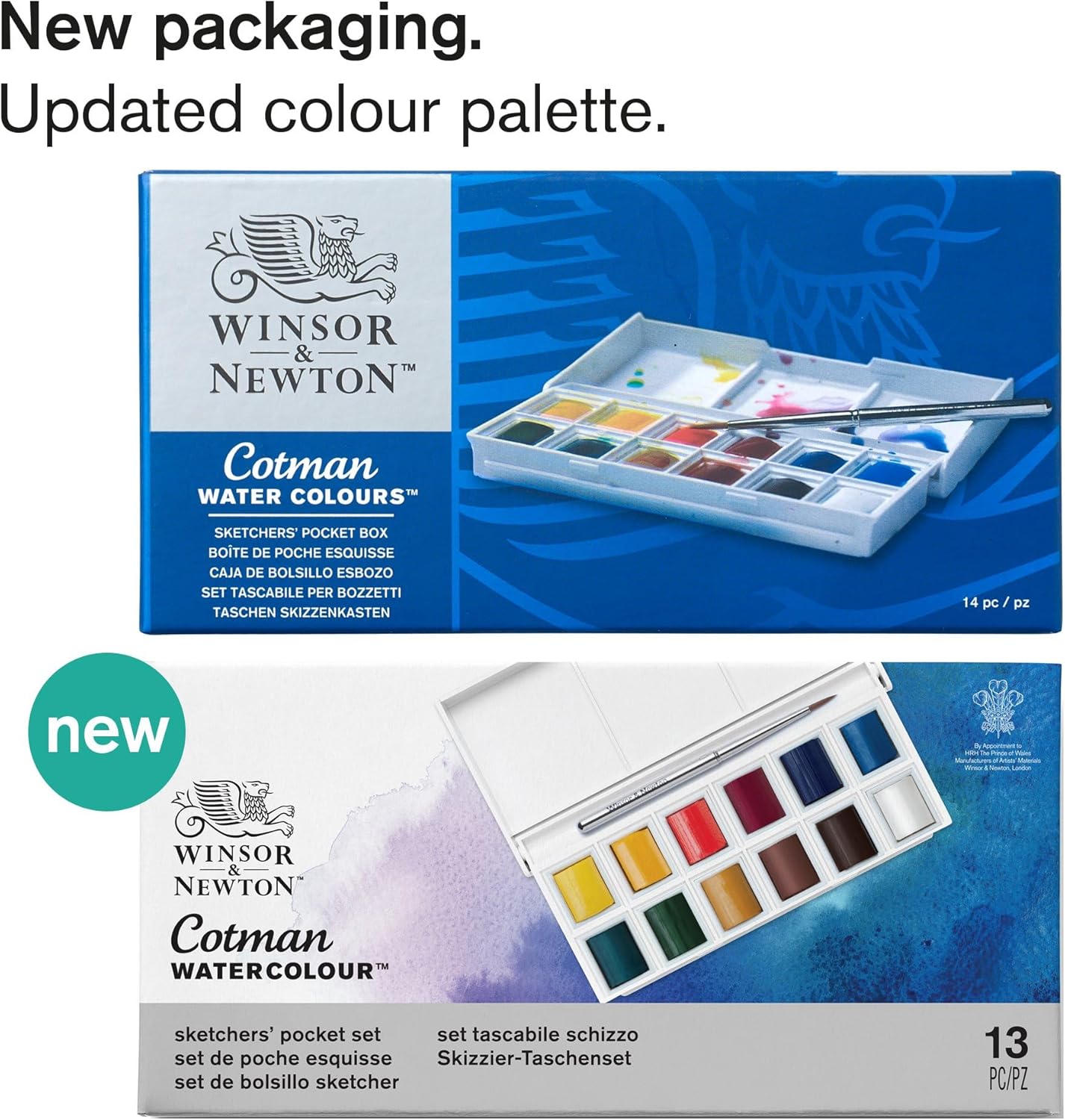
The Winsor & Newton Cotman range is the dominant entry point across Australian art supply chains — Eckersley’s, Riot Art & Craft, and Spotlight all carry it. Cotman substitutes cheaper pigments for expensive ones (Hue colours — e.g., “Cadmium Red Hue” uses a synthetic alternative to genuine cadmium) and uses a slightly higher binder-to-pigment ratio to control cost. For learning wet-on-wet technique, colour mixing theory, and brush control, this is entirely rational. Owners consistently report that Cotman pans activate quickly and re-wet reliably, which matters enormously for students still building brush fluency.
The Kuretake Gansai Tambi 36-pan set sits in interesting territory: it’s a Japanese-made, traditionally formulated watercolour with higher-than-expected pigment density for its price, and it has a devoted following among illustrators and urban sketchers. It’s not ASTM-rated in the same systematic way Western professional paints are, so it’s not ideal if lightfastness documentation is required, but for sketchbooks and non-archival work, it overperforms its price point. Available through Jetpens AU distributors and selected online art retailers.
Intermediate Tier ($55–$150): Where the Real Decisions Happen
This is the inflection zone — where you’re spending enough that mistakes sting, but not enough to get full professional-grade pigment load across an entire set. Two approaches dominate:
Professional brand, curated small set. A Winsor & Newton Professional 12-pan half-set (around $95–$105 AU) gets you genuine single-pigment colours, ASTM I–II lightfastness throughout, and the crisp granulation behaviour that professional paints are known for. The tradeoff: 12 colours forces disciplined mixing. Intermediate practitioners who’ve built a colour-mixing foundation tend to find this liberating; those still learning find it limiting.
Mid-range full set. The Schmincke Horadam range, available through Jacksonsart.com.au and selected Australian stockists, occupies a respected position in this band. Published specs show pigment load consistently higher than Cotman but competitive with Winsor & Newton Professional. Schmincke’s particular strength, noted in multiple long-form reviews at artistsnetwork.com, is the smoothness of the pigment grind — colours lift predictably for wet-lifting techniques, which is significant if that’s part of your practice.
Professional Tier ($150–$350+ for sets): Schmincke, Daniel Smith, Sennelier
At this level, the conversation shifts from “is the pigment good?” to “which pigment personality suits my practice?”
Daniel Smith (distributed in Australia via Art Shed Online and selected retailers) is the brand most associated with granulating pigments and unusual mineral-derived colours — Lunar Black, Primatek mineral series. Published pigment data from Daniel Smith’s own colour chart documentation confirms single-pigment formulation across almost the entire range. The 15-tube Essentials set is the most logical entry point and is frequently cited at artistsnetwork.com as a strong first professional set for those moving out of student paints.
Schmincke Horadam at the professional 24-pan level offers one of the most comprehensive single-purchase setups available in Australia without resorting to building a custom palette from individual tubes.
Sennelier L’Aquarelle — honey-based binder, intensely saturated, very high pigment load — is the professional choice most recommended for plein air work because the honey binder keeps pans from cracking in dry conditions. Australian availability is patchier (primarily through Jacksonsart.com.au and specialty Sydney suppliers), and the price premium over Winsor & Newton Professional is approximately 15–20%.
Reading the Value Equation: Cost Per Wash, Not Cost Per Pan
The cost-per-pan number in the table above is an entry point, not the full picture. What actually determines value is cost per usable wash — how much colour you extract from a given spend.
A Cotman pan at $1.75 that requires three or four passes to load a brush adequately may cost more per effective wash than a Winsor & Newton Professional pan at $8.13 that loads fully in a single pass. This is not hypothetical — it’s the consistent pattern across long-form owner reviews and practitioner discussions at artistsnetwork.com and the Jackson’s Art watercolour guide: higher-load paints use less paint per session, extend pan life, and reduce the frustration-tax of scrubbing at pans that won’t activate.
The math: a professional-tier pan at $8–$10 that lasts twice as many sessions as a student pan at $2–$3 converges toward price parity on a per-session basis. Where it does not converge is in the quality of colour output — professional-grade pigment load changes what you can actually achieve, not just how long the pan lasts.
Australian Sourcing: Freight, Availability, and the Grey-Import Trap
A few practical realities for Australian buyers in mid-2026:
Local stocking is uneven. Winsor & Newton Cotman is available same-week from Eckersley’s, Riot, and Spotlight nationally. Schmincke Horadam and Daniel Smith often require 3–10 business day waits from online specialist retailers, and some less common colours are import-to-order only. If you’re preparing for a class, workshop, or deadline, factor lead time.
Jacksonsart.com ships to Australia and is frequently price-competitive with Australian retail even after international freight — worth checking, particularly on Daniel Smith tubes and Schmincke sets, where the AU import markup can push prices 20–30% above the UK equivalent. Craft Council Australia’s materials guidance notes that for specialist materials with thin local distribution, international specialist retailers with reliable tracking and returns policies are a legitimate primary source, not a last resort.
Grey-import sets via general marketplaces sometimes undercut specialist retailers significantly on apparent price. The risk is authenticity — counterfeit Winsor & Newton and Daniel Smith sets have been documented in import markets. Buy from authorised stockists or directly from specialist art retailers with verifiable supplier relationships.
The Decision Rule: If X, Then Y
If you’re still building colour-mixing confidence and paint on unprimed paper or sketchbooks at least three times a week: start with Cotman 24-pan (~$42). Lock in the habit. Swap one colour at a time to professional pans once you know which hues you reach for most.
If you’re producing work you intend to sell, exhibit, or gift: ASTM I–II lightfastness is non-negotiable. Winsor & Newton Professional 12-pan ($95–$105) or a Daniel Smith 15-tube Essentials set ($185) is the entry point. The Cotman range is not archival and shouldn’t be represented as such.
If your practice centres on granulation, texture, or experimental wet-on-wet: Daniel Smith’s Primatek and granulating colours are the published-spec standout. Budget the full $150–$200+ set investment.
If you paint dry-climate plein air and pans are cracking between sessions: Sennelier L’Aquarelle’s honey binder addresses that specific problem directly, per manufacturer documentation and consistent owner reports in plein air practitioner communities.
If you’re buying as a considered gift for a serious intermediate practitioner: a Winsor & Newton Professional or Schmincke Horadam 12-pan half-set in the $95–$130 range is more meaningful than a large student set. Fewer colours, far more pigment.
The pigment code on the label is not fine print — it’s the product’s honest biography. Learn to read it once, and you’ll never overpay for filler or underspend on the paints that will actually move your work forward.