When you squeeze acrylic paint from a tube or open a student-grade set, you’re probably focused on colour. But there’s a second variable that shapes how your finished work looks and behaves: finish — the surface quality the paint settles into once it’s fully dry. “Gloss” means the dried paint has a sheen that reflects light, similar to an oil painting’s surface. “Matte” means the surface absorbs light and looks flat, like chalk on a wall. “Satin” and “semi-matte” sit between those poles — a quiet luminosity without a mirror shine. The finish isn’t just aesthetic. It determines whether you can draw over a dried layer, how a varnish behaves on top, and how a photograph of your work will read. If you’re buying your second or third set and wondering why two canvases look so different in the same light, this is likely why.
This comparison covers five sets that crop up repeatedly in the Australian intermediate-practitioner market: ARTEZA 60-colour, Mont Marte 24-piece, MEEDEN Heavy Body, Pebeo Studio Acrylics, and Golden Heavy Body. Each sits at a different price tier and, more usefully, produces a distinct dry finish that suits different working methods. The goal here is a clear decision rule, not an exhaustive catalogue.
| EDITOR'S PICKARTEZA Acrylic Paint Set | Mid-tierWinsor & Newton Galeria Acrylic… | Budget pickPEBEO Studio Fine Acrylics Pain… | |
|---|---|---|---|
| Tube Count | 60 | 10 | 1 |
| Tube Size | 22 ml | 60 ml | 100 ml |
| Finish | — | — | Satin Matte |
| Viscosity | High | — | High |
| Metallic Colors | ✓ | — | — |
| Suitable Surface | Canvas, Wood, Paper | — | — |
| Price | $59.99 | $34.07 | $9.11 |
| See on Amazon → | See on Amazon → | See on Amazon → |
How Finish Actually Works in Acrylic Paint
Acrylic paint is made of pigment particles suspended in an acrylic polymer emulsion. When the water evaporates and the polymer film forms, the surface micro-texture is determined by the ratio of binder to pigment, any added fillers or matting agents, and the paint’s viscosity. Golden Artist Colors’ published technical data sheets, titled “Working with Acrylics,” document that matting agents — usually synthetic silica — scatter light at the surface level, producing a flat appearance without reducing pigment saturation in the wet state. This is worth understanding because it explains a common frustration: some matte paints look vivid when wet and disappointingly chalky when dry. That’s the matting agent doing its job, and it’s not a defect — but it’s a tradeoff you need to know you’re accepting.
Gloss finishes contain minimal or no matting agents, so the polymer film cures smooth and reflective. They tend to show brushwork more clearly, which is useful if you want visible texture but problematic if you want smooth blends. Satin finishes use a partial matting agent load to land somewhere predictable in the middle.
Artists Network’s editorial guide, “Understanding Acrylic Paint Finishes and Varnishes,” notes that the dry finish of the paint itself and the finish of any varnish applied over it are independent variables — you can shift the final result significantly by choosing the right topcoat, regardless of what the paint does underneath. That distinction matters practically: it means finish is not a permanent decision made at the moment of purchase.
The Five Sets, Finish by Finish
ARTEZA 60-Colour Set — High Gloss, Oil-Painting Comparison
Owners of the ARTEZA 60-colour set consistently volunteer the same observation unprompted: the dry finish reads closer to oil paint than to most student acrylics. That’s a gloss finish doing its job. The reflective surface quality is one of the set’s genuinely distinguishing characteristics — reviewers describe it with enough specificity (visible light reflection, texture definition in impasto marks) to treat it as reliable across aggregated practitioner feedback.
The implication for your practice: if you’re working on canvas and want a result that photographs with that warm, luminous depth typical of oil painters, this finish works in your favour. If you’re planning to draw over dried layers with pencil, charcoal, or ink, the gloss surface will resist them — pencil graphite won’t grip, and some inks will bead slightly.
At this price tier, the pigment load is relatively light in some colours (yellows are the most reported weak point — more on that shortly), so the gloss can occasionally look slightly plastic in thin applications. Build the paint to a reasonable body and the effect is considerably more convincing.
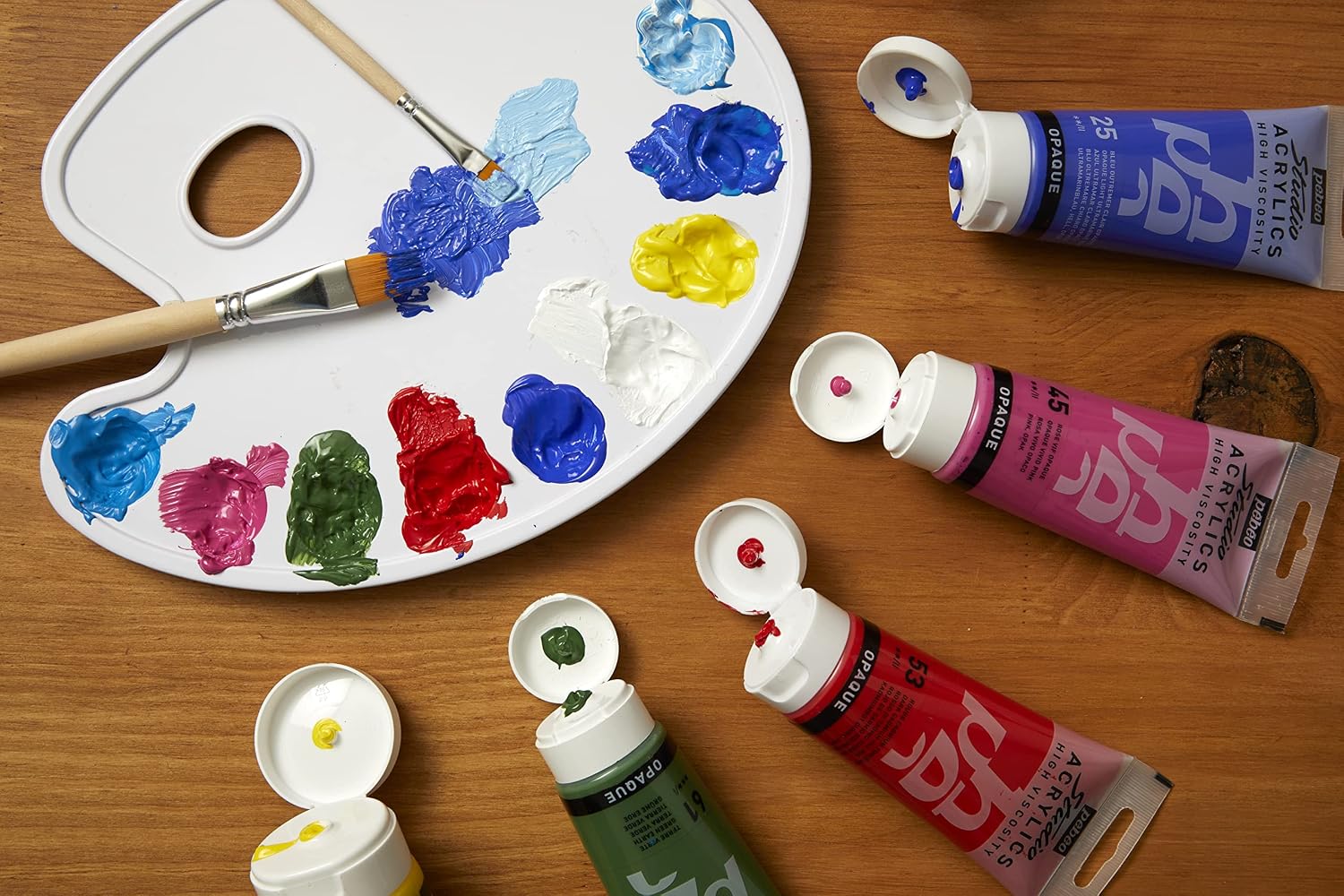
PEBEO
$9.11
In stock on Amazon
Check price on AmazonMont Marte 24-Piece — Semi-Matte, the Mixed-Media Maker’s Finish
Mont Marte’s 24-piece set has attracted some of the most operationally specific positive feedback of any set at its tier. Notably, practitioners reviewing the set frequently cite surprise at the quality for the price — and the detail they land on is the semi-matte finish, which provides enough surface tooth (microscopic texture in the dried film) to accept pencil, pastel, and other dry media on top. For mixed-media practitioners working in a layered way — acrylics as a base, pencil or charcoal for detail — this is a genuinely useful characteristic, not incidental.
Semi-matte also means the finish isn’t so flat that it looks chalky (a concern with aggressive matte formulations), nor so reflective that it throws off a glare under studio lighting. Maker and Student’s published article “Mixed Media Surfaces and Compatibility” flags that semi-matte polymer films offer better adhesion for subsequent dry-media layers than gloss surfaces do, which squares directly with what Mont Marte owners report in practice.
PEBEO
$9.11
In stock on Amazon
Check price on AmazonMEEDEN Heavy Body — Satin Finish, Photographic Cleanliness
The MEEDEN heavy body set occupies a particularly useful niche for teaching contexts. The satin finish is central to this praise — a satin surface photographs cleanly, neither blowing out in direct light (a gloss problem) nor losing depth (a matte problem). For a teacher documenting student work, or a practitioner building a portfolio, this matters practically.
Satin finishes also tend to be the most neutral for varnishing. Because you’re starting from a middle point, both gloss and matte varnishes produce predictable results — you’re not fighting the paint’s existing surface energy in either direction. Jacksons Art’s “Acrylic Paint Buyer’s Guide” notes that satin finishes in the heavy-body class are typically associated with higher binder concentrations, which contributes to the film’s flexibility and durability over time — a meaningful consideration if your work is destined for storage or travel.
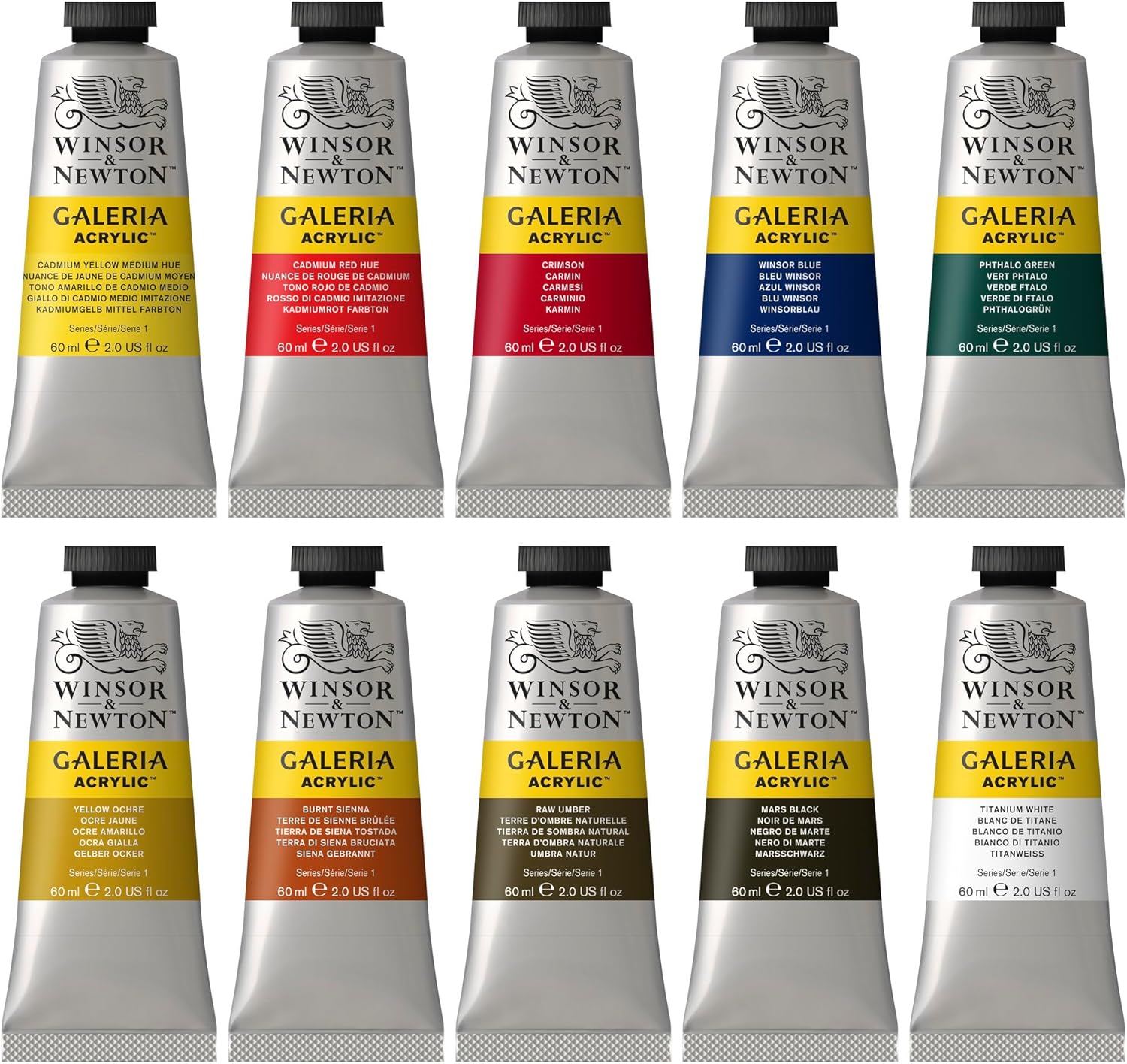
Winsor
$34.07
In stock on Amazon
Check price on AmazonPebeo Studio Acrylics — Neutral Middle Ground
Pebeo Studio reviewers consistently focus on two qualities: pigment accuracy (colours mix predictably and match the tube label reasonably well) and good mixing behaviour across the range. The finish is less discussed — which is, in itself, editorially useful information. A finish that nobody complains about and nobody specifically celebrates is likely landing in a neutral semi-gloss range that doesn’t impose itself on the work.
Frame this as the set for painters whose finish priority is not having their paint make decisions for them. You can push it toward gloss with a medium, pull it toward matte with a matting paste, and the base finish won’t resist either direction strongly. For colour-mixing focused practitioners — those building colour theory skills, or working in an educational context where predictable hue behaviour matters more than surface quality — this neutrality is an asset rather than a compromise.
Winsor
$34.07
In stock on Amazon
Check price on AmazonGolden Heavy Body — Professional Gloss, the Reference Point
Golden’s heavy body range is the closest thing to an industry reference point for professional-grade acrylic finish, and its published technical data is unusually transparent. Golden Artist Colors’ “Working with Acrylics: Technical Data Sheets” documents the dry finish as a consistent gloss across the range, with colour-to-colour variation being lower than in student grades because the pigment-to-binder ratios are tightly controlled.
Practitioners who own Golden consistently report that the gloss reads as rich rather than plastic — the difference being pigment density. When there’s enough pigment to create genuine optical depth, the gloss enhances it. When pigment load is low (as in some budget sets), gloss amplifies the thinness. At AU $30–$60 per tube, this is a considered investment, and the finish is part of what you’re paying for. If your work is destined for exhibition under gallery lighting, the Golden gloss finish holds up in ways that student-grade approximations don’t.
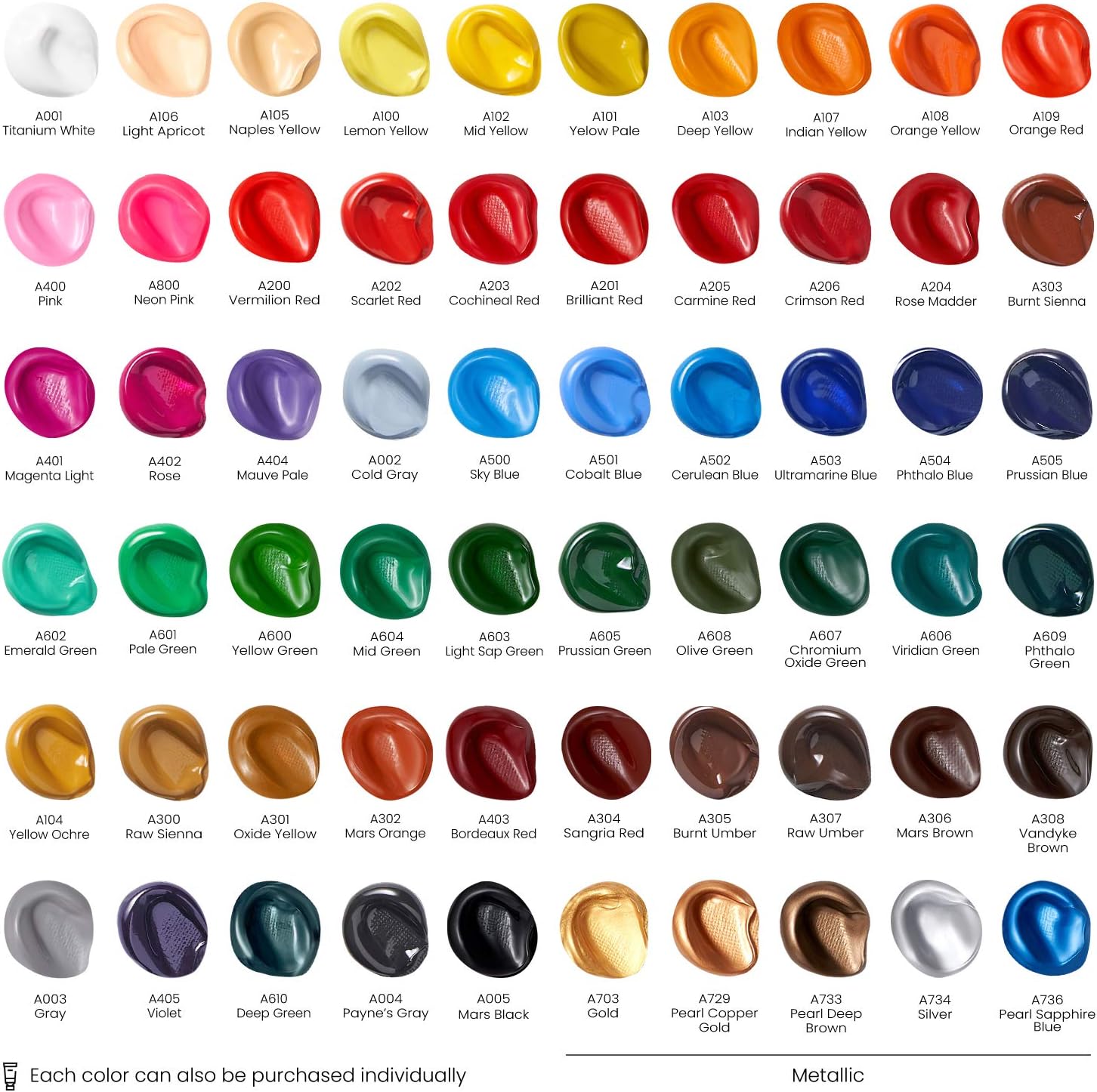
ARTEZA
$59.99
In stock on Amazon
Check price on AmazonFinish Compared at a Glance
| Set | Dry Finish | Mixed-Media Friendly? | Recommended Varnish Direction | Tier |
|---|---|---|---|---|
| ARTEZA 60-colour | High gloss | Low (pencil resists) | Matte varnish to correct | PEBEO — $9.11 |
| Mont Marte 24-piece | Semi-matte | High (tooth for dry media) | Either direction works | PEBEO — $9.11 |
| MEEDEN Heavy Body | Satin | Medium | Neutral — both directions | Winsor — $34.07 |
| Pebeo Studio | Semi-gloss (neutral) | Medium | Either direction works | Winsor — $34.07 |
| Golden Heavy Body | Gloss | Low (pencil resists) | Matte varnish to correct | ARTEZA — $59.99 |
The Yellow Problem Is Real Across All of These
Reviewers across every set at every price tier consistently flag the same issue: yellows tend toward transparency regardless of brand or finish. This is a pigment characteristic, not a formulation failure. Yellow pigments — particularly Hansa yellows and azo yellows used across most student and intermediate ranges — have naturally lower tinting strength and opacity. The finish doesn’t compound the problem, but it doesn’t solve it either. Build yellow layers with more paint body, consider a white underpainting for maximum vibrancy, and don’t read yellowy translucency as a sign that the rest of the set will behave the same way.
Frequently Asked Questions
Can you varnish over a glossy acrylic finish to achieve a matte result? Yes, reliably. A matte varnish applied over a glossy acrylic surface will reduce sheen effectively. Artists Network’s guide “Understanding Acrylic Paint Finishes and Varnishes” recommends waiting a minimum of 24–72 hours after the final paint layer before varnishing, and working in thin, even coats. The paint’s finish and the varnish’s finish are independent — a matte varnish will unify a mixed-finish surface across the canvas, which is particularly useful if you’ve used both glossy and matte paints in the same work.
Does the dry finish change if paint is thinned with water? Yes. Thinning acrylic paint with water reduces the binder-to-pigment ratio, which typically pushes the dry finish flatter and more matte — and can compromise the film’s integrity if you exceed roughly a 30% dilution. For controlled thinning that preserves the finish, use a flow improver or acrylic medium rather than water alone.
Which finish is best for painting on wood or fabric rather than canvas? Satin and semi-matte finishes tend to perform better on absorbent or textured non-canvas surfaces. Gloss finishes can highlight grain imperfections on wood and may crack on fabric with heavy flexing. For fabric specifically, look for acrylic sets that specify a fabric medium additive — the finish is secondary to the paint’s flexibility rating.
Does semi-matte finish mean the paint looks chalky when dry? Not necessarily. A chalky appearance is usually caused by aggressive matting agents in a low-pigment formulation. A well-made semi-matte finish — like the one Mont Marte reviewers describe — preserves colour saturation while reducing reflectivity. If you’re seeing chalkiness, it’s more likely a pigment density issue than a finish issue.
Can you mix paints from different brands with different finishes on the same canvas? Generally yes, as long as both are standard acrylic formulations (not oil-modified or encaustic). The dry finishes will vary across the surface, which can look inconsistent in direct light — particularly if you mix gloss and matte in adjacent areas. A unifying varnish coat at the end resolves this cleanly.
The Decision Rule
If you’re working in mixed media and need paint that accepts dry media on top: Mont Marte’s semi-matte finish is the specific choice practitioners make for this reason, and the surface tooth it provides is a documented property of semi-matte polymer films, not an accident of manufacture — as noted in Maker and Student’s “Mixed Media Surfaces and Compatibility.”
If you want oil-painting visual depth at an accessible price: the ARTEZA 60-colour gloss finish consistently earns that comparison from its owners — accept that you’ll varnish matte at the end if needed.
If you’re teaching or documenting work photographically: MEEDEN’s satin finish is the most forgiving under varied lighting conditions and the most neutral starting point for a final varnish in either direction. Jacksons Art’s “Acrylic Paint Buyer’s Guide” supports the view that satin heavy-body formulations offer the film durability to back up that versatility.
If you want no finish surprises while you build colour-mixing skills: Pebeo Studio’s neutral semi-gloss sits quietly in the background and lets hue behaviour take centre stage.
If the finish has to be exhibition-grade and consistent across a professional range: Golden Heavy Body is the reference point, its technical data is publicly documented by Golden Artist Colors in “Working with Acrylics: Technical Data Sheets,” and the per-tube cost reflects exactly that level of formulation control.