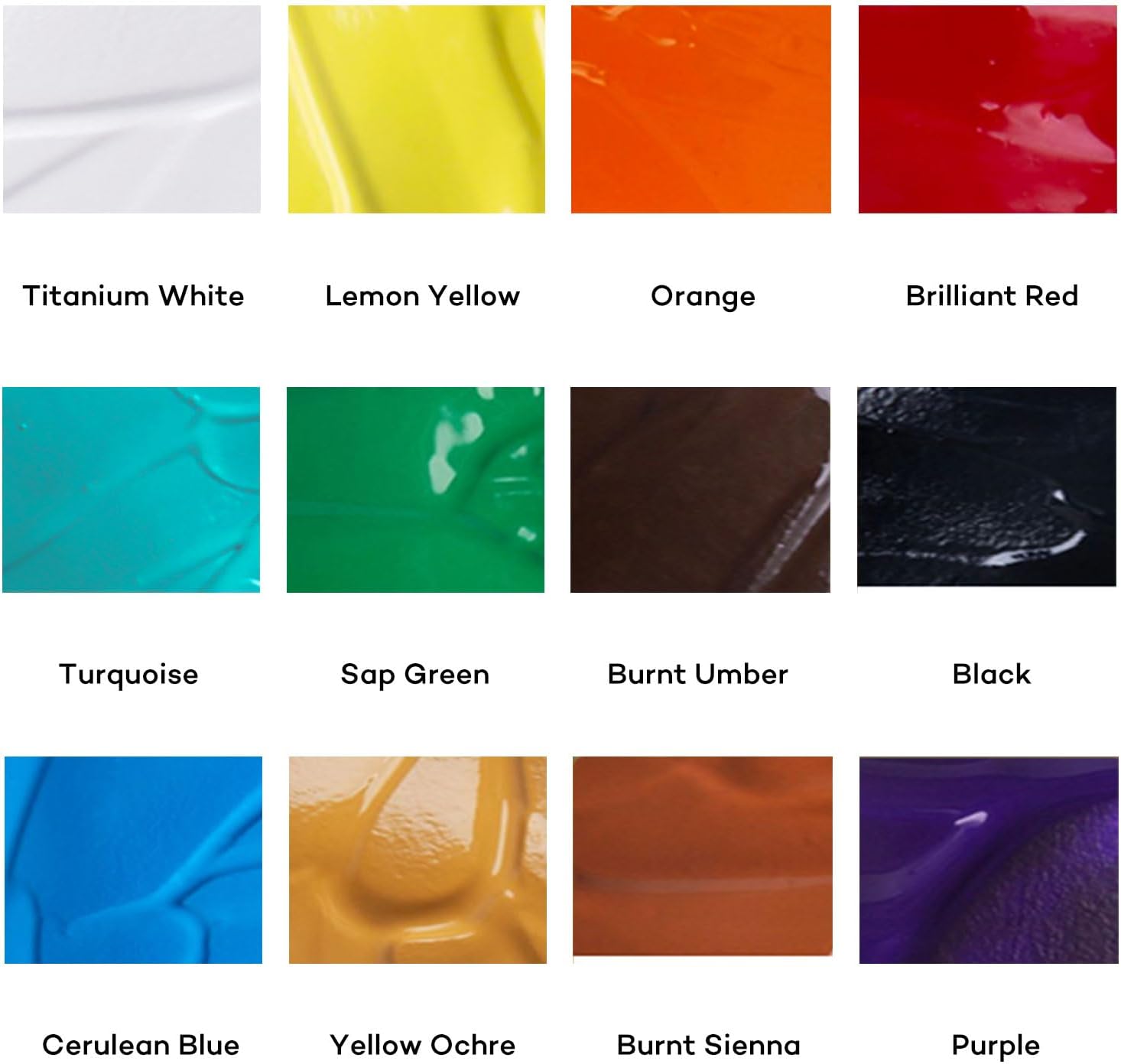
If you’ve ever squeezed the last centimetre of paint from a tube mid-painting session, you already know the anxiety. Acrylic paint — a water-based paint that uses a plastic-like binder called an acrylic polymer to carry pigment — dries fast, plays well on stretched canvas, and covers a wide range of styles from thin washes to thick, textural impasto (paint applied so thickly it holds a physical ridge or peak). The bigger question, once you’re painting regularly enough that small tubes feel wasteful, is whether the jump to large-volume formats — typically 250 mL jars through to 5-litre buckets — is actually economical, and what you give up or gain in paint quality when you make that jump. This guide runs the numbers, names the Australian-available options, and gives you a clear decision framework so you can stop re-ordering 75 mL tubes every three weeks.
What “Large Volume” Actually Means — and the Three Formats You’ll Choose Between
In the Australian market as of mid-2026, large-volume acrylic paint sits across three meaningfully different formats, and they’re not interchangeable in how you use them.
Jar format (250 mL – 2 L): The most common upgrade path for canvas painters. Brands like Golden Heavy Body, Liquitex Professional, and Winsor & Newton Professional all produce jar formats in their top-tier lines. These deliver the same pigment load and consistency as the equivalent tube paint — the formulation is identical, just the packaging changes. The trade-off is that jars expose more paint to air each time you open them, which matters if you’re a slow worker. Decanting small amounts into a stay-wet palette (a palette with a damp paper layer that slows drying) addresses this.
Tub format (500 mL – 5 L): This is where student and craft-grade paints dominate. Brands like Chromacryl, Mont Marte, and Matisse Structure offer large tubs, but the formulation in these products typically uses more filler (chalk or clay added to bulk out the paint) and less pigment. That’s not inherently a problem — these ranges have legitimate uses in large-scale grounds, underpainting, or teaching contexts — but conflating a 2 L tub of student-grade paint with a 500 mL jar of professional paint is an easy mistake that disappoints on the canvas.
Professional-grade fluid/high-flow (500 mL – 1 L bottles): A separate category altogether. Products like Golden High Flow and Liquitex Acrylic Ink are designed for staining, pouring, airbrushing, or diluted washes — not as a like-for-like swap for tube-consistency paint. Mentioned here because they’re often stocked alongside large-volume heavies, and the bottles look similar at a glance.
The Cost-Per-mL Analysis: Where the Maths Actually Lands
The promise of large-volume paint is lower cost per millilitre. Let’s test that assumption against real Australian retail pricing as of May 2026, drawing on current pricing from suppliers including Eckersley’s, The Melbourne Artist Supply Store (MASS), Jackson’s Art Supplies (which ships to Australia), and direct-brand Australian distributors.
By the numbers — professional-grade acrylic, approximate AUD retail (May 2026)
| Product | Size | Approx. AUD retail | Cost per mL |
|---|---|---|---|
| Golden Heavy Body (single pigment, mid-range colour) | 59 mL tube | $18–$22 | ~$0.34/mL |
| Golden Heavy Body (same colour) | 237 mL jar | $58–$68 | ~$0.27/mL |
| Liquitex Professional Heavy Body | 59 mL tube | $14–$18 | ~$0.27/mL |
| Liquitex Professional Heavy Body | 473 mL jar | $72–$85 | ~$0.17/mL |
| Winsor & Newton Professional Acrylic | 60 mL tube | $16–$20 | ~$0.30/mL |
| Winsor & Newton Professional Acrylic | 200 mL jar | $42–$50 | ~$0.23/mL |
Prices are indicative of mid-2026 Australian retail; exact pricing varies by colour series and retailer. Student-grade paint (Chromacryl, Mont Marte, Galeria) runs $0.03–$0.08/mL in large tubs — cost comparisons across grades are meaningless without accounting for pigment load.
The saving is real but more modest than it appears at first glance: moving from a 59 mL Liquitex tube to the 473 mL jar saves roughly 37% per millilitre. That’s worth capturing, but only if the colour is one you use in quantity. Buying 473 mL of a colour you rarely reach for just to hit a better unit rate is a false economy — the paint will skin over in the jar long before you finish it.
The Jackson’s Art Supplies acrylic buying guide makes a useful point here: the cost-per-mL calculation should always factor in your actual consumption rate, not your aspirational one. A working studio painter doing large-format canvases weekly will exhaust a 237 mL jar of Titanium White in a month. A hobbyist doing two canvases a month might find the same jar lasts a year — at which point the surface skinning and reduced workability are real losses.
What Actually Changes (and Doesn’t) When You Go Large
The persistent anxiety about large-volume professional paint is whether the jar formulation is truly identical to the tube. Based on published technical data from Golden Artist Colors and Liquitex, the answer for professional-grade jars is yes — pigment load, vehicle (the acrylic medium carrying the pigment), and lightfastness ratings are specified as identical between tube and jar formats in the same product line.
Lightfastness is the rating (usually on an ASTM I–II scale, where I is “excellent” permanence) that tells you how resistant a pigment is to fading under light exposure. It’s one of the most important specs for canvas work intended to last. Artists Network’s guide to selecting acrylics reinforces that lightfastness ratings are tied to pigment chemistry, not to volume format — a Cadmium Red rated ASTM I in a tube doesn’t change its rating in a jar. Where lightfastness can drop is when you cross grades: many student-range paints substitute cheaper pigments (like azo dyes for cadmiums) that carry lower permanence ratings. This is the grade distinction that matters, not the size format.
Pigment load (how much actual pigment the paint contains relative to filler and binder) is the other critical difference between grades. Winsor & Newton’s technical data sheets for their Professional Acrylic range show single-pigment formulations across most colours, compared to their Galeria student range, which uses more pigment mixes and extenders. Across aggregated studio reviews, professional painters consistently report that higher pigment load means less product used to achieve opacity — which partially offsets the higher per-mL cost at the professional tier.
Consistency shift is the one legitimate concern with large jars of heavy body paint: jar storage (vertical, sealed, with minimal air gap) can allow some surface thickening over time, particularly in warm climates. Australian painters in Queensland or the Northern Territory report this more frequently than those in Victoria or Tasmania. Decanting into smaller airtight containers for current use, and keeping the main jar sealed, manages this effectively.
Which Ranges Are Worth Buying in Volume in Australia?
There’s no single right answer, but there is a decision framework. Here’s the honest tradeoff map.
Golden Heavy Body (237 mL – 473 mL jars): The benchmarked professional standard. Golden’s published pigment information is the most transparent in the category — every colour’s pigment codes (the CI numbers identifying exact pigment chemistry) are listed on labels and on their website. Artists Network and Jackson’s Art both cite Golden as a reference point for professional heavy body acrylics. The Australian price premium over US retail runs 20–30% after freight, which is typical for the category. Best for: painters with established palettes who know they’ll use the full jar.
Liquitex Professional Heavy Body (473 mL jars): Slightly lower cost per mL than Golden at the large-jar tier in Australian retail, and more widely stocked at national retailers like Eckersley’s and Officeworks’ art range. Liquitex’s professional range uses single-pigment formulations across most colours, with clear lightfastness ratings. Across long-run studio reviews, painters note Liquitex’s slightly softer working consistency compared to Golden — a preference question, not a quality difference. Best for: painters who want professional-grade at a more accessible entry price per mL, and who value widespread local availability.
Winsor & Newton Professional Acrylic (200 mL jars): The 200 mL format is a middle-ground option that suits painters not ready to commit to 473 mL but finding 60 mL tubes expensive. The per-mL saving over tubes is around 23–25%, modest but real. Best for: painters with 10–15 working colours who want to step up without the full jar commitment.
Matisse Structure (250 mL – 1 L): An Australian-made professional-grade option that deserves more attention than it gets internationally. Matisse Structure’s large-format tubs have been reviewed positively by Australian painters on consistency and pigment load, and the locally-manufactured supply chain means less freight-related price inflation. For painters prioritising Australian-made and consistent local availability, Matisse warrants serious consideration alongside the international brands.
Student-grade large-tub ranges (Chromacryl, Mont Marte): Legitimate for underpainting, large ground coverage, or teaching studios — not as a substitute for professional colour mixing where pigment purity and lightfastness matter. The cost-per-mL numbers look excellent until you account for needing to apply 2–3 layers where a professional paint would cover in one.
The Decision Rule
If you’re painting canvases regularly — more than once a week — and you’ve identified 4–6 colours you reach for constantly (Titanium White, a warm and cool of each primary, a reliable neutral), the jump to 237–473 mL professional-grade jars pays off cleanly. Run your own per-mL calculation: divide your current tube price by the tube volume in mL, then compare to the jar equivalent. A saving of 25% or more on colours you use frequently is worth the upfront spend and the discipline of proper jar storage.
If you’re painting less frequently, or if your palette is still shifting as you develop your practice, smaller tubes are actually more economical when you factor in waste from skinning. The better investment at that stage is buying 2–3 colours you know you love in jar format while keeping the rest in tubes until your palette stabilises.
And if you’re covering large grounds, priming, or teaching — that’s exactly what student-grade large-tub paint was designed for. Use it without guilt for that purpose, and save the professional-grade jars for the colour work that will be visible in the finished painting.
The maths is simple. The variable is honesty about how you actually paint.