If you’ve ever stood in front of a shelf of art supplies and wondered whether to grab a single colourful box labelled “56-piece complete acrylic set” or to slowly assemble your own kit tube by tube, brush by brush — this article is for you. An all-in-one acrylic kit is exactly what it sounds like: a single purchase that typically includes acrylic paints (small tubes or pots), a selection of brushes, one or more small canvases or canvas boards, and sometimes a palette and basic mediums. They’re marketed as a frictionless starting point, and for pure convenience, they mostly deliver on that promise. But convenience has a cost, and for anyone past the absolute beginner stage, the question isn’t whether the box contains enough stuff — it’s whether the right stuff is in there. After cross-referencing aggregated buyer feedback, published spec comparisons from Jackson’s Art and Artists Network, and maker survey data from the Craft Council of Australia, a clear picture emerges: the kit’s paints are often surprisingly competitive; the brushes are almost always the weakest link; and whether the bundle saves money depends entirely on what you were going to buy anyway.
| EDITOR'S PICKWinsor & Newton Artists' Acryli… | Mid-tier[ESRICH Professional Acrylic Pai…](https://www.amazon.com/dp/B0C2816M7S?tag=greenflower20-20) | Budget pickWinsor & Newton Galeria Acrylic… | |
|---|---|---|---|
| Number of tubes | 12 | — | 10 |
| Tube size | 20ml | — | 60ml |
| Brushes included | ✗ | ✓ | ✗ |
| Canvas included | ✗ | ✓ | ✗ |
| Easel included | ✗ | ✓ | ✗ |
| Series/Line | Artists' | Professional | Galeria |
| Price | $60.89 | $52.99 | $34.07 |
| See on Amazon → | See on Amazon → | See on Amazon → |
What’s Actually Inside a Bundled Kit (And What Gets Left Out)
The marketing copy on kits like the Chalkola 56-piece and ESRICH 60-piece leans heavily on piece count. Sixty pieces sounds comprehensive — but it’s worth pulling that number apart before you hand over your money.
A typical mid-range bundle in the AU$40–$90 range tends to include:
- 24–48 acrylic paint tubes or pots, usually 12 ml each, spanning a broad colour range including earth tones, primaries, and a few mixed-convenience colours like skin tone or grey
- 10–20 brushes, generally a mix of flat, round, and fan shapes in synthetic fibre
- 2–4 canvases or canvas boards, typically in the 20×25 cm range
- A mixing palette, either plastic or tear-off paper
- Occasionally: a small bottle of varnish, a medium, or painting knives
What’s missing almost universally: larger canvases (reviewers of the Chalkola kit specifically flag that they wished the included canvas was bigger), higher-grade brushes (more on this shortly), gesso for surface preparation, and any kind of colour-mixing guide or medium beyond a basic gloss.
The gap between what’s shown on the box and what a serious practice actually demands is real — but it’s also knowable in advance, which makes it manageable.
The Brush Problem: How Bad Is It, Really?
This is the most consistent finding across aggregated buyer reviews, and it’s worth being direct about. Reviewers across multiple all-in-one kit listings raise the same flag: the brushes are functional for learning basic mark-making, but they tend to shed bristles, lose their shape after heavy use, and lack the spring that makes detail work satisfying. One reviewer quoted across several product listings stated plainly: “I wish the brushes were of better quality.” That sentiment shows up repeatedly.
The practical question is whether this matters for your current stage. Artists Network’s guidance on brush grades notes that brush quality affects control, not just durability — a brush that holds its point through the stroke gives you feedback that a splaying synthetic doesn’t. If you’re working on foundational colour-mixing exercises or gestural studies, the bundled brushes are fine. If you’re working on any painting you intend to keep or sell, they’ll frustrate you.
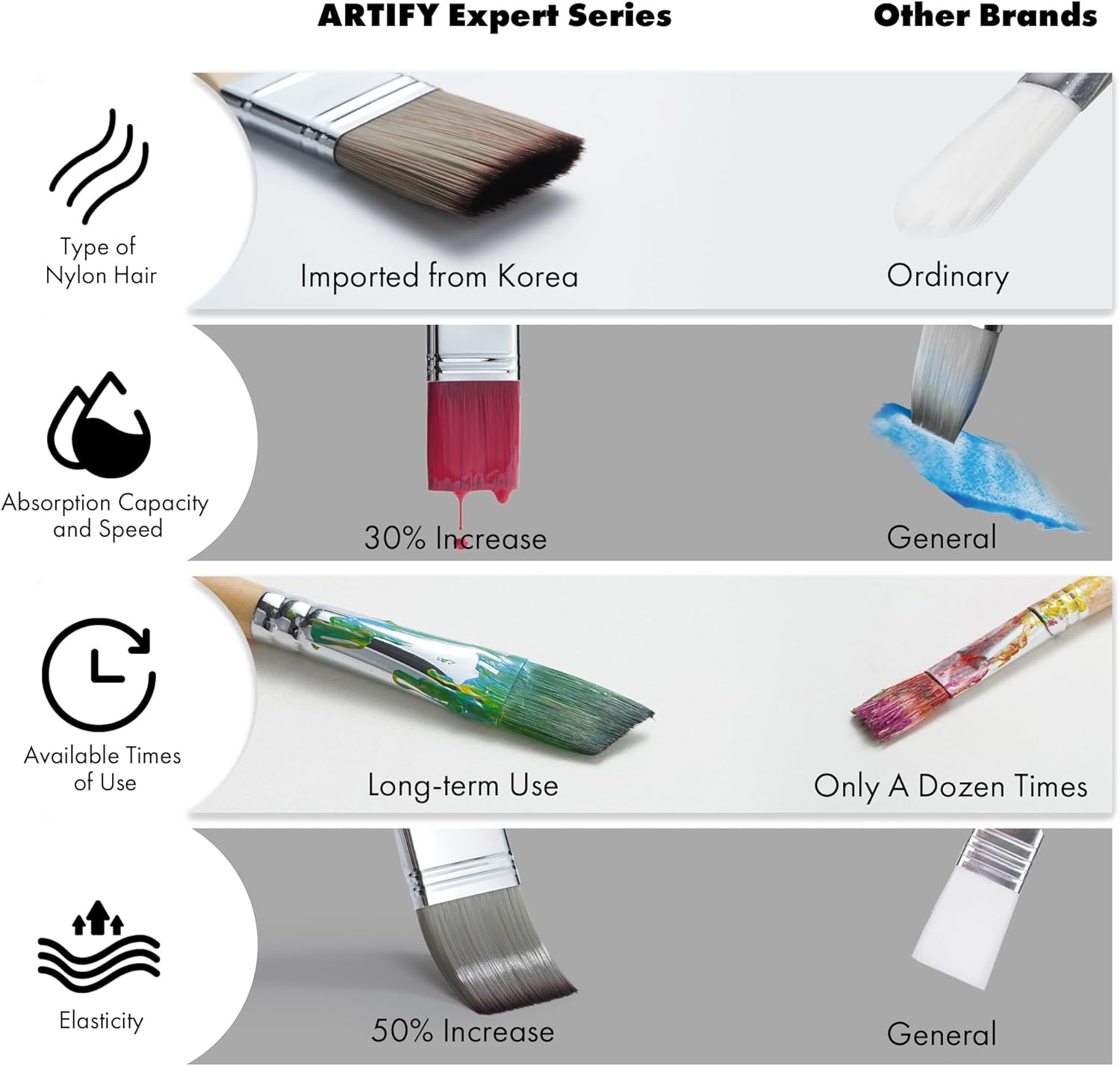
The upgrade path here is more affordable than it sounds. The ARTIFY 25-piece brush set is regularly cited by buyers — including one reviewer purchasing for a teen artist — for the variety of shapes and sturdy, well-balanced handles. The Nicpro 36-piece brush set draws consistent praise in long-run reviews for zero shedding even during extended mural sessions. Either set can be added to a bundled kit purchase for under AU$40, at which point you’ve effectively got a full working studio setup.
Decision frame for brushes: If you’re buying a kit for someone else or for initial exploration, accept the included brushes as functional placeholders. If you’re buying for your own practice at the 6-month-plus stage, budget AU$25–$45 for a dedicated brush set alongside the kit and treat the bundled brushes as backup.
Paint Quality: What You’re Actually Getting
This is where bundled kits are more competitive than their reputation suggests — with one important caveat.
Mid-range kits in the AU$50–$90 bracket typically include student-grade acrylic paint, which means lower pigment load and more filler (usually chalk or extender) per millilitre compared to professional-grade tubes. The visual effect: colours may appear slightly less saturated when dry, and opacity over dark grounds can require additional coats. The Jackson’s Art acrylic buyers guide notes that student-grade paints commonly have pigment-to-binder ratios that can be 30–50% lower than professional lines.
That said, the gap is not as stark at working scale as it sounds in theory. Buyers consistently report that bundled kit paints perform adequately for studies, practice canvases, and learning colour theory. Where they start to fall short is in colour mixing precision (more extender means less predictable mixing behaviour) and lightfastness (long-term resistance to fading), which matters if you’re making work you want to last.
Compare this to standalone student lines: the Winsor & Newton Galeria range draws strong reviews for opacity and smooth brushstroke coverage — “no brushstroke visibility” is a phrase that appears repeatedly in owner reviews. The Liquitex Basics 48-set is consistently praised for vibrant, reliable colour at its price point and is a known quantity among intermediate practitioners. These standalone sets sit in the AU$60–$120 range depending on tube count, and they use named single pigments more consistently than most bundled kits.
The honest summary: For practice and learning, bundled kit paints are workable. For any work you intend to exhibit, sell, or give as a meaningful piece, invest in even a modest standalone tube set.
The Numbers: Bundle vs Build-Your-Own
Here’s where the decision gets concrete. Based on current AU market pricing as of May 2026:
| Component | Bundled kit (est.) | Bought separately (est.) |
|---|---|---|
| 24 paint tubes (student grade) | Included in AU$65–$90 kit | AU$45–$70 standalone set |
| 10–15 brushes | Included | AU$25–$45 quality set |
| 2–3 canvases | Included | AU$12–$20 (3-pack) |
| Palette | Included | AU$5–$12 |
| Total | AU$65–$90 | AU$87–$147 |
The bundle wins on upfront cost — typically by AU$20–$50. But that saving is offset if you upgrade the brushes immediately (which the research suggests most intermediate practitioners should), at which point the cost lines converge. The bundle loses the comparison if you want higher-grade paint from the outset: a Liquitex Basics 48-set plus a quality brush set plus canvases will run AU$130–$175, but the paint you’re working with is demonstrably better.
The Wirecutter’s art supply guidance for 2025 reaches a similar conclusion: bundles make sense when the buyer values simplicity over component optimisation, and standalone builds make sense when any single component — usually paints — needs to meet a higher specification.
When the Bundle Is the Right Call
There are three scenarios where an all-in-one kit is the defensible choice, not a compromise:
-
Gift buying without skill-level certainty. The Craft Council of Australia’s 2024 maker survey found that gift-buyers consistently over-estimate recipient skill levels and under-estimate how intimidating an incomplete set feels to a new maker. A complete box removes that anxiety entirely. For a gift to someone whose experience you genuinely can’t gauge, a well-reviewed 40–60 piece kit is the right call.
-
Trying a new medium. If you’re primarily a watercolourist or fibre artist exploring acrylics for the first time, a bundled kit lets you test whether you actually enjoy the medium before committing AU$150+ to standalone components. This is rational resource allocation, not cutting corners.
-
Studio or classroom supply. A ceramics teacher equipping a studio for mixed-skill students, or a craft group leader running a one-off session, gets better value from several bundled kits than from the same budget spread across individual components — even accounting for the brush quality issue, because breakage and loss are expected at that scale.
Frequently Asked Questions
Are the brushes in all-in-one acrylic kits good enough to learn on, or should you replace them immediately? Good enough to start — not good enough to stay with. Bundled brushes will get you through the first few weeks of mark-making and colour studies without any real obstacle. But once you’re working on anything with edge control or detail, the shedding and shape-loss become genuinely limiting. The upgrade investment is small: AU$25–$45 for a quality set like the ARTIFY 25-piece or Nicpro 36-piece is worth doing alongside your kit purchase if you can manage it.
Are kit canvases suitable for finished artwork or practice only? Mostly practice. Bundled canvases tend to run small (20×25 cm is common) and use lighter-weight canvas that accepts paint adequately but can buckle under heavy impasto or multiple wet layers. Reviewers specifically flag wishing the included canvases were larger. For practice, colour studies, and gift-friendly display pieces they’re fine. For portfolio work or anything intended for sale, invest in a separately sourced canvas.
What paint quality should I expect from a bundled kit vs a standalone tube set? Student-grade paint throughout. Expect adequate coverage, reasonable colour range, but lower pigment load than standalone student lines like W&N Galeria or Liquitex Basics — meaning slightly less saturation and less predictable colour mixing. For learning, workable. For exhibition work, upgrade.
Is it cheaper overall to buy a bundle or select components separately? Bundles are cheaper upfront by AU$20–$50. That saving disappears if you immediately upgrade the brushes — which most intermediate practitioners should. If you’re satisfied with student-grade paint for now, the bundle wins on price. If you need better paint from the start, building your own kit with a Liquitex Basics set as the foundation is worth the extra spend.
Which all-in-one kit is best as a gift when you don’t know the recipient’s skill level? A 40–60 piece kit in the AU$60–$90 range from a recognised brand is the safest choice. Piece count signals generosity; the contained format removes overwhelm. The Chalkola 56-piece and ESRICH 60-piece are both well-regarded in this role across aggregated buyer feedback — neither is a professional tool, but both are genuinely satisfying to unwrap and start using the same day.
The decision rule, plainly stated: If you’re buying for yourself and you’ve been painting for more than six months, skip the bundle and build your own kit anchored by a standalone paint set (Liquitex Basics 48 or W&N Galeria) and a quality brush collection. If you’re buying as a gift, introducing someone else to the medium, or just want to try acrylics without a major investment, a well-reviewed all-in-one kit is a completely sound choice — just plan to replace the brushes when the time comes.