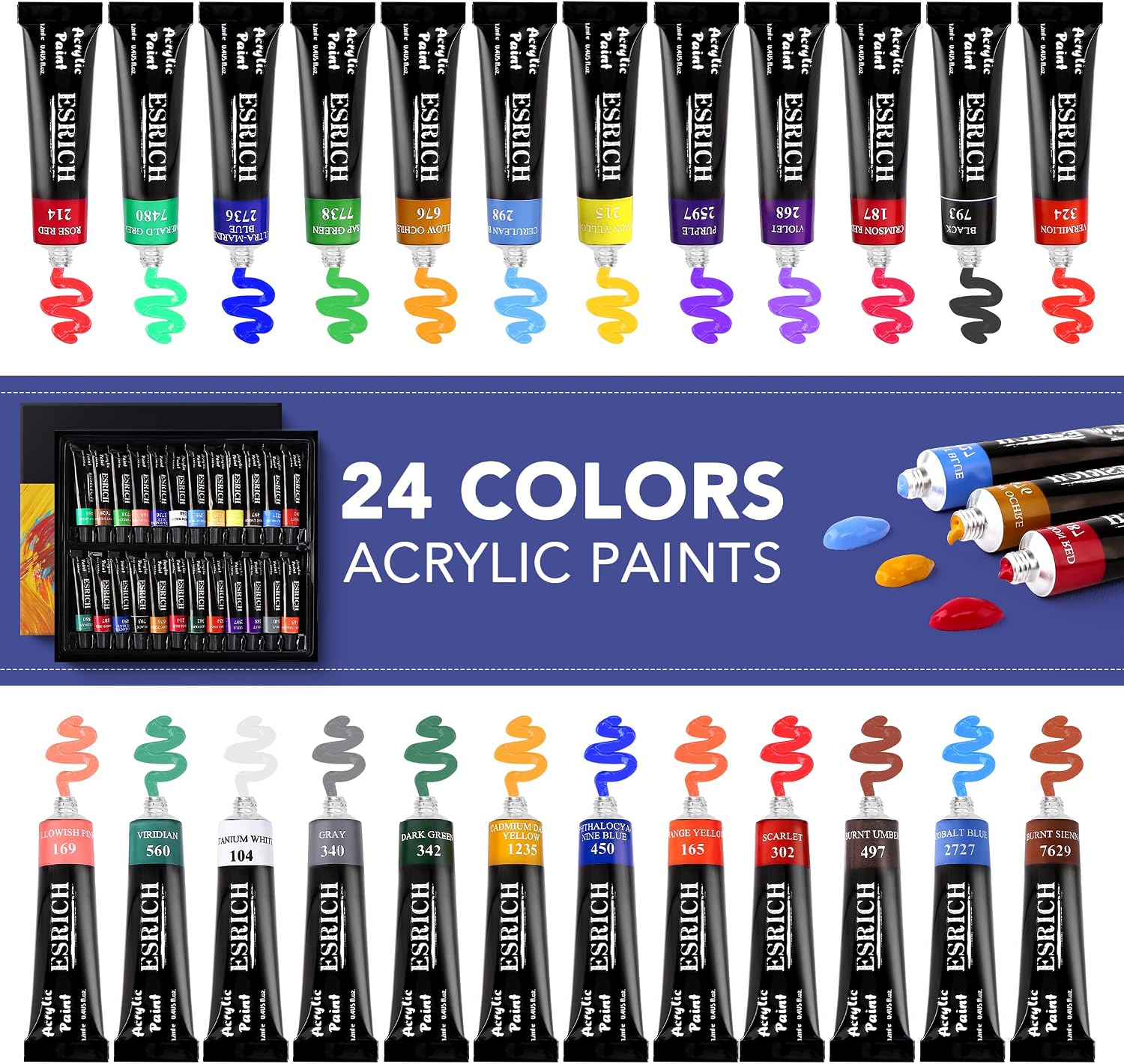
An acrylic starter kit is exactly what it sounds like: a single box that bundles acrylic paint (a fast-drying, water-based medium that cleans up with soap and works on almost any surface), brushes, a palette for mixing colours, and usually a canvas or two — everything a new painter needs to sit down and start without a second shopping trip. The pitch is convenience, and for a lot of buyers it lands. But the gap between what the box promises and what you can actually make with it is where most of the confusion lives. This guide cuts through that gap. Whether you’re buying for yourself after a long break from painting, or choosing a gift for someone who’s been saying “I’d love to try that,” here’s what each price tier realistically delivers, which kits earn their keep, and what the tradeoffs look like when you start spending more.
| EDITOR'S PICKESRICH Professional Acrylic Pai… | Mid-tierARTIFY 25 Pieces Professional P… | Budget pickWinsor & Newton Cotman Watercol… | |
|---|---|---|---|
| Paint included | ✓ | ✗ | ✓ |
| Canvas included | ✓ | ✗ | ✗ |
| Easel included | ✓ | ✗ | ✗ |
| Piece count | 60 | 25 | 12 |
| Paint type | Acrylic | — | Watercolor |
| Price | $52.99 | $29.99 | $20.08 |
| See on Amazon → | See on Amazon → | See on Amazon → |
What “All-Inclusive” Actually Means at Each Price Point
The phrase “everything included” does a lot of work on a product listing and almost none of it is standardised. At the $30–$60 range — the most crowded part of the Australian market for these kits — you’re typically getting:
- 12–24 paint colours in small tubes (usually 12ml, occasionally 22ml)
- 10–15 synthetic brushes of mixed sizes
- A folding tabletop easel (more on this below)
- One or two stretched canvases, commonly 20×25cm or 25×30cm
- A plastic palette with wells
By the numbers:
- Entry kits (under $50): ~12ml tubes, canvases typically 20×25cm
- Mid kits ($50–$90): 22–60ml tubes, canvases up to 30×40cm, sometimes linen panels
- Premium kits ($90–$180): heavy-body or artist-grade paint, larger canvases, better brush construction
The canvas size issue is the single most consistent complaint across aggregated buyer reviews of ESRICH and Chalkola kits — Artists Network’s beginner resources flag canvas sizing as a top sourcing confusion point for new painters. Buyers routinely describe the included canvas as “smaller than it looked in the photo.” This isn’t a defect; it’s a category-wide pattern. A 20×25cm canvas is roughly A4 — fine for a study, tight for a proper painting.
At the mid tier, the calculus shifts. Jackson’s Art’s explainer on heavy-body versus fluid acrylics (jacksonsart.com) draws a clear line: heavy-body paint (the thick, buttery consistency that holds brushstrokes and palette-knife texture) is meaningfully different from the thinner, more liquid formula in most entry kits. When buyers of the Artecho Professional 60ml tubes describe “thick consistency, pigment richness, no cracking” — these are specifically heavy-body qualities. Artecho buyers in aggregated reviews skew notably away from pure beginners; they’re people who know what they want and recognise what they’re getting.
Kit-by-Kit Breakdown: Who Each One Is Actually For
ESRICH All-in-One Acrylic Kit
The ESRICH kit is a genuine workhorse at the entry level, and the pattern in its reviews is distinctive: it’s frequently purchased as a gift for someone returning to painting after years away, not for first-timers. One widely-cited buyer describes an emotional reaction from a family member — an older relative for whom the kit represented permission to return to something they’d loved. That context matters editorially. This is a kit that signals “I support your creative life” as much as it delivers materials.
What you’re actually getting: 24 acrylic paint tubes (typically 12ml), a range of brushes, a folding tabletop easel, palette, and canvas. The easel question comes up constantly (see the FAQ below), and the honest answer is that it works for its purpose without competing with a proper studio easel. Pigment quality is student-grade — functional, somewhat less lightfast than artist-grade pigments, and the colours are pre-mixed for convenience rather than purity. For a returning painter who wants to rediscover process before reinvesting in serious materials, that’s a fair trade.
Chalkola Complete Acrylic Set
Chalkola earns its place by being genuinely honest about what it is: a family-activity kit. Buyer reviews consistently describe multi-generational use — one describes a full family painting session over a US Thanksgiving holiday, with adults and children working side by side. The Craft Council of Australia’s 2024 materials access report notes that shared creative activity is one of the primary drivers of entry-level craft kit purchases, and Chalkola fits that frame exactly.
The paints are bright, the set is generous in piece count (typically 40–60 pieces), and the construction is built to survive enthusiastic handling rather than precise technique. If the goal is creative family time rather than skill-building, this is the correct kit. If the goal is developing real painting skills, the buyer will outgrow it quickly — probably within three to five projects.
Artecho Professional 60ml Acrylic Tubes (Kit Format)
This sits in a different category. Artecho’s 60ml heavy-body tubes are reviewed by people who have clearly used professional-grade paint before — they reference consistency, opacity, and the absence of cracking by name, which are not terms beginner buyers typically use. Per Winsor & Newton’s published guidance on acrylic consistency (winsornewton.com), heavy-body acrylics behave fundamentally differently in impasto work (thick, textured application) and hold colour integrity better over time.
The tradeoff: Artecho kits are less complete as standalone packages. The focus is on paint quality, not ecosystem completeness. If you’re pairing Artecho tubes with brushes and canvases you already own, it’s an excellent value. If you’re expecting everything-in-one-box convenience, you’ll need to supplement.
Meeden Heavy Body Acrylic Set
The Meeden set has a specific champion in its review pool: art teachers. One classroom review notes the yellow transparency as “expected rather than a flaw” — a technically literate comment that signals the reviewer understood what they were buying. Per Artists Network’s beginner acrylic guide, yellows and some reds are inherently more transparent in acrylic formulations because of the pigment’s natural properties; opacity is added by the manufacturer, not a given. An art teacher calling this out by name is a strong signal that Meeden’s product communication is honest about its materials.
For classroom use or for a practitioner who wants reliable heavy-body consistency and a wide colour range without paying Liquitex Professional prices, Meeden is a defensible choice. The caveat is that classroom-grade heavy body still sits below artist-grade in pigment load — it performs better than entry-level student paint but won’t match Liquitex or Golden tube for tube.
The Australian Sourcing Reality
Freight matters here in a way that’s easy to underestimate. Entry kits in this category are largely shipped from China-based fulfilment centres via Amazon Australia, which means delivery windows and return processes are consistent but not always fast. For a gift purchase with a specific date in mind, factor in lead time.
Mid-tier and premium options — including Artecho and Meeden — are more consistently stocked domestically, and their price points sit in closer parity with US listings than many specialty art materials do. Jackson’s Art (jacksonsart.com) ships to Australia with reasonable freight costs for larger orders, and for buyers wanting to supplement a starter kit with higher-quality brushes or larger canvases, that’s worth knowing.
One pricing note for 2026: the AU dollar’s relative stability against USD through early 2026 has kept import-reliant kit pricing from the volatility seen in 2024–2025. The $50–$90 bracket is currently well-stocked locally.
Frequently Asked Questions
Is the easel in the ESRICH kit sturdy enough for actual use or just display? Across aggregated reviews, the ESRICH tabletop easel is consistently described as functional for small canvases (up to about 30×40cm) on a stable table surface. It folds flat for storage and holds the included canvas without issue. It is not a studio easel — it won’t manage a large canvas or heavy board, and it’s not designed to. For what it’s included to do — hold a small canvas for a beginner — owners report it works. Don’t expect it to replace a dedicated H-frame or A-frame easel.
How many projects will the paint in a starter kit realistically last? This depends heavily on technique and canvas size, but the general pattern from buyer reviews is: 12ml tubes across a 24-colour kit will last a beginner through four to eight small (20×25cm) paintings before key colours run out. Working larger, or with thick impasto technique, shortens that significantly. Plan to supplement before you finish the kit.
Which colour always runs out first in an acrylic starter kit? Titanium white. Universally, across every brand reviewed here. White is used in nearly every colour mix to lighten tones, and the small tube included in most starter kits is nowhere near proportionate to how much you’ll use. Buy an additional white tube — ideally in 60ml or larger — at the same time as your kit.
Can the Artecho 60ml tubes be used directly in an all-in-one kit palette? Yes, but the wells on most entry-level plastic palettes are sized for 12ml tube openings — the 60ml tube nozzle may not seat cleanly, and the volume of paint per squeeze is harder to control. Artecho’s heavy-body consistency also means it doesn’t self-level in a palette well the way thinner paint does. Owners report working directly from the tube onto a flat palette surface (a ceramic tile or a stay-wet palette) gives better control. Not a dealbreaker, but worth knowing before your first session.
Is a 40-piece or 60-piece kit better as a gift for someone returning to painting? Piece count is largely a marketing metric — more pieces doesn’t mean better quality, and the difference is usually extra brushes or small palette knives that add perceived value without changing what you can actually paint. For a gift, focus on tube size (22ml or larger is meaningfully more usable than 12ml), canvas size (30×40cm minimum), and whether the recipient paints in a space with good table room for a folding easel. The ESRICH kit in particular reviews strongly in the gifting context for returning painters; the Chalkola is the better choice if the gift is for shared family use.
The Decision Rule
If the buyer is returning to painting after a break and wants a single box that says “welcome back” without requiring further shopping: ESRICH is the editorial pick. The package is coherent, the gifting framing holds up, and buyers consistently report emotional satisfaction with it.
If the painting is for a family or multi-person creative session and durability matters more than paint quality: Chalkola fits that brief honestly.
If the buyer already has brushes and canvases and wants to level up the paint itself: Artecho Professional 60ml is where the money should go. The heavy-body quality jump is real, reviewers confirm it, and the per-ml cost is reasonable for what it delivers.
If the context is classroom or group instruction and you need consistent, honest heavy-body performance across a range of skill levels: Meeden Heavy Body is the defensible choice — an art teacher’s recommendation in aggregated reviews carries weight, and the transparency-aware colour range is a genuine teaching asset.
In every case: buy an extra tube of titanium white on day one. That’s not optional advice.