Watercolour paint — pigment suspended in a water-soluble binder, typically gum arabic — is one of the most format-sensitive media in crafting. The same pigment behaves differently depending on whether it reaches your brush as a compressed dry cake (a pan) or a freshly squeezed ribbon from a tube. Winsor & Newton’s Cotman range is one of the most widely available student-to-intermediate watercolour lines in Australia, stocked at Eckersley’s, Riot Art & Craft, and most independent art supply shops. It comes in three distinct configurations: the compact Pocket Set (a folding tin with half pans), the full-sized Sketcher’s Pocket Box, and tube sets in various counts. If you’re six months to two years into watercolour and you’re wondering which Cotman format to invest in next — or whether the format you’re already using is quietly working against you — this is the decision frame you need.
| EDITOR'S PICKWinsor & Newton Professional Wa… | Mid-tier[Winsor & Newton Cotman Watercol…](https://www.amazon.com/dp/B000XYHYI4?tag=greenflower20-20) | Budget pickWinsor & Newton Cotman Watercol… | |
|---|---|---|---|
| Number of Pans | 24 Half Pan | 45 Half Pan | 12 Half Pan |
| Includes Brush | — | ✓ | ✓ |
| Set Type | Lightweight Metal Box | Studio Set | Sketchers' Pocket Set |
| Paint Series | Professional | Cotman | Cotman |
| Case Material | Metal | — | — |
| Price | $163.95 | $52.68 | $20.08 |
| See on Amazon → | See on Amazon → | See on Amazon → |
Why Format Matters More Than Most Beginners Expect
The assumption most people make when they start watercolour is that paint is paint — and that the quality of their work hinges entirely on paper and technique. That’s partially true. But format shapes your workflow in ways that compound over time.
Pan sets reward habitual, spontaneous painters. Because the paint is already in the palette, there’s no setup friction: open the tin, dampen your brush, go. Owners consistently report that pan sets see far more daily use precisely because of this low-friction access. The trade-off is activation time — getting sufficient pigment off a dry half pan into a wash colour requires more brush passes and a few minutes of pre-wetting if you want full saturation quickly.
Tube paint, by contrast, is fresh and immediately responsive. Squeeze a ribbon of Cotman from a tube and you can load your palette with a rich, saturated pool of colour in seconds. Painters who work in larger formats — A3 paper and above — consistently prefer tubes because they can mix generous quantities without exhausting themselves scrubbing at a pan. The trade-off: if you don’t seal tubes properly or leave caps off (notoriously easy to do mid-session), the paint dries in the nozzle and you lose paint and money.
The third variable — portability — is where format choice stops being theoretical and becomes urgent. If you paint in the field, at life drawing sessions, in cafés, or in a classroom, the pocket-format pan set is genuinely purpose-built in a way that tubes simply aren’t.
Cotman Pan Set, Pocket Box, and Tube Set Compared
The three main Cotman configurations sit at different points on the portability-versus-volume axis. Understanding where each sits helps clarify which one is actually solving your problem.
Cotman Pocket Set (Half Pans)
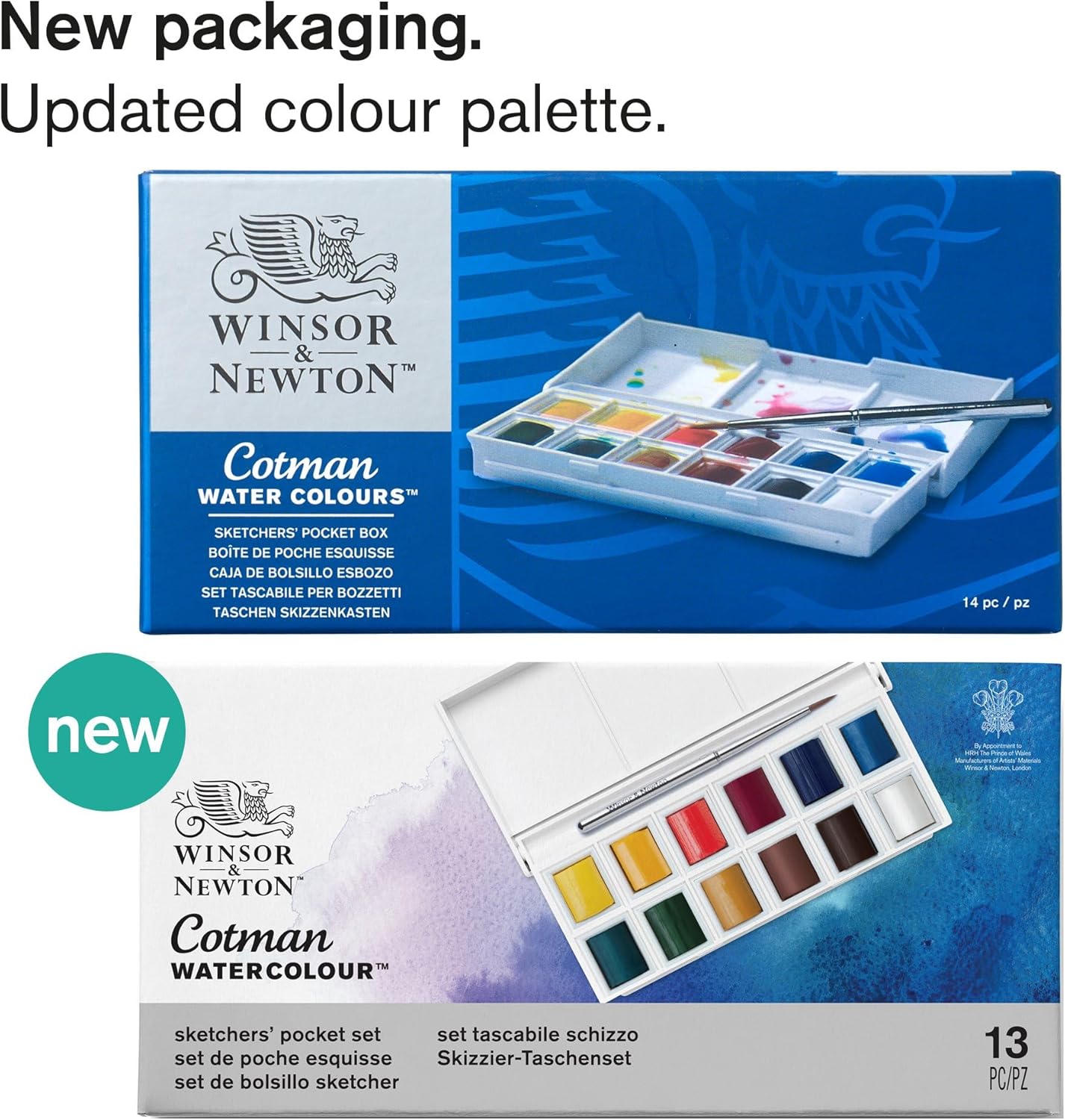
The Cotman Pocket Set typically retails between AU$35 and AU$45 and includes 12 half pans in a magnetic-closure tin with a fold-out mixing area. It fits in a jacket pocket and requires no additional equipment to begin painting. Jackson’s Art Supplies’ Watercolour Buying Guide — Student vs Professional Grades identifies pan sets as the recommended format for location painting, citing setup time and leak risk as the two factors that make tubes impractical in the field.
At paper sizes up to A4, the half pans provide more than adequate pigment volume for most sessions. Where they begin to strain is in large wet-in-wet passages or flat wash backgrounds across a full A3 sheet — those applications require sustained scrubbing to load enough pigment, which can disturb the wash surface and slow the rhythm of a session.
Winsor
$20.08
In stock on Amazon
Check price on AmazonCotman Sketcher’s Pocket Box
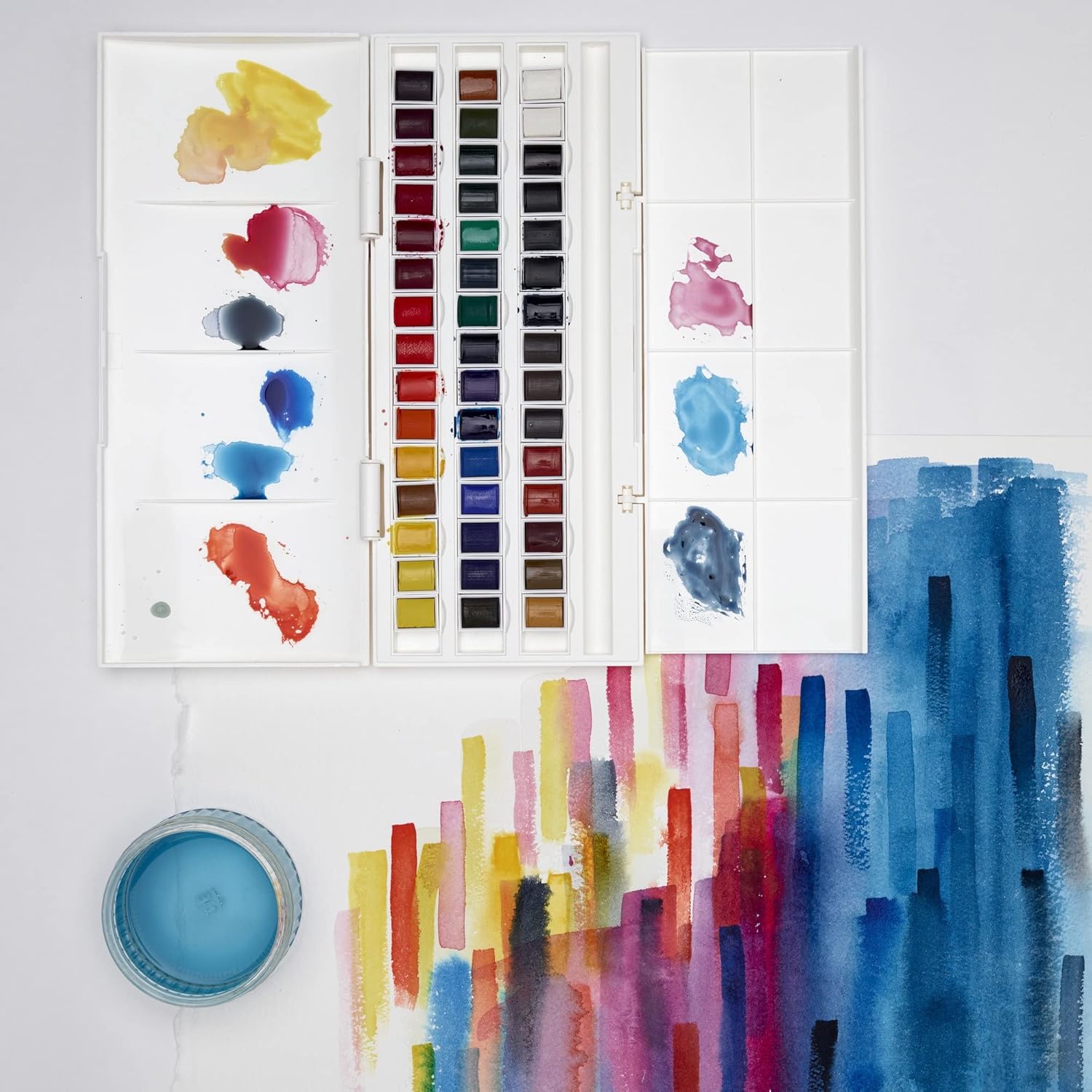
The Sketcher’s Pocket Box sits at roughly AU$55–$75 and expands on the basic pocket set with a larger tin format, additional mixing trays, and in some configurations a slightly larger brush. The pigment formulations are identical to the standard pocket set — this is a workflow and ergonomics upgrade, not a colour quality upgrade. Winsor & Newton’s product documentation for the Cotman range confirms that pigment load across pan configurations is consistent within the line.
For painters who find the pocket set’s mixing area cramped, or who regularly work on A4 sheets and want space to hold more pre-mixed colour pools, the Sketcher’s Pocket Box is the natural next step without moving to tubes.
Winsor
$52.68
In stock on Amazon
Check price on AmazonCotman Tube Set (12 × 8ml)
The Cotman tube set typically retails between AU$55 and AU$70 for 12 tubes and requires a separate folding palette — typically adding AU$15–$40 to the setup cost. The tubes deliver fresh, immediately responsive paint: squeeze a ribbon onto the palette and you can build a large, saturated pool of colour in seconds rather than minutes.
Artists Network’s Understanding Watercolour Paint Grades notes that tube paint is the practical standard for painters working at A3 and above, where wash volume requirements make pan activation impractical for extended sessions. Several long-run reviews aggregated by Maker and Student’s Beginner Watercolour Setup Reviews describe Cotman tube paint — in either format — as performing noticeably above what the student-grade label implies, with colour saturation and transparency closer to mid-tier professional paint than to budget craft sets.
The tube set is less suited to field use: the separate palette requirement adds bulk, and tubes are more vulnerable to leakage in transit than sealed pans.
Winsor
$52.68
In stock on Amazon
Check price on AmazonThe Van Gogh Alternative
If you’re in the AU$50–$80 bracket for a pocket pan set, you will almost certainly also encounter the Royal Talens Van Gogh Pocketbox. It’s worth addressing directly.
Artists Network’s Understanding Watercolour Paint Grades includes community-documented comparisons noting that Van Gogh pigments draw consistent praise from experienced watercolourists, with at least one long-run reviewer rating the Van Gogh palette layout as superior for mixing complementary colours. The Van Gogh tin is also slightly larger, which some painters find easier to work from.
The honest trade-off is one of Australian retail geography. Cotman replacement half pans — useful when you exhaust a single colour — are stocked at most Australian art suppliers. Van Gogh refill pans are less commonly available in Australian bricks-and-mortar stores, which means you may be waiting on freight for a replacement Ultramarine if you use it frequently. For painters who rely on walk-in retail access for restocking, or who are supplying a class environment where continuity matters, Cotman’s Australian retail footprint is a practical advantage.
Decision rule: If you are primarily studio-based and price-sensitive, the Van Gogh is a legitimate Cotman alternative. If walk-in refill access matters to your practice, the Cotman’s distribution advantage is real.
When to Move from Cotman to the W&N Professional Range
This is the question that doesn’t get asked directly enough, so here is a direct answer.
The Winsor & Newton Professional Watercolour 24-pan set — typically AU$220–$280 depending on retailer — is the natural upgrade target for plein air landscape painters and those approaching exhibition work. The key differences are higher pigment density (you can activate a rich wash with fewer brush passes), single-pigment formulations with documented lightfastness ratings, and a self-contained metal tin with quality mixing areas.
The move from Cotman to Professional is worth making when two of the following three conditions are true:
-
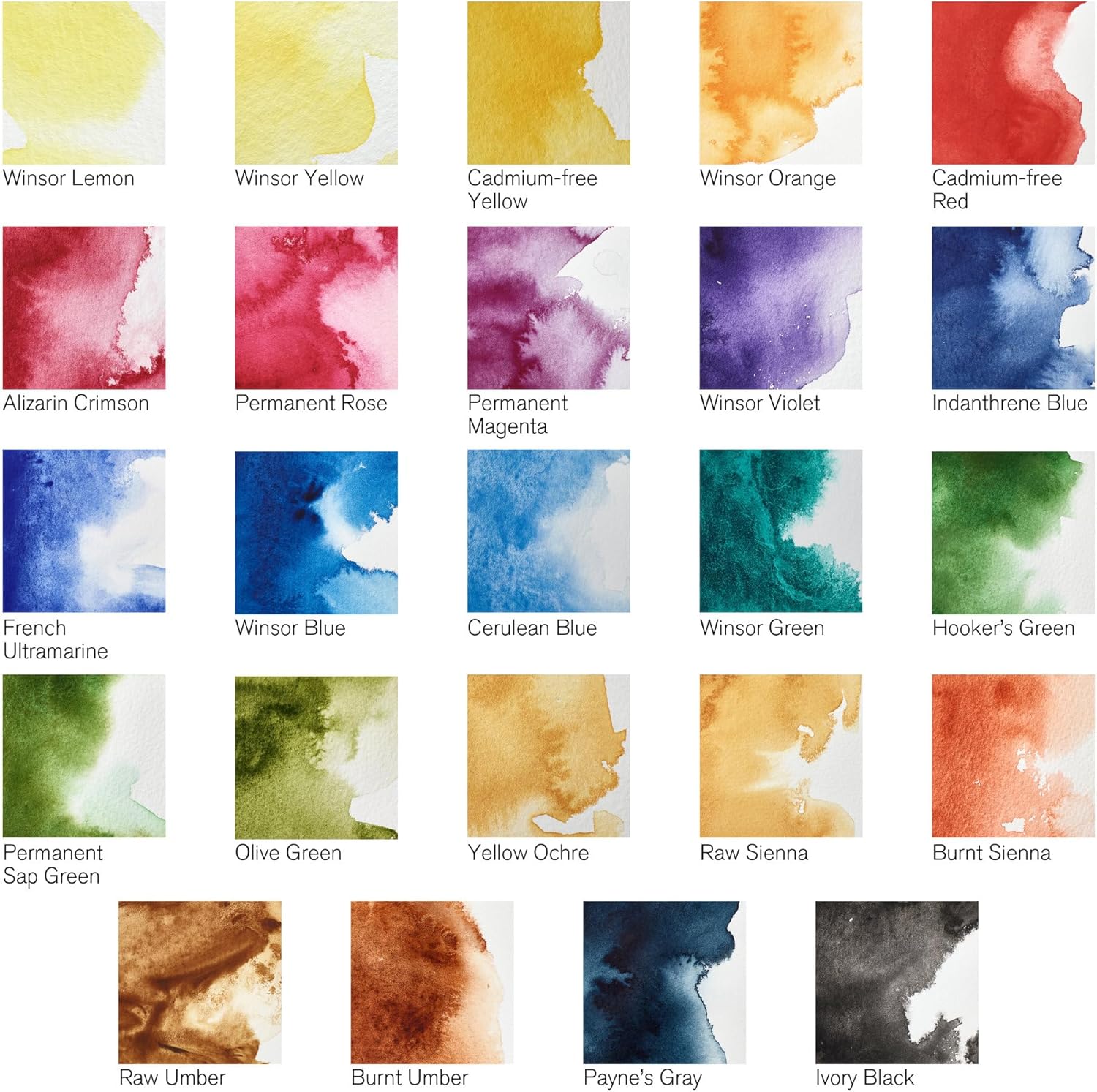
You’re experiencing Cotman’s ceiling. Specifically: granulating colours like Burnt Sienna or French Ultramarine are behaving inconsistently, or transparent glazing layers are muddier than you expect. This is where single-pigment Professional formulations begin to show a clear difference.
-
Lightfastness is now a concern. Cotman uses hue substitutions for some pigments — combinations engineered to approximate more expensive single pigments at lower cost. Winsor & Newton’s product documentation for the Cotman range discloses these substitutions. For work intended for exhibition, sale, or archiving, Professional single-pigment lightfastness ratings offer more certainty.
-
You’re working at A2 or larger regularly. At those scales, Professional tube paint becomes the most economical per-millilitre option and delivers the wash volume needed without rationing.
Artists Network’s Understanding Watercolour Paint Grades notes explicitly that the Cotman line is designed to allow a painter to develop their practice without the barrier of professional paint prices, and that the quality gap between Cotman and Professional is narrower than many assume. If only one of the above conditions applies, Cotman is still doing its job.
Winsor
$163.95
In stock on Amazon
Check price on AmazonFrequently Asked Questions
Is Cotman actually student grade or is it closer to professional quality? Technically, it is student grade by Winsor & Newton’s own classification — that designation reflects hue substitutions for some pigments and a lower pigment load than the Professional line. In practice, Maker and Student’s Beginner Watercolour Setup Reviews aggregates multiple long-run owner accounts describing Cotman as feeling closer to a mid-tier professional product than to cheap craft paint. The distinction matters more as your work advances and lightfastness becomes a priority, but for the first one to three years of serious practice, Cotman is a capable tool.
Do the pans in the pocket set dry out between uses? In normal Australian conditions, properly sealed Cotman half pans stay workable for months. The tin’s magnetic closure provides adequate protection for pans that have been used and left to re-dry. In drier inland climates, a light misting of the pans before beginning a session speeds reactivation significantly.
Can you refill Cotman pans from tubes? Yes — this is a well-documented and cost-effective practice. Jackson’s Art Supplies’ Watercolour Buying Guide — Student vs Professional Grades covers this as a standard studio workflow: squeeze fresh tube paint into an empty pan, allow it to cure for 24–48 hours in a dry location, and the dried paint behaves identically to a factory-filled pan.
Is the brush included in the pocket set worth using? The included travel brush is functional for field sketching where no alternative is available. The consensus across aggregated reviews is that it is adequate for emergencies but lacks the belly capacity and snap of a proper watercolour brush. Most painters who develop a regular practice replace it with a quality synthetic travel brush — an Escoda Versatil or Da Vinci Casaneo travel size, for example — within the first few months.
When should a beginner move from Cotman to the W&N Professional range? Not before you have genuinely exhausted Cotman’s ceiling, which for most painters takes longer than expected. Artists Network’s Understanding Watercolour Paint Grades specifically cautions against upgrading for psychological reasons — the sense that better tools will accelerate skill — rather than in response to a clearly identified technical limitation.
The Bottom Line
If your practice is portable or intermittent — field sketching, classes, painting in short sessions — the Cotman Pocket Set is the cleaner choice. Its format actively supports the habit of painting, and the low-friction setup is precisely why owners return to it consistently.
If you’re working large, mixing generous washes, or building a studio practice where you paint at a desk for one to three hours at a stretch, the Cotman Tube Set will serve you better. The higher mix volume matters at A3 and above, and the identical pigment formulations mean you’re not sacrificing colour quality.
If you’re close to the Professional threshold — your work is exhibition-bound, or you’ve genuinely hit Cotman’s ceiling on lightfastness or granulation — the W&N Professional 24-pan set is the right upgrade target, not a lateral move to a different student-grade product.
Format is a workflow decision, not a quality ladder. Make the choice that matches how you actually paint, not how you imagine you’ll paint once you have better gear.