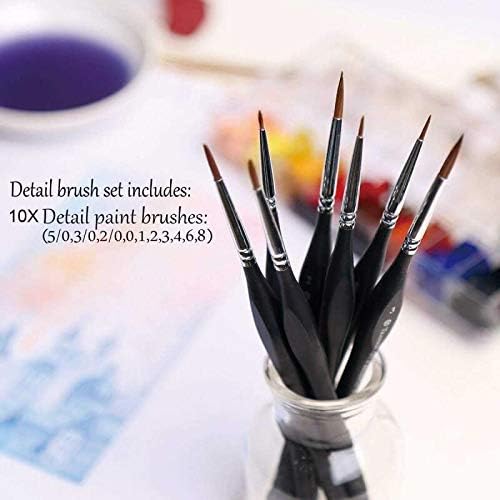
Detail painting — the practice of applying paint with very fine-tipped brushes (sizes ranging from 20/0 up to size 2 or 3) to achieve crisp lines, tiny highlights, and intricate patterns — is one of those disciplines where your tools either cooperate or actively fight you. Whether you’re picking out the eyes on a 28mm tabletop miniature, adding feather texture to a botanicals watercolour, or filling numbered sections on a paint-by-number canvas, the brush in your hand is doing the thinking. A good detail brush holds a needle-sharp point under load, releases paint smoothly without dumping, and — critically — doesn’t shed fibres onto wet paint. A bad one does none of these things reliably, and no amount of technique corrects for a brush that springs sideways mid-stroke. This guide cuts the field to the sets that actually earn their place on a serious maker’s desk, based on aggregated reviewer patterns and published brush specifications.
| EDITOR'S PICKARTIFY 25 Pieces Professional P… | Mid-tierARTEZA Paint Brushes Set of 12 | Budget pickGolden Maple Detail Paint Brush… | |
|---|---|---|---|
| Brush count | 25 | 12 | 10 |
| Bristle type | Synthetic nylon | Synthetic hair | — |
| Handle material | — | Birch wood | — |
| Ferrules | — | Rust-resistant | — |
| Roll case | ✓ | — | — |
| Palette knife | ✓ | — | — |
| Price | $29.99 | $20.99 | $16.99 |
| See on Amazon → | See on Amazon → | See on Amazon → |
Why Most “Detail Brush” Sets Disappoint — and What to Look For Instead
The market is cluttered with sets that photograph well and perform poorly. The failure modes are predictable: bristles that splay after three uses, ferrules (the metal collar that clamps the bristles to the handle) that loosen when exposed to water, and “size 0” brushes whose bellies are so fat the tip barely qualifies as fine.
When evaluating a set, the variables that actually matter are:
Belly-to-tip ratio. A well-formed detail brush has a full belly (which holds a reservoir of paint) tapering to a true needle point. Sets that skimp on bristle length produce a flat, scrubby tip that can’t hold enough paint to complete a stroke without reloading.
Bristle material. Natural hair — Kolinsky sable being the premium standard — has microscopic scales that grip and release paint with exceptional control. Synthetic alternatives (usually nylon or Taklon) have improved dramatically; the better sets now use multi-diameter filaments that mimic the snap and absorbency of natural hair closely enough that most intermediate practitioners won’t notice a difference in everyday use, per Jackson’s Art’s synthetic vs natural hair guide. For pure watercolour work at a professional level, natural hair retains an edge. For acrylics, gouache, and resin touch-up, quality synthetics are entirely defensible and significantly more durable.
Shedding and ferrule integrity. This is the most-cited complaint in long-run reviews. Shedding is usually a manufacturing defect — bristles not adequately bonded into the ferrule — rather than an inherent property of the material. The sets highlighted below have been specifically selected because reviewers consistently report minimal to no shedding after extended use.
Shape variety. For miniature and detail work specifically, rounds are the workhorse, but riggers (long thin bristles for continuous fine lines), daggers (angled tip for leaves and scales), and cat tongue (a flat oval useful for dry-brushing highlights) give you options that rounds simply can’t replicate.
The Sets Worth Buying, Matched to Use Case
For Tabletop Miniatures and 3D Printed Figures: Golden Maple Detail Brush Set
Golden Maple has carved out genuine credibility in the tabletop painting community, and the reviewer pattern here is unusually specific — buyers consistently call out smooth coverage on textured resin and plastic surfaces, zero shedding after months of regular use, and handle ergonomics that reduce fatigue during close-focus sessions. Artists Network’s brush care documentation notes that ergonomic handle length becomes material when you’re holding a brush within 15cm of your face for extended periods, and Golden Maple’s shorter, balanced handles address this directly.
This is the set to shortlist if your primary substrate is 3D printed PLA or resin-cast miniatures. The paint load and release are calibrated for acrylic — which is almost universal in the miniature hobby — and the point retention holds up under the thin, high-pigment paints (Vallejo Model Colour, Citadel, Army Painter) that the format demands.
Tradeoff to name explicitly: Golden Maple rounds are optimised for precision over paint volume. If you also need to basecoat larger areas, you’ll still want a separate flat or mop brush alongside — this set isn’t trying to do everything.
For Paint-by-Number and Beginner-to-Intermediate Detail Work: Soucolor Fine Detail Set
Paint-by-number (PBN) has a specific demand that’s often underestimated: the sections are pre-defined, which means staying within boundaries is the challenge, not mark-making freedom. Soucolor buyers repeatedly mention PBN as their primary use case and call out the small detail brushes specifically — sizes in the 5/0–10/0 range — as the reason they recommend the set. The bristle stiffness is calibrated towards beginners who need a bit of resistance feedback to stay on-canvas, rather than the ultra-soft response of premium Kolinsky.
Per the Maker and Student guide to miniature painting, beginners typically benefit from slightly stiffer synthetics because the firmer tip telegraphs pressure more clearly, helping develop consistent stroke control before moving to more responsive natural hair. Soucolor sits in that sweet spot.
Tradeoff: If you’re already past the foundational stage, you may find the stiffness limiting for fine watercolour work. But for acrylic-based PBN and hobby painting, reviewers consistently report it punching above its price tier.
For the Mixed-Media Maker Who Needs Variety: ARTIFY Detail Brush Set
ARTIFY earns its place through shape diversity and structural reliability. Owners highlight the variety of forms — rounds, flats, fans, liners — and note the handles as sturdier than comparable-priced competitors. One reviewer pattern that stands out: it’s frequently purchased as a gift for teen or young adult artists who need the full toolkit from fine detail up to broad stroke work. That tells you something about the set’s architecture — it’s designed to be a complete working palette of shapes, not just a fine-tip specialist.
If you’re building out a first serious kit or equipping a teaching setup where students need genuine shape variety without specialised tool fatigue, ARTIFY is the considered choice. The Craft Council of Australia’s maker tools documentation emphasises that early-stage practitioners benefit most from access to a range of shapes to understand what each does before narrowing to favourites — ARTIFY is structured for exactly that learning arc.
Tradeoff: The breadth means no single brush in the set is as optimised as a specialist tool. Advanced practitioners will eventually outgrow the flats and fans; the fine rounds hold their value longer.
For Riggers, Daggers, and Less Common Shapes: Fuumuui 9-Shape Set
Fuumuui is the set for the maker who already has rounds covered and wants to extend their shape vocabulary. Owners specifically call out the cat tongue, dagger, and rigger brushes, and report no shedding after sustained acrylic and gouache use — a meaningful data point because gouache, with its higher pigment load, is rougher on bristles than diluted acrylics.
The rigger (also called a liner or script brush) deserves particular attention. It has a disproportionately long, thin bristle bundle that holds enough paint to draw an unbroken fine line across a significant length of canvas without reloading — essential for illustrative detail, lettering on signs within a painting, or rigging on maritime subjects (which is literally where the name comes from). Jackson’s Art’s brush guide notes that riggers are chronically underused by intermediate practitioners who default to their shortest rounds and then wonder why their fine lines have uneven pressure breaks.
Tradeoff: Nine brushes means limited redundancy. If you lose or damage a rigger mid-project, you don’t have a backup in this set. Consider buying two sets or supplementing with individual specialist brushes for the shapes you use most.
For 3D Print Painters Who Hate Constant Brush Changes: Nicpro 30-Piece Set
The Nicpro 30-piece is the logistics answer. Reviewers who paint 3D printed figures specifically note that the size range handles both the tiny detail work (eyes, gems, inscription text) and the fill areas (armour plates, clothing) without requiring a separate brush kit for each phase. Thirty brushes sounds excessive until you’re mid-session and need to switch from a 10/0 for a pupil to a size 2 for a cloak — having the right brush already clean and ready is a genuine workflow gain.
By the numbers:
- Nicpro 30-piece: covers sizes 10/0 through 12 across multiple shapes
- Golden Maple: 10–12 pieces, fine-end specialist (sizes 5/0–2)
- Fuumuui: 9 shapes, mid-range sizes emphasising specialty forms
- Soucolor: focused fine range, ideal 5/0–1 for PBN work
Tradeoff: With 30 brushes, quality control variance is statistically more likely than in a 10-piece. Reviewers are generally positive on consistency, but a set this size has a wider manufacturing surface to cover. Inspect on arrival and cycle any underperformers out immediately rather than letting them corrupt your workflow.
Frequently Asked Questions
What brush size is best for paint-by-number detail sections? For most PBN kits, sizes 5/0 through 0 cover the majority of fine sections. The very smallest sections (1–2mm across) warrant a 10/0, but using an ultra-fine brush for larger sections slows you down significantly — match the brush to the section, not the smallest section in the painting.
Do synthetic brushes shed more than natural hair for detail work? Not inherently — shedding is a quality-control issue, not a material property. Premium natural hair sets can shed badly; well-manufactured synthetics can be virtually shed-free. The sets highlighted here were selected specifically because reviewer patterns across hundreds of purchases show minimal shedding complaints.
Is a 10-piece detail set enough, or do you need 25+ brushes? For focused miniature and detail work with a single medium, 10–12 well-chosen brushes is genuinely sufficient. The case for 25+ is workflow efficiency (always having a clean brush of the right size ready) and shape variety. Artists Network’s brush selection guidance notes that most painters settle into 5–7 frequently used brushes from any large set — but having the range available during skill development helps you discover which 5–7 those are.
How do you maintain a fine point on detail brushes? Three practices make the most difference: never let paint dry in the bristles past the ferrule, rinse with a brush soap (not dish detergent, which strips natural oils from natural hair) after every session, and store vertically with the tip up or horizontally — never tip-down in a jar. Maker and Student’s miniature painting guide recommends reshaping the wet tip with a point between fingers after washing, then letting it air-dry in position.
Are the same brushes suitable for both acrylic and watercolour detail work? Synthetic brushes handle both without damage. Natural hair handles both but technically watercolour rounds with high absorbency can feel sluggish with acrylic — the paint loads heavily and can dry in the belly before you finish a stroke. If you’re splitting time between both media, a synthetic or synthetic-blend set gives you more flexibility without a dedicated kit for each.
The Decision Rule
If your primary use case is tabletop miniatures or 3D printed figures, start with Golden Maple and supplement with Nicpro 30-piece once your size range needs expand.
If you’re working in paint-by-number or structured hobby painting, Soucolor’s fine-end range is calibrated for exactly that demand — don’t overcomplicate it.
If you need shape variety across media and are still building your brush vocabulary, ARTIFY is the right first investment.
If you already have rounds covered and want to add specialty shapes, Fuumuui’s rigger-dagger-cat tongue combination fills the gap most intermediate painters hit around the 12–18 month mark.
The single most common mistake at this stage? Buying a premium-priced individual brush before you’ve established which shapes you actually reach for. Start with a structured set, run it for a full project cycle, then invest in individual replacements for the forms you’ve worn out first — those are the brushes your practice actually needs.