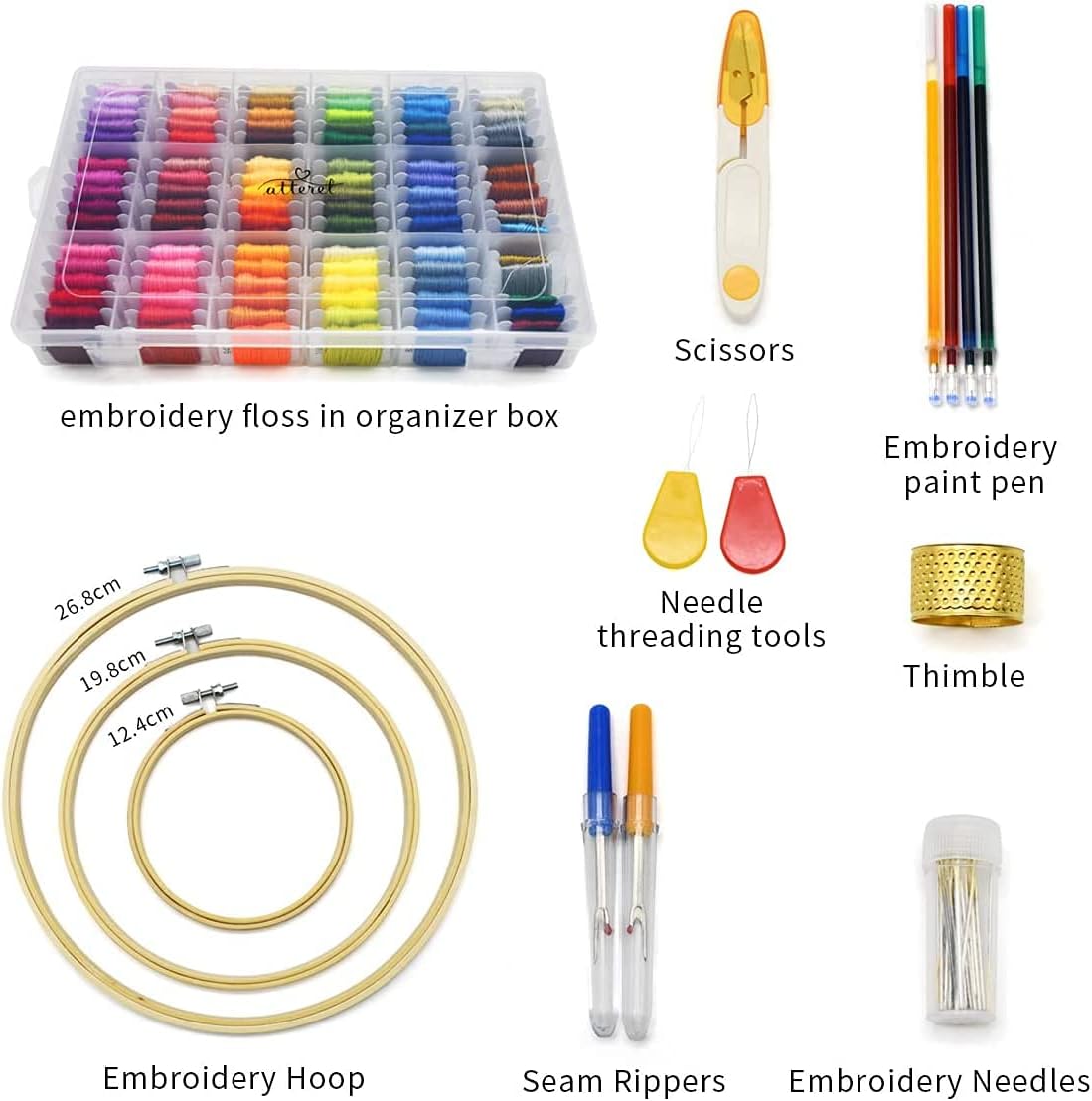
Embroidery is simply the art of decorating fabric with a needle and coloured thread — and if you’ve spent more than a few months doing it, you already know that the needle and thread are the easy part. The hard part is building a thread library that actually covers what you want to stitch. That’s the pitch behind “200-thread” or “complete supply” kits: one purchase, sorted. These bundles — typically ranging from about AU$35 for a basic import set to AU$180+ for a curated mid-range pack — promise to hand you a fully stocked workbasket. But what’s genuinely inside them, and does the maths work out in your favour? This guide unpacks the contents, compares the real cost per skein (a small wound bundle of thread, usually about 8 metres), and gives you a clear decision rule for whether to buy in bundle or build your own.
What “200 Threads” Actually Means (and What It Doesn’t)
The number is the first place to interrogate. In most mass-market kits, “200 threads” means 200 individual skeins — but that’s not the same as 200 distinct colours. Across aggregated reviews on crafting platforms and the Maker and Student Intermediate Embroidery Toolkit Review (2025), the most commonly reported pattern is this: a 200-skein kit contains somewhere between 100 and 150 unique shades, with multiples of the most popular mid-range hues (think dusty rose, sage green, navy) padded to hit the headline number. You get two or three skeins of the same colour whether you want them or not.
That matters because serious embroiderers often work within a specific palette — a botanical illustrator doesn’t need five skeins of terracotta any more than a crewelwork practitioner doing Jacobean florals needs a run of neon brights. The 200-skein count is a marketing figure, not a design-utility figure.
There’s also the question of fibre content. The vast majority of bundled kits use six-strand cotton floss — the standard stranded cotton you’ll recognise from DMC or Anchor. Six-strand simply means the thread is made of six thinner strands twisted together; you split them down to one, two, or three strands depending on your fabric and stitch density. Kits at the AU$35–$70 price point rarely specify lightfastness ratings (a measure of how resistant a colour is to fading in light). The Artists Network Embroidery Floss Guide (2025) notes that budget poly-cotton blends are common in import bundles and typically perform poorly over time compared to mercerised 100% cotton — the surface finishing process that gives quality floss its characteristic sheen and dye uptake.
The non-thread contents vary significantly by price tier but typically include:
- A set of assorted needles (usually 12–25, various gauges)
- A plastic or bamboo embroidery hoop (15–20 cm diameter — fine for practice, limiting for serious work)
- Thread organisers or bobbin cards
- A small scissors pair
- Sometimes a needle threader and seam ripper
- Occasionally a starter pattern or printed fabric panel
At the AU$35–$60 tier, most of these accessories are functional but disposable. At AU$100–$180, you start seeing metal-tipped scissors, quality bamboo hoops, and better-organised storage.
The Price-Per-Skein Maths: When Bundles Win (and When They Don’t)
Here’s the arithmetic that actually drives the buy/build decision.
By the numbers — 200-skein kit vs. building equivalent from retail:
| Route | Approx. cost (AU$) | Cost per skein |
|---|---|---|
| Import 200-skein kit (AU$35–$50) | ~$45 | ~$0.23 |
| Mid-range branded 200-skein kit (AU$130–$180) | ~$155 | ~$0.78 |
| DMC stranded cotton, bought individually at AU retailers | ~$2.20–$2.80 | $2.20–$2.80 |
| Anchor equivalent, individual | ~$2.00–$2.50 | $2.00–$2.50 |
| Appleton crewel wool (specialty), individual | $30+ per skein | — |
Prices surveyed May 2026 from Australian online retailers; individual DMC pricing per Jackson’s Art Supplies Australian price list.
On raw cost-per-skein, bundles win decisively — sometimes by a factor of ten. But that calculation only holds if you’ll use the thread. If 60 of your 200 skeins are colours you’ll never stitch with, your effective cost per useful skein climbs fast. A mid-range kit at $155 with 130 genuinely usable shades costs you $1.19 per useful skein — still competitive, but the gap narrows.
The accessories also need to be factored. A single good-quality embroidery hoop (Elbesee or Hardanger-style) retails at AU$12–$25 individually. A quality needle set runs AU$8–$15. If the kit’s accessories are things you’d have bought anyway, they offset the bundle price. If you already own them — or if the kit’s versions are too low-grade to use — they’re dead weight.
The Craft Council of Australia Maker Survey (2024) found that intermediate practitioners most commonly cited “buying too much of the wrong colour” as their primary materials waste issue, suggesting that palette-specific building beats completeness-for-its-own-sake for most serious makers.
The Quality Gradient: What Changes Between Tiers
At the AU$35–$70 tier (your typical import bundle sourced through major Australian mass-market retailers or online marketplaces), the threads are generally serviceable for learning and for projects that won’t see heavy light exposure or frequent washing. Colour labelling is often inconsistent — the numbering system won’t match DMC or Anchor standards, which means you can’t cross-reference shades against published patterns.
This matters enormously for pattern-following embroiderers. If you’re working from a Trish Burr bird portrait pattern or an Inspirations magazine project, those call out specific DMC numbers. An unlabelled bundle thread in “colour 47” tells you nothing. You’re essentially stranded (forgive it) without a conversion chart that likely doesn’t exist.
The AU$100–$180 mid-tier is where the value proposition shifts. A number of suppliers active in Australia — including local haberdashery specialists and online craft retailers — offer curated 100-colour and 150-colour sets using branded floss with full colour numbering. These aren’t the 200-skein marketing bundles; they’re genuinely useful starter libraries. Owners reviewing these sets through Australian crafting communities consistently report that full DMC-standard labelling is the single feature that justifies the premium over import bundles.
Above AU$200, you’re largely moving into the territory of deliberately curated specialty sets — hand-dyed Australian fibres from indie dyers, silk/wool blend threads for goldwork, or Appleton crewel wool collections. These are a different category entirely: not a “complete kit” play, but a palette investment. Pricing here is per-project logic, not per-skein bulk logic.
A note on hoops and accessories: at any tier, the plastic hoops included in most bundles are worth using to learn tension but will likely be retired once you discover the grip and adjustability difference of a quality wooden or beechwood hoop. Clover and Elbesee are the names that consistently appear in Australian maker communities as meaningful upgrades. Budget around AU$15–$30 for that replacement when the time comes — it’s not an if, it’s a when.
Who Should Buy a Bundle (and Who Shouldn’t)
The honest decision framework here isn’t complex, but it does require you to know where you are in your practice.
Buy a 200-thread bundle kit if:
- You’re within your first year of embroidery and genuinely don’t know which colours you’ll gravitate toward. The low cost-per-skein gives you permission to explore without financial commitment to specific palettes.
- You’re equipping a teaching scenario — a school group, a studio workshop, or a community class — where colour accuracy matters less than having enough working thread for 10–15 students.
- You primarily work from your imagination rather than from published patterns, so the absence of standard colour numbering isn’t a workflow problem.
- You’re gifting to a beginner or returning hobbyist who needs critical mass of supplies to feel set up.
Build your own library instead if:
- You consistently work from published patterns that specify DMC or Anchor colour numbers. Unlabelled bundle threads create friction every single time you sit down to stitch.
- You work in specialty fibres — crewel wool, silk, overdyed cotton — where bundles simply don’t exist at meaningful quality levels. In this case, sourcing from Australian specialist retailers (search for Appleton stockists through Walker Ceramics-adjacent haberdashery channels, or Londonderry Yarn Studio for wool threads) is the only viable route.
- You’ve already established a palette. If you know you’re a cool-neutral stitcher who lives in greys, blues, and sage, a 200-skein bundle padded with oranges and pinks is actively unhelpful.
- Your work will be framed, exhibited, or sold. Lightfastness matters. Per the Artists Network Embroidery Floss Guide (2025), top-quality mercerised cotton from established brands is meaningfully more fade-resistant than budget blends — and for work that leaves your hands, that’s a professional obligation, not a preference.
The if/then rule: If you’re primarily learning or teaching, buy a mid-tier bundle (AU$100–$160) with numbered thread. If you’re working to patterns or toward exhibition or sale, build selectively from branded individual skeins and invest the saved bundle money in one good hoop and a proper needle assortment from Clover or Tulip.
Australian Sourcing Notes
Freight context matters here more than in most craft categories. Import bundles — particularly the large-volume 200-skein kits from overseas suppliers — are subject to Australia Post and courier weight charges that can add AU$15–$40 to the effective price of anything heavy. Thread is denser than it looks. A 200-skein kit that appears attractively priced at AU$38 shipped internationally can land at AU$55–$60 once realistic freight is applied, which erodes the cost-per-skein advantage against Australian-stocked alternatives.
Major Australian craft chains — Spotlight being the most accessible nationally — stock DMC stranded cotton individually and in smaller curated sets. Prices run AU$2.20–$2.80 per skein as of mid-2026. For specialty threads, online Australian haberdashery retailers and the handful of dedicated embroidery suppliers operating through Etsy’s Australian marketplace offer better selection than bricks-and-mortar for anything beyond standard floss.
The Maker and Student Intermediate Embroidery Toolkit Review (2025) specifically recommended that Australian stitchers calculate total landed cost — purchase price plus freight plus any customs handling — before comparing bundle versus individual pricing. It’s the only honest way to run the maths.
One final note: the secondary-use value of bobbins and storage systems included in better kits is genuinely useful and often undervalued. If you’re going to build a thread library over time, a good bobbin winding system (the plastic cards that come with better bundles are functional; the ring-and-label systems are better) saves real time. It’s not glamorous, but organisation is what turns a pile of thread into a working studio resource.
The verdict: 200-thread kits are a legitimate entry point and a genuine value for learning and teaching contexts. For practitioners with 12+ months of practice, a working palette, and pattern-driven projects, the bundle logic inverts — and the money is better spent on fewer, better, numbered skeins you’ll actually reach for.