Embroidery is the craft of decorating fabric with a needle and thread — and if you’ve been circling it online, you’ve probably noticed that “beginner kit” covers a wild range. Some kits hand you four stitches and a single hoop. Others land on your doorstep with 38 techniques, six progressively harder patterns, and a QR code linking to a full video library. The gap between those two experiences is, according to a growing body of honest reviewer feedback, the difference between finishing your first project and quietly abandoning the whole idea. This article maps four structured embroidery kit families by their stitch progression, tutorial quality, and honest first-timer suitability — so you can match the right rung of the ladder to where you’re actually starting.
One plain-English note before we dive in: a stitch in embroidery is a single named technique — a French knot, a satin stitch, a stem stitch. More stitches in your repertoire means more visual variety in your finished work. A hoop is the circular frame (usually 15–25 cm across) that holds the fabric taut while you work. Most kits include one.
The Core Problem: “Beginner” Is a Spectrum, Not a Standard
The Craft Council of Australia’s 2024 Needle Arts Participation Report notes that first-time embroiderers cite unclear instructions as the primary reason they abandon the craft within the first two projects — ahead of cost, time constraints, or thread tangles. That finding lines up precisely with what reviewers are saying at the product level.
A Craftwiz reviewer put it plainly: she had “tried another beginner kit and was ready to throw in the towel” before switching to the Craftwiz set and completing her first project. That experience — kit-induced frustration before the craft itself has had a fair hearing — is the editorial tension every comparison in this piece is designed to resolve.
The four kit families reviewed here sit at measurably different points on the complexity spectrum. Before examining each one in detail, the table below gives you the headline numbers at a glance:
| Kit | Stitches taught | Stage / pattern count | Video support |
|---|---|---|---|
| Pre-stamped colour-coded kit | ~4–6 | 1 standalone | Minimal / printed only |
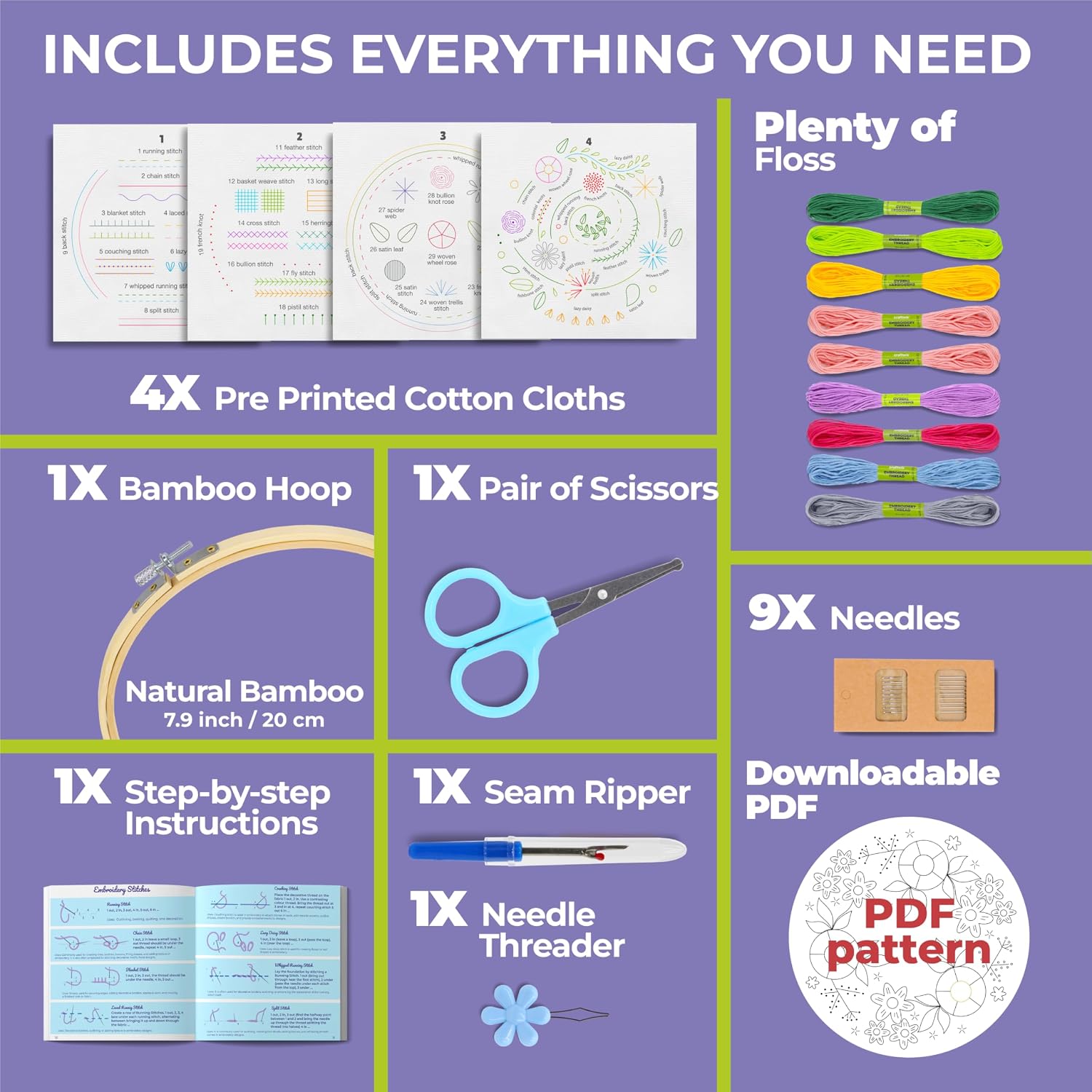
| Craftwiz Beginner Set | ~12–16 | 4 progressive | Short per-stitch videos |
| ETSPIL Structured Set | ~20–24 | 4–5 progressive | Full video library, QR-linked |
| CYANFOUR 6-Stage Kit | ~38 | 6 progressive | QR-linked; directions dense |
Each represents a genuine value proposition — the question is which one matches your starting point.
Kit by Kit: What the Reviewers Actually Say
The Pre-Stamped Colour-Coded Kit — Low Barrier, Limited Runway
Don’t let the entry-level framing put you off entirely: several adult reviewers bought these kits as a deliberate first step, particularly people who’d had bad experiences with more ambitious sets. The consistent praise from reviewers centres on one specific design decision: colour-coordinated floss. Each thread colour is matched visually to the section of the printed design it belongs in, removing the guesswork of pattern-reading entirely. For a true absolute beginner — someone who has never held an embroidery needle — that removal of one decision layer matters.
The honest ceiling: reviewers agree that once you’ve completed the single project, there’s nowhere to go within the kit itself. You’ve learned a handful of stitches, you have a finished piece, and you need to buy something else. For gifting to a child or as a one-evening curiosity-test, this works well. As a structured learning pathway, it isn’t designed to be one.

ETSPIL
$20.98
In stock on Amazon
Check price on AmazonThe Craftwiz Beginner Set — The Four-Stage Structure That Converted the Sceptics
The Craftwiz set is where the reviewer evidence gets most interesting. The same reviewer quoted above — who’d nearly abandoned embroidery entirely — specifically credits the short, independently navigable stitch videos as the format that finally worked for her. This is a non-trivial distinction worth understanding: the Craftwiz approach breaks tutorials into discrete clips, one per technique, rather than a single long walkthrough video. Craftwiz reviewers explicitly praise this over long single-video formats. If you get stuck on a French knot at 11pm, you can pull up the French knot clip without scrubbing through forty minutes of footage.
The four-stage project progression is calibrated so that each pattern introduces new stitches while consolidating the ones from the stage before. Reviewers consistently report completing all four projects, which is a meaningful outcome metric in a category where abandonment is common.
One note for Australian buyers: the Craftwiz set ships from international warehouses, so factor two to three weeks freight into your timeline if you’re buying as a gift with a specific date in mind.

10
$23.98
In stock on Amazon
Check price on AmazonThe ETSPIL Structured Set — The Accessibility Standout
The ETSPIL set earned a specific category of review that the others didn’t: accessibility testimonials. One ETSPIL reviewer explicitly identifies as an adult with ADHD and describes the structured, video-supported format as the factor that made the difference between success and abandonment. That’s worth naming directly because it points to a design feature with real pedagogical intent — the kit doesn’t just include videos, it structures the learning experience so that each session has a clear, completable goal. For learners who struggle with open-ended projects or need discrete wins to maintain momentum, this architecture matters.
The ETSPIL set sits in the mid-range of stitch count (roughly 20–24 techniques across four to five stages) but scores highest among reviewed sets for the quality and accessibility of its supplementary support. Reviewers note that the QR-linked video library is comprehensive without being overwhelming, and that the progression feels scaffolded rather than assumed.
Practically: the ETSPIL kit’s video library requires a stable internet connection. Reviewers don’t report an offline download option, so if you’re planning to stitch on a rural property, on a long flight, or anywhere with unreliable connectivity, download any linked tutorials to your device while you have a signal.
10
$23.98
In stock on Amazon
Check price on AmazonThe CYANFOUR 6-Stage Kit — Maximum Stitch Range, Honest Caveats
The CYANFOUR 6-stage kit is the most ambitious product in this comparison, teaching approximately 38 stitches across six progressively harder projects. For someone who’s already worked through a four-stage kit and wants a substantial next challenge, it’s a logical escalation — and the product quality (fabric, thread, hoop materials) earns consistent praise.
The honest caveat comes from a telling 4-star review that this article would be doing readers a disservice to gloss over: directions feel unclear for true first-timers, even though the underlying product is good. This reviewer’s criticism isn’t about material quality — it’s about instructional design. The written instructions assume a level of embroidery literacy that a genuine absolute beginner doesn’t yet have. The QR-linked video support is present but reviewers describe it as less beginner-scaffolded than the ETSPIL equivalent.
The editorial read: the CYANFOUR kit is best positioned as a second kit, not a first. If you’ve completed a four-stage set and want to push your stitch vocabulary toward the higher end, the CYANFOUR’s range and quality justify the investment. Starting here with no prior experience risks replicating exactly the frustration the Craftwiz and ETSPIL sets were designed to prevent.
Craftwiz
$24.99
In stock on Amazon
Check price on AmazonHow to Choose: A Clear Decision Framework
The logic here is relatively clean once you’re honest about your starting point:
If you have zero prior needle experience and learn best with minimal friction: Start with the pre-stamped colour-coded kit. Treat it as a one-project proof-of-concept. If you finish it and want more, move to Craftwiz or ETSPIL next.
If you’ve done one or two projects but abandoned previous kits in frustration: The Craftwiz set’s modular video format addresses the most commonly cited frustration point. Reviewers who’d failed with other kits succeeded here. That’s the strongest endorsement signal available short of independent testing.
If you’re a structured learner, have ADHD, or need session-sized wins to maintain momentum: ETSPIL’s scaffolded approach has the most robust evidence of working for this learning profile. The video library is the strongest in this comparison for accessibility.
If you’ve already completed a four-stage kit and want to substantially expand your stitch vocabulary: The CYANFOUR 6-stage kit is the right next step, with the understanding that you’ll be bridging some instructional gaps yourself.
One additional framing for Australian buyers: kits sourced via Australian marketplace listings will typically land at a small premium over overseas prices but with meaningfully faster freight and easier returns. For a gift purchase or a time-sensitive start, that premium is usually worth it.
Frequently Asked Questions
What is the difference between a 4-stage and 6-stage embroidery kit in terms of difficulty?
Stage count refers to the number of distinct projects in the kit, each designed to introduce new techniques. A 4-stage kit typically teaches 12–24 stitches across four patterns of escalating complexity. A 6-stage kit like the CYANFOUR extends this to roughly 38 stitches across six patterns, with later stages assuming the skills from all earlier ones. The practical difference isn’t just more patterns — it’s that the later stages of a 6-stage kit sit at an intermediate skill level that a true beginner may not be ready for. Think of stage count as a rough proxy for the ceiling the kit can take you to, not just its starting point.
Do the video tutorials work offline or do they require a stable internet connection?
Based on reviewer reports, the QR-linked video libraries for both ETSPIL and CYANFOUR require an active internet connection — reviewers do not report an offline download option for either. The Craftwiz per-stitch video clips are similarly accessed online. If you’re planning to stitch in a location with unreliable connectivity, download any linked tutorials to your device while you have a signal before you head out.
Are these kits suitable for adults with no prior sewing experience at all?
Yes, with the right kit choice. The pre-stamped colour-coded kit and the Craftwiz four-stage set have both been reviewed positively by adults with no prior needle experience. The ETSPIL set has specific reviewer evidence of working for adults who’ve previously struggled with other formats. The CYANFOUR 6-stage kit is less suitable as a first-ever project; reviewer feedback suggests its instructional design assumes some prior familiarity.
What should I buy next when I’ve finished all the patterns in a kit?
The natural progression after a 4-stage beginner kit is either the CYANFOUR 6-stage kit (for a structured continuation with more stitches) or moving to standalone pattern sheets and separated materials — buying your own fabric, DMC stranded cotton by skein, and a dedicated hoop. At that point you’re no longer kit-dependent, which is the actual goal. Artists Network (artistsnetwork.com) publishes technique guides and pattern recommendations suited to self-directed practice at this stage, and the Craft Council of Australia’s practitioner resources offer additional guidance for Australian-based embroiderers looking to deepen their practice beyond structured kits.
Is a magnetic needle minder actually necessary for beginners or is it just a bonus?
A needle minder is a small magnetic accessory that holds your needle to the fabric when you’re not actively stitching — it stops the needle disappearing into the couch. Reviewers consistently describe it as a quality-of-life improvement rather than an essential tool, but several note that losing needles was a source of genuine frustration before they started using one. If the kit you choose includes one, treat it as a useful feature. If it doesn’t, you can add one cheaply later. It won’t affect whether you learn to stitch — it’ll just reduce the number of times you’re on your hands and knees searching the carpet.
Sources: Craftwiz customer reviews, aggregated product listing, 2025–2026; ETSPIL product reviews, aggregated listing feedback, 2025–2026; CYANFOUR 6-stage kit reviews, aggregated listing feedback, 2025–2026; Craft Council of Australia, ‘Needle Arts Participation Report’, 2024; Artists Network, embroidery technique resources, artistsnetwork.com, 2024–2025.