Hand embroidery is the practice of using a needle and coloured thread — called floss — to stitch decorative patterns onto fabric by hand. It requires no machine, very little space, and the core tools cost less than a dinner out. That simplicity is exactly why it’s one of the fastest-growing craft categories in Australia right now, per the Craft Council of Australia’s State of Making 2024 participation report, which recorded a sharp uptick in textile and needlework enrolments since 2022. But here’s the thing beginners consistently report: buying a kit is easy; finding a kit that actually teaches you is not. Most entry-level packs contain a hoop, some floss, and a photocopied instruction sheet that assumes you already know what a satin stitch is. This guide cuts through those options to name the kits where the tutorial experience — not just the materials — is genuinely good enough to carry a complete beginner through to a finished piece they’re proud of.
Why Tutorial Quality Is the Real Product You’re Buying
The materials in most beginner embroidery kits are interchangeable. Aida fabric, a basic wooden hoop, six-strand cotton floss — these are commodity components. What separates a kit you’ll finish from a kit you’ll shelve is the instruction layer: how well it teaches you to hold the needle, tension the thread, and execute each stitch with enough clarity that you don’t have to guess.
Across aggregated review patterns, the signal is remarkably consistent. Reviewers of the Craftwiz embroidery kit return again and again to one specific structural decision: rather than a single long tutorial video, each stitch gets its own short, self-contained clip accessed via a QR code printed inside the kit. One reviewer explicitly noted they had “tried another beginner kit and was ready to throw in the towel” before this format changed their experience. That’s not a small thing. Embroidery involves a sequence of distinct micro-skills — threading a needle without a tool, making a waste knot, executing a French knot without it pulling through — and learning them piecemeal, at your own pace, is categorically different from pausing a 45-minute YouTube video trying to find the moment where they explained the back stitch.
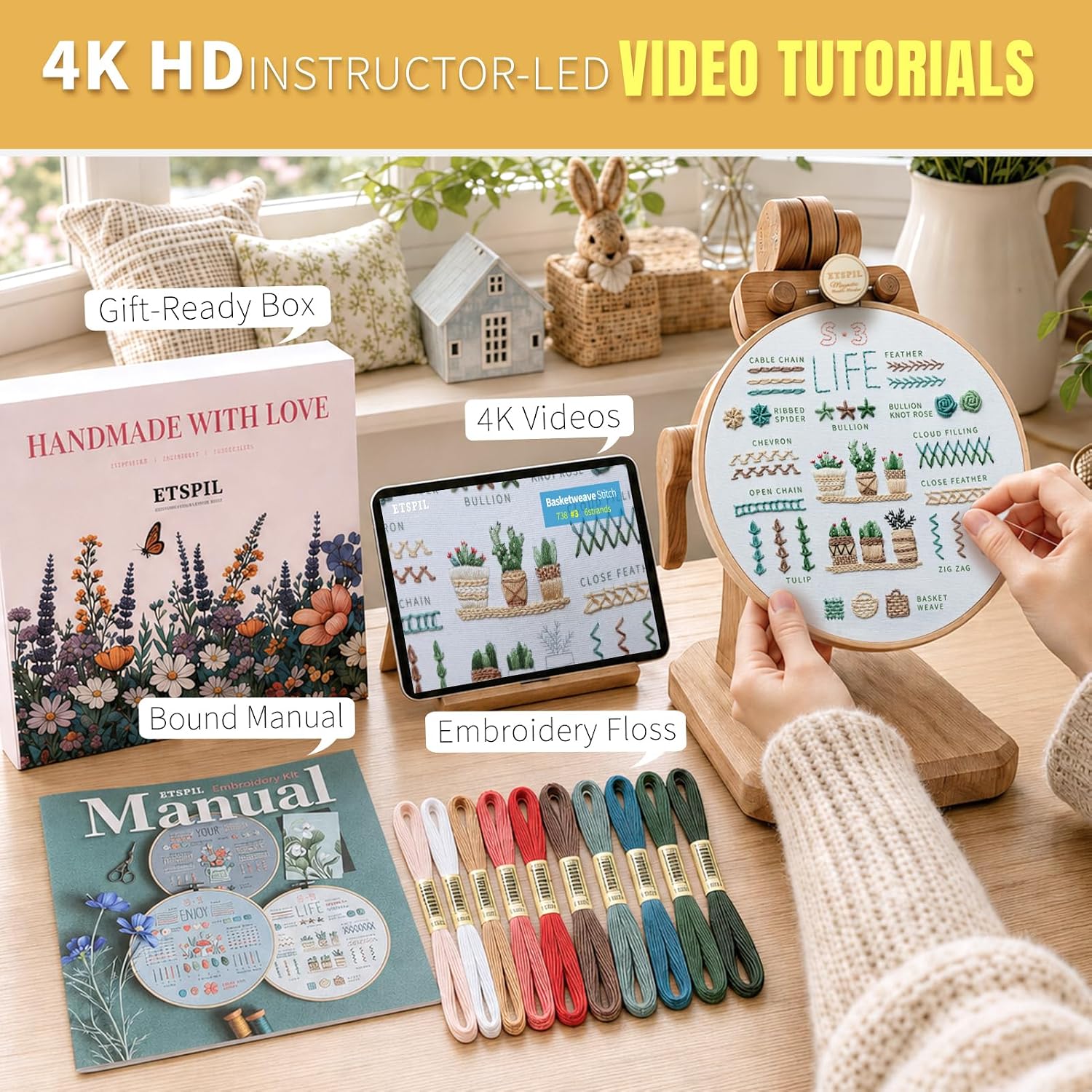
The ETSPIL embroidery kit draws a notably specific cohort of enthusiastic reviewers: adults with ADHD and other attention-processing differences who report that learning from a printed book or diagrammatic instruction sheet has never worked for them, but that the kit’s video-based approach finally clicked. This is useful editorial data, not niche feedback. If you retain information better through watching than reading, it’s worth prioritising kits that lead with video rather than treating it as supplementary.
The CYANFOUR kit illustrates the inverse problem: reviewers consistently note that the written instructions are harder to follow in isolation, but that the video tutorials effectively compensate. If you’re someone who can tolerate a moderate learning curve on written material, this is workable — but it means you must use the video, not just the paper guide.
As Artists Network’s ‘Getting Started with Hand Embroidery’ editorial overview notes, the biggest dropout point for adult beginners isn’t difficulty — it’s ambiguity. When a stitch diagram is unclear and no video backup exists, most people stop rather than guess wrong and unpick.
The Stitch Count Problem: How Much Is Too Much?
Here’s a decision frame that most kit marketing obscures: the number of stitches a beginner kit teaches is not a selling point — it’s a risk factor. A kit covering 15 stitches sounds more comprehensive than one covering six. In practice, a beginner completing their first project needs to execute four to six stitches well, not attempt twelve stitches adequately.
By the numbers:
- 4–6 stitches: ideal scope for a first project (running stitch, back stitch, satin stitch, French knot, stem stitch, lazy daisy)
- 8–10 stitches: appropriate for a second or third project once tension and thread management are established
- 12+ stitches in one kit: best reserved for reference kits used alongside structured learning, not as a standalone first experience
Reviewers of kits that introduce too many stitches simultaneously consistently report the same outcome: they complete the project but feel like they haven’t mastered any individual stitch well enough to reproduce it independently. The Craftwiz kit’s per-stitch video architecture implicitly solves this by making each stitch a discrete, completable learning unit rather than one item in a long sequence.
For a practitioner audience building intuition about kit selection — whether for yourself, a student, or a gift — the tradeoff is this: depth over breadth, always, at the beginner stage. A kit that teaches six stitches clearly and lets you finish a project you’re proud of will retain a beginner. A kit that introduces ten stitches with mediocre instruction will not.
Kit-Specific Profiles: Where Each One Actually Lands
Craftwiz is the clearest editorial recommendation for most adult beginners with no sewing background at all. The per-stitch video format is structurally sound, the pattern choices are contemporary enough that the finished piece doesn’t feel dated, and the review cohort skews toward people who explicitly tried other kits first and found this one worked. The Wirecutter ‘Best Craft Kits for Adults’ buying guide identifies tutorial accessibility as the primary differentiator in this category — Craftwiz’s architecture aligns directly with that criterion.
ETSPIL is worth naming as the specific pick for learners who know they struggle with traditional instruction formats. The video-first approach, combined with the relatively contained stitch count, makes it a strong recommendation for adult beginners who are returning to a craft after a negative early experience — or who have specific learning differences that make book-based instruction unreliable.
CYANFOUR suits the learner who is comfortable doing a bit of problem-solving and can tolerate written instructions that require cross-referencing with video. It’s not the first choice for a complete beginner with no textile background, but reviewers note that the video quality is high enough to carry the project even when the printed guide is ambiguous.
Bradove occupies a different niche worth naming explicitly. Reviewers who praise it most specifically include people arriving from adjacent skills — bead embroidery is the most cited example — who found Bradove’s approach built naturally on existing needle-and-thread intuition. If the person you’re buying for (or if you yourself) already has some bead work, cross stitch, or basic sewing in their background, Bradove will feel more immediately logical. For someone with zero textile experience, it’s a harder entry point.
Children’s kits — a secondary but editorially relevant segment — consistently draw a specific reviewer profile: grandparents purchasing for grandchildren aged seven to twelve. The most-cited praise across this segment is colour-coordinated floss that matches numbered or colour-coded positions on the pre-printed pattern. This sounds like a minor design detail; in practice, it’s the difference between a child confidently matching thread to area and a child requiring adult supervision for every colour decision. If you’re selecting a children’s kit, colour-coded matching is non-negotiable.
Frequently Asked Questions
Do the QR code video links in these kits actually work and stay live?
This is a legitimate concern and one the reviews surface directly. The short answer: for the kits covered here, reviewer feedback as of mid-2025 consistently reports working links. The structural risk is real — QR codes are only as durable as the hosting infrastructure behind them, and a small craft brand can pull or migrate video content without notice. Practically, the mitigation is straightforward: open every QR link before you start your project (or before gifting the kit), and if a video is particularly useful, bookmark or save it to a watch-later list. The kits in this guide are from brands with enough review volume and market presence that link mortality is lower risk than it would be for an unknown generic brand, but it’s never zero risk.
Are the pre-printed patterns on the fabric permanent enough to last through the whole project?
Across review aggregates, the consistent finding is: yes, for the kits covered here, the pre-printed transfer lines hold through normal working. The practical caveat is moisture — if you’re stitching with wet hands or in high humidity conditions, some water-soluble printed lines can fade faster than expected. The precaution most experienced embroiderers recommend is to photograph the pattern before you begin stitching, so you have a reference if lines fade in heavily worked areas.
How many stitches should a true beginner kit cover before it becomes overwhelming?
As covered above, four to six stitches is the editorial recommendation for a first project. This isn’t a conservative estimate — it reflects the scope at which most beginners achieve genuine competence rather than surface familiarity. The Design Files’ 2024 feature on slow craft explicitly frames embroidery’s appeal as depth of attention to individual technique, not breadth of output — a framing that maps directly onto this recommendation.
Can adults with no sewing background at all complete these kits?
Yes, specifically for the Craftwiz and ETSPIL kits, where reviewer cohorts include adults who explicitly identify as having never held a needle before. The critical condition is following the video tutorials in sequence rather than attempting to work from the printed instructions alone. Adults who try to self-direct without the video support, or who skip it assuming they can figure it out from the diagram, report more frustration. The tutorial is not supplementary — it is the kit.
What is the difference between a cross stitch kit and a hand embroidery kit for someone brand new to the craft?
Cross stitch uses a counted grid fabric called Aida — a stiff, open-weave cloth with clearly defined holes — and the technique involves making uniform X-shaped stitches across the grid to build up a pixelated image. It is highly structured, formulaic, and very forgiving for absolute beginners because the fabric dictates exactly where each stitch goes. Hand embroidery (also called surface embroidery or needlework) uses a smoother fabric — often linen or cotton — and involves a broader repertoire of stitches applied more freely onto a printed or transferred design. Cross stitch is arguably the lower-friction entry point for someone who wants a clearly defined process; hand embroidery offers more creative latitude but requires internalising stitch technique rather than just counting grid positions. The kits in this guide are all hand embroidery kits. If you’re genuinely uncertain which to start with, cross stitch is the lower-risk first project; hand embroidery is the skill set with more long-term expressive range.
The Decision Rule
If you are a complete beginner with no textile background and you want the highest probability of finishing your first project: Craftwiz, for the per-stitch video architecture alone.
If you know you learn better through video than reading, or you have attention-processing differences that make book instruction unreliable: ETSPIL, specifically.
If you’re arriving with adjacent needle skills (bead work, cross stitch, basic sewing) and want something that builds on that intuition: Bradove.
If you’re selecting for a child aged seven to twelve: prioritise colour-coded floss matching over every other feature — it’s the single variable that determines whether they can work independently.
The honest underlying principle, supported by both the Craft Council of Australia’s participation data and aggregated reviewer sentiment across these kits, is this: embroidery is not technically difficult. The barrier is instructional quality, not inherent complexity. Buy the kit whose tutorial you’ll actually use, not the one with the most content in the box.