Embroidery is the craft of decorating fabric using a needle and thread — and if you’ve never picked it up before, the tooling looks deceptively simple. In practice, the difference between a frustrating first session and a genuinely pleasant one almost always comes down to three things: a hoop that holds the fabric taut without distorting it, needles matched to your thread weight and fabric count, and thread that separates cleanly when you need to work with two strands instead of six. That’s it. Everything else in a kit is either a convenience or filler. This article is written for makers who are a few projects in — you know what a running stitch is, you’ve probably cursed at a hoop that won’t tighten — and you’re now deciding whether to build your toolkit piece by piece or commit to a bundled kit. We’ll name tradeoffs, show the math, and give you clear if/then decisions at the end.
| EDITOR'S PICKBYMORE 262 Pack Embroidery Thre… | Mid-tierSimilane Embroidery Kit 215 Pcs | Budget pickMudder 53 Pieces Cross Stitch T… | |
|---|---|---|---|
| Total pieces | 262 | 215 | 53 |
| Thread colors | 200 | 100 | — |
| Thread length | 8 m/pc | — | — |
| Hoops included | — | 5 | ✓ |
| Aida cloth | — | 3 pcs | — |
| Storage | 4-tier box + bins | — | Floss bobbins |
| Price | $26.99 | $21.99 | $14.49 |
| See on Amazon → | See on Amazon → | See on Amazon → |
What a Good Embroidery Kit Actually Includes (and What’s Just Padding)
The bundled kit market has expanded significantly since 2022, and the quality range is genuinely wide. The Craft Council of Australia, in its report Making It: The State of Australian Craft Practice 2024, noted that fibre arts — including embroidery and cross stitch — saw a substantial increase in new practitioner uptake over the preceding two years, which drove a corresponding flood of imported entry-level kits. Most of them are adequate. Some are surprisingly good. A few are structured in ways that will genuinely slow you down.
Here is the core checklist for evaluating any bundle:
Hoops: Bamboo is standard; what varies is the tension mechanism. A loose inner ring or a screw that strips under moderate tightening will drive you mad inside a single session. The hoop diameter matters too — a 6-inch (15 cm) hoop is the practical workhorse for most beginner-to-intermediate projects, while anything under 4 inches is novelty territory.
Needles: Embroidery needles (also called crewel needles) have a long, thin eye for threading multiple strands of floss. Cross stitch needles have a blunt tip and a larger eye — they’re designed for counted work on evenweave or Aida fabric, a stiff grid-weave cloth where you stitch into pre-formed holes rather than piercing the weave. A good kit includes both types in at least two sizes each. If the needle assortment is unlabelled, that’s a red flag.
Thread/floss: Embroidery floss — the standard six-strand cotton thread used in most kits — should separate cleanly into individual strands. Most patterns call for two or three strands at a time. Thread that resists separation, or that pills when pulled through fabric repeatedly, will cost you time and finish quality on every single stitch. Artists Network, in their guide How to Choose Embroidery Needles for Every Technique, makes the point that thread quality and needle eye size are interdependent — poor thread frays through even a well-sized needle, and that fraying is often the first quality signal to check in any kit.
Storage: Bobbins (small plastic or cardboard spools you wind thread onto) and a binder or bag to organise them are genuinely useful, not just marketing. Tangled thread is a real time cost.
The Kits Worth Knowing: INSCRAFT, BYMORE, YITOHOP, Similane, and ATTERET
INSCRAFT — The One Professionals Repurchase
The INSCRAFT kit earns a specific distinction that most bundles don’t: at least one hand embroidery professional reports repurchasing it deliberately to restock thread and hoops rather than sourcing components individually. That’s a meaningful signal. When someone working at a professional level finds a bundled product efficient enough to buy again — not as a starter kit, but as a restocking mechanism — it suggests the component quality is consistent enough to trust.
The thread selection in INSCRAFT kits is broad, the hoops are reported as holding tension reliably across bamboo sizes, and the organisational system is functional rather than decorative. Wirecutter, in their review The Best Embroidery Hoops, notes that hoop consistency matters more than most beginners expect — a point that aligns with what INSCRAFT reviewers consistently describe about the tension mechanism holding across extended stitching sessions. For intermediate practitioners who want a foundation kit that can absorb new patterns without requiring a full materials rethink, this is the bundle most worth examining first.
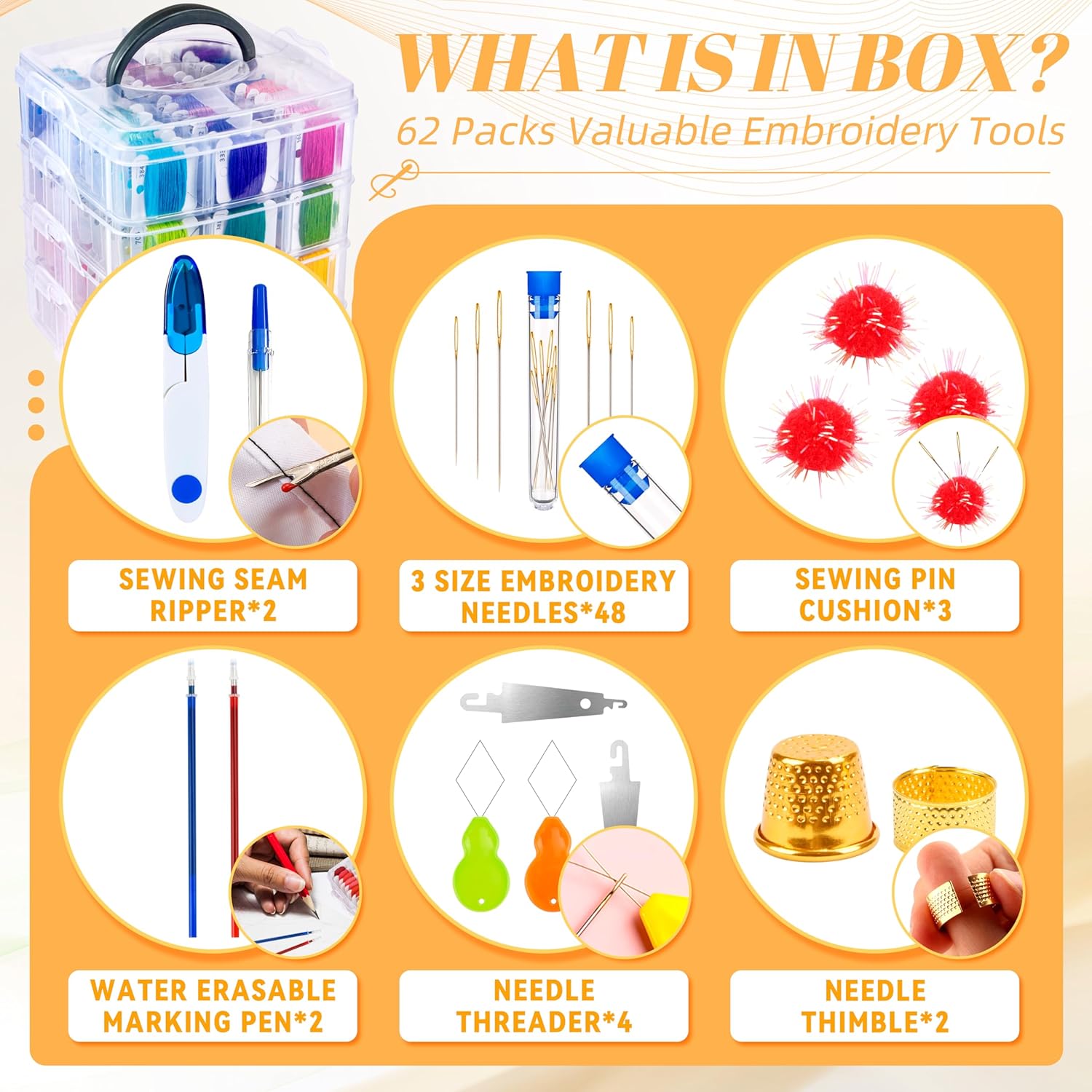
BYMORE
$26.99
In stock on Amazon
Check price on AmazonBYMORE — 200 Colours, Honestly Counted
One BYMORE reviewer physically counted threads after organising the full set and confirmed 200 distinct colours — with the honest addendum that both white and black appear as duplicates. That kind of first-hand accounting is genuinely useful editorial information, and it tells you something about how to use this kit: if white and black are your most-used neutrals (they almost always are in cross stitch), the duplication is practical rather than a flaw. If you’re evaluating colour range for variety in a complex pattern, subtract two from the headline number.
Across aggregated reviews, the pattern on BYMORE is consistent: colour count is accurate, organisation is straightforward, and the thread quality handles standard cross stitch work without issue. The duplication detail is the kind of nuance that separates an informed purchase from a surprised return.
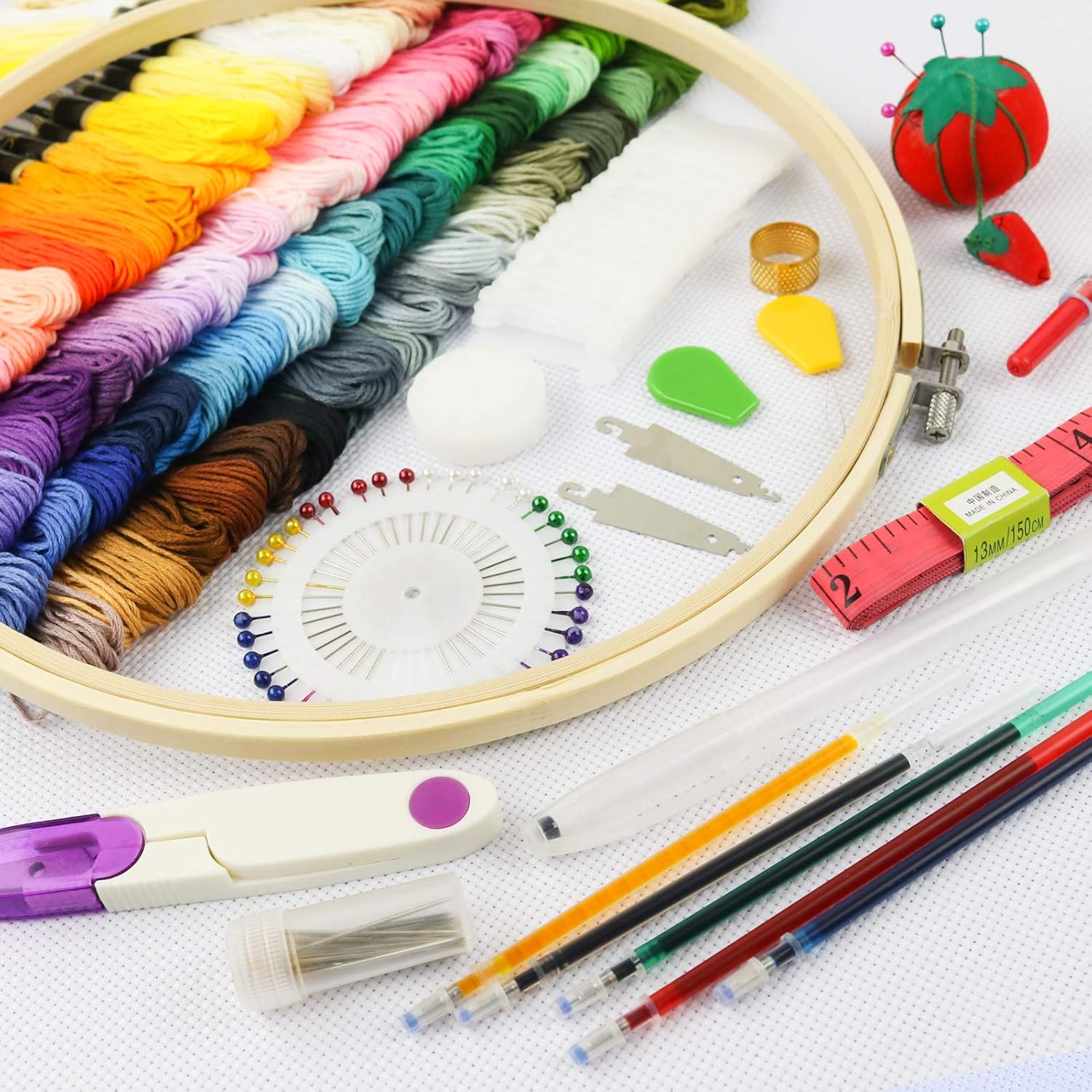
Similane
$21.99
In stock on Amazon
Check price on AmazonYITOHOP — DMC Codes on Every Bobbin
YITOHOP’s decision to print DMC colour codes on each bobbin is called out consistently by serious cross stitch reviewers as genuinely helpful — and it is. DMC (Dollfus-Mieg & Compagnie) is the global standard numbering system for embroidery thread colours. When a commercial pattern calls for DMC 321 (a specific red), having that code on your bobbin means you can match colours to patterns without guesswork, and reorder exact replacements when you run out. This isn’t a marketing detail. It’s a workflow decision that saves real time.
For cross stitch practitioners specifically — where pattern fidelity matters and colour substitution is a deliberate choice rather than an accident — YITOHOP’s coding system is the strongest functional differentiator in this price tier.
The kit also includes friendship bracelet floss alongside standard embroidery floss, which is worth addressing directly: bracelet floss tends to be twisted rather than loosely stranded, which changes how it separates and how it sits on fabric. More on this in the FAQ below.
Similane
$21.99
In stock on Amazon
Check price on AmazonSimilane — Functional, With Honest Texture Notes
Similane thread is consistently described as harder to separate than genuine DMC but functional and full in coverage. That’s a meaningful tradeoff to name explicitly. If your current projects use two or three strands and you’re working on medium-count Aida (14-count is the most common beginner fabric, meaning 14 stitchable squares per inch), Similane thread will perform adequately. If you’re doing fine work on 28-count evenweave — the finer cloth favoured by intermediate cross stitchers for greater detail — the separation difficulty will be more noticeable and more frustrating.
Maker and Student, in their analysis Thread Quality in Budget Embroidery Kits: What Reviewers Actually Say, identify thread that resists strand separation as the most commonly cited frustration across budget kit reviews. Similane sits in a middle tier on this measure — not among the worst offenders, but noticeably behind DMC or Anchor brand thread purchased individually.

Mudder
$14.49
In stock on Amazon
Check price on AmazonATTERET — Buy It for the Bag
ATTERET’s standout component is its storage bag, and reviewers are unusually specific about why: thick material, no zipper failures under full load, durable stitching at stress points. For anyone building a permanent, portable kit — a ceramics teacher equipping a studio, a market seller who packs and unpacks regularly — the physical durability of the storage component is not a secondary concern. A bag that fails when fully loaded means a reorganised mess at the worst possible moment.
The thread and hoops in ATTERET are serviceable rather than exceptional. The kit’s value proposition is the organisational system’s longevity. If you already have decent thread and want a storage upgrade, ATTERET is worth considering on that basis alone.
Mudder
$14.49
In stock on Amazon
Check price on AmazonComparison at a Glance
| Kit | Thread colours (claimed) | DMC codes on bobbins? | Hoop types included | Separation difficulty | Tier |
|---|---|---|---|---|---|
| INSCRAFT | Not published | Not consistently noted | Bamboo, multiple sizes | Low (professional repurchase signal) | BYMORE — $26.99 |
| BYMORE | 200 (confirmed; 2 duplicates) | No | Not specified | Moderate | Similane — $21.99 |
| YITOHOP | 50–100+ (varies by bundle) | Yes | Bamboo, multiple sizes | Low to moderate | Similane — $21.99 |
| Similane | Varies | No | Basic bamboo | Moderate to high | Mudder — $14.49 |
| ATTERET | Varies | No | Included | Not primary focus | Mudder — $14.49 |
If/Then Decision Rules
If you’re a cross stitch practitioner who follows commercial patterns and cares about colour accuracy — choose YITOHOP for the DMC coding system. The workflow benefit is real and recurrent.
If you want the largest functional colour library and can work around two neutral duplicates — choose BYMORE. The 200-colour honest count gives you genuine range for complex or multi-project work.
If you’re a practitioner who wants a kit that can serve as a restock mechanism rather than a one-time purchase — choose INSCRAFT. The professional-repurchase signal is the strongest quality indicator in this tier.
If you’re building a permanent portable kit and storage durability is a real concern — choose ATTERET for the bag, and supplement thread separately.
If your projects use fine fabric (28-count or higher) and thread separation matters — avoid Similane as your primary thread source and treat budget kits generally as colour libraries rather than performance thread.
Frequently Asked Questions
Are the DMC codes on budget thread kits actually accurate matches to real DMC colours?
Broadly, no — not to spectrophotometric precision. Budget threads printed with DMC codes are closest-equivalent approximations, not licensed colour matches. Reviewers who cross-stitch seriously report that YITOHOP’s codes are useful for pattern-matching intent but that the actual thread can be a shade off, particularly in the mid-tone greens and blues. For projects where exact colour fidelity matters — reproduction work, commissioned pieces — purchase DMC or Anchor brand thread to match the codes precisely. For personal projects, the approximations are close enough that most stitchers won’t notice.
What’s the difference between embroidery floss and cross stitch thread in these kits?
Functionally, they’re the same product described from different use-contexts. “Embroidery floss” refers to the six-strand cotton thread used in both freehand hand embroidery and counted cross stitch. Kits sometimes label the same thread differently depending on the primary audience they’re marketing to. The distinguishing factor in kits is whether the thread is wound on bobbins (better for cross stitch organisation) or bundled in skeins (more common for general embroidery). Both work for both techniques.
Do bamboo hoops work as well as metal hoops for hand embroidery?
For most hand embroidery, yes — bamboo is the standard and works well when the tension mechanism is solid. Metal hoops (typically spring or Q-snap frames) have a flatter inner lip that can grip fabric more evenly, and they’re preferred by some cross stitch practitioners working on fine evenweave who find bamboo grips unevenly. For general embroidery on quilting cotton or linen, bamboo hoops in the 5–7 inch range are the practical choice and what most kits correctly include.
How many colours do you realistically need to start embroidery?
Fewer than most kits suggest. For genuine beginners, 30–50 colours covers the majority of accessible patterns and teaches colour judgement without overwhelming storage. The 200-colour kits like BYMORE make more sense for intermediate practitioners tackling complex designs or building a permanent library. Start smaller unless you already have specific patterns in mind that demand range.
Can you use friendship bracelet floss from the YITOHOP kit for regular hand embroidery patterns?
Yes, with caveats. Friendship bracelet floss is typically a tightly twisted or braided thread rather than a loosely stranded floss — this means it doesn’t separate into individual strands the way standard embroidery floss does. Used as a single thread, it creates a slightly rope-like texture that some embroiderers use deliberately for outlining or decorative detail. For filled stitches or blended colours (where you’d normally separate and recombine strands), standard floss from the same kit will serve you better. Think of the bracelet floss as a texture tool rather than a direct substitute.