If you’ve ever stood in front of a wall of brushes at Eckersley’s or Riot Art & Craft and felt immediately overwhelmed, you’re in excellent company. A paint brush is just a bundle of fibres — natural animal hair or synthetic nylon or polyester — glued into a metal collar called a ferrule and attached to a handle. The number printed on the handle tells you the brush’s size within its shape family, not some universal standard. A size 6 round from one brand can be nearly twice the width of a size 6 from another. The shape name — round, flat, filbert, fan — tells you what the tip looks like and therefore what marks it makes. Once you understand those two axes, fibre type and shape, the wall of options stops being terrifying and starts being a decision tree. This guide walks through that tree for watercolour, acrylic, and oil work, with specific recommendations geared to what’s actually available in Australia at mid-2026 prices.
| EDITOR'S PICK[ARTIFY 25 Pieces Professional P…](https://www.amazon.com/dp/B0CLR58HS6?tag=greenflower20-20) | Mid-tier[ARTEZA Paint Brushes Set of 12](https://www.amazon.com/dp/B08VN5SMXJ?tag=greenflower20-20) | Budget pick[Golden Maple Detail Paint Brush…](https://www.amazon.com/dp/B075L8LCTG?tag=greenflower20-20) | |
|---|---|---|---|
| Number of Brushes | 25 | 12 | 10 |
| Bristle Material | Synthetic Nylon | Synthetic | — |
| Ferrule Material | — | Rust-Resistant | — |
| Handle Material | — | Birch Wood | — |
| Case Included | ✓ | — | — |
| Palette Knife Included | ✓ | — | — |
| Price | $29.99 | $20.99 | $16.99 |
| See on Amazon → | See on Amazon → | See on Amazon → |
Shape Numbers Are Not a Universal Standard — Here’s What They Actually Mean
The numbering system used on brush handles has no governing body behind it. As Winsor & Newton’s published brush guide explains, sizes run from 000 (the tiniest, roughly 0.5 mm wide at the belly) upward through 0, 1, 2, 4, 6, 8, 10, 12, and beyond — but the physical dimensions corresponding to those numbers vary by manufacturer and even by product line within the same manufacturer. The Artists Network editorial guide “Choosing the Right Paintbrush” makes the same point, noting that the only reliable approach is to check the published belly width in millimetres when precision matters.
The shapes you’ll actually use:
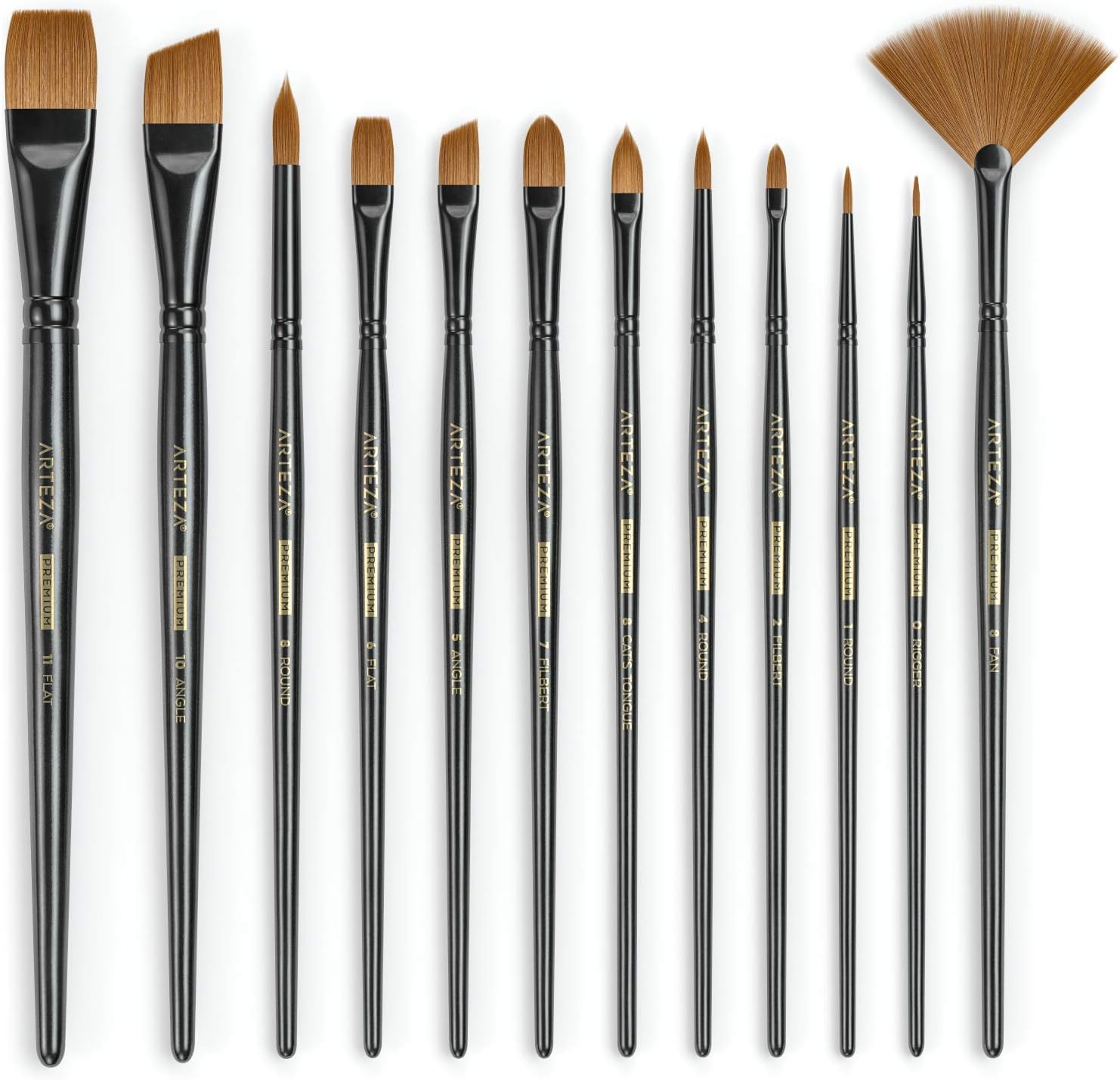
- Round — pointed tip, round belly. The most versatile shape; holds a reservoir of paint and snaps back to a point for detail. Your workhorse for watercolour and for loose acrylic work.
- Flat — squared-off tip, parallel sides. Makes crisp edges, covers ground fast. Used heavily in oils and for bold acrylic strokes.
- Filbert — flat with a rounded, almond-shaped tip. The hybrid recommended for portraiture and botanical work because it blends while retaining some edge.
- Fan — spread fibres in a thin arc. Useful for dry-brushing texture such as foliage, hair, and weathered wood, but oversold in beginner sets as an essential shape.
- Liner / Rigger — very long, thin fibres. Holds enough paint to pull a long unbroken line; essential for calligraphic marks, rigging lines, and fine botanical stems.
- Mop — large, soft, round-ish head. Primarily a watercolour shape for washes and soft backgrounds. Not practical for oils.
Rough belly-width benchmarks using Winsor & Newton Series 7 as a reference point:
| Handle Size | Approx. Belly Width |
|---|---|
| 000 | ~0.5 mm |
| 2 | ~2 mm |
| 6 | ~4–5 mm |
| 10 | ~7–8 mm |
| 14 | ~10–12 mm |
Treat these as orientation only. Always check the specification sheet for the specific line you are buying, because these numbers shift across manufacturers and product ranges.
Natural Hair vs Synthetic Nylon: The Real Tradeoffs
This is where most intermediate buyers get stuck, because the marketing language — springy, soft, absorbent — does not translate easily into decision criteria. The structural difference is this: natural hair, including kolinsky sable, squirrel, and hog bristle, has microscopic scales along each filament that grip paint and release it gradually. Synthetic nylon or polyester fibres are smooth, which means they spring back faster but release paint in a more abrupt, less controlled way for water-based media.
Watercolour Brushes
Natural kolinsky sable, or a quality blend, is the traditional recommendation for watercolour because the belly holds a large water-and-pigment reservoir and the tip snaps to a point when wet. Squirrel mops are softer and absorb even more water, making them ideal for large background washes. The Jackson’s Art Supplies editorial guide “Brush Hair Types Explained” notes that the best synthetics have closed the gap significantly over the past decade; brands such as Princeton Neptune and Escoda Versatil are consistently cited by watercolourists as handling close to sable at roughly 40–60% of the price.
For Australian buyers, a Winsor & Newton Cotman synthetic round sits at approximately AU$12–$18 each and makes a practical starting point. A Series 7 kolinsky round in sizes 4–8 runs AU$55–$120 each through suppliers such as Eckersley’s or Art Shed Online. Think of that anchor brush as a long-term tool rather than a consumable.
ARTEZA
$20.99
In stock on Amazon
Check price on AmazonAcrylic Brushes
Synthetic is the correct choice for acrylic work — full stop. Acrylic paint is alkaline and will degrade natural hair over time. It also dries fast, meaning frequent cleaning with water and sometimes mild soap; synthetic fibres tolerate this abuse far better than natural hair. Liquitex’s Tools & Brushes FAQ, published in the product specification documentation on liquitex.com, explicitly recommends synthetic bristle for acrylic application.
For intermediate acrylic work, a set covering a size 12 flat, filbert in sizes 6 and 10, round in sizes 4 and 8, and a liner in size 2 handles the majority of tasks. The Winsor & Newton Galeria range is widely stocked in Australia, consistently reviewed as durable for regular use, and priced at AU$10–$18 per brush. The Princeton Catalyst line — stiffer blade-style synthetics — is worth adding if you work with heavy body acrylics at impasto weight, as the firmer fibres push thick paint without folding. Avoid the 20-piece nylon sets priced under AU$25 total; the ferrules crimp and the fibres splay within weeks of regular use.
Golden
$16.99
In stock on Amazon
Check price on AmazonOil and Ceramics Brushes
Hog bristle, stiff and natural, is the traditional oil brush because it holds thick paint and leaves a visible, textural stroke that oil painters often want. Softer natural or synthetic hair is used for blending and glazing layers. If you are working with water-mixable oils such as Cobra or Winsor & Newton Artisan, synthetic brushes work throughout and simplify cleanup considerably.
For ceramics and glaze work, Walker Ceramics Australia’s product range notes distinguish between flat hake brushes for even glaze application across large surfaces and round brushes for detail work over bisqueware. Glaze brushes are best treated as consumables — alkaline glaze solutions degrade fibres faster than acrylic does — so mid-range synthetic rounds at AU$8–$15 each are the sensible call. Keep a dedicated set and do not cross-contaminate with your painting brushes.
Golden
$16.99
In stock on Amazon
Check price on AmazonWhat to Actually Buy: Australian Sourcing and Price Reality
Australian craft supply pricing sits roughly 30–45% above equivalent US retail once GST and the AU/USD exchange rate at mid-2026 are factored in. That gap is real, but it narrows when you account for international freight, customs delays, and the absence of a local return path if something goes wrong. For brushes specifically, the calculation also includes transit handling risk — natural hair brushes arrive damaged more often than any other craft product category when shipped from overseas without specialist packaging.
Premium Watercolour Set (AU$80–$180 working set)
The strongest value proposition at this level is a mixed set: two to three synthetic rounds for everyday use, one quality natural-hair kolinsky or sable-blend round in size 8 or 10 for your best work, and a squirrel mop for washes. Art Shed Online and Eckersley’s both stock the Princeton Neptune range, which craft community reviews consistently describe as the most sable-like synthetic available without stepping up to an Escoda Versatil at roughly twice the price. Expect to spend AU$15–$22 per Princeton Neptune round. Your kolinsky anchor brush — a Winsor & Newton Series 7 size 8 — will run AU$80–$95. The Artists Network guide “Choosing the Right Paintbrush” recommends treating a single high-quality natural-hair round as a career-length investment rather than a line-item purchase decision.
ARTIFY
$29.99
In stock on Amazon
Check price on AmazonMid-Range Acrylic Set (AU$60–$120)
A flat in size 12, a filbert in sizes 6 and 10, a round in sizes 4 and 8, and a liner in size 2 covers the majority of acrylic work. The Winsor & Newton Galeria range meets this need at AU$10–$18 per brush and is available in most Australian art supply stores. The Princeton Catalyst line adds value for heavy body and impasto techniques. If budget is the primary constraint, the Jasart range stocked at Eckersley’s provides acceptable durability for occasional practice but should be treated as a stepping-stone rather than a long-term set.
ARTEZA
$20.99
In stock on Amazon
Check price on AmazonEntry-Level Multi-Medium Starter (AU$30–$60)
For a maker just beginning to work across media, the goal is to establish which shapes and sizes you actually reach for before committing to more expensive tools. A five-brush synthetic set — one round size 6, one round size 10, one flat size 10, one filbert size 8, and one liner size 2 — covers the majority of exploratory work without significant investment. The Jackson’s Art Supplies guide “Brush Hair Types Explained” puts the core principle directly: five good brushes will always outperform fifteen cheap ones. At AU$8–$12 per mid-range synthetic, a five-brush working set sits comfortably in this tier. Label the handles with a paint pen to track which medium each brush has touched, and replace individual brushes as they wear rather than buying another large count set.
Golden
$16.99
In stock on Amazon
Check price on AmazonThe “If X, Then Y” Decision Rules
If you primarily work in watercolour and are ready to invest in your practice: prioritise one quality kolinsky or sable-blend round in size 8–10 as your anchor, fill the rest of your working set with Princeton Neptune synthetics, and add a squirrel mop for washes. Do not buy a 20-piece complete set — you will use four of the brushes and the rest will clutter your jar.
If you primarily work in acrylics at any level: buy synthetic only. Spend the budget you save on natural hair on a wider size range and a spare of your most-used shape. The Artists Network editorial guide “Choosing the Right Paintbrush” notes that experienced acrylic painters typically cycle through size 8–10 flats and filberts fastest — buy two of each.
If you work across multiple media: keep brushes strictly separated by medium, label the handles, and accept that this means maintaining two or three small sets rather than one large one. Cross-medium contamination — especially oils into a watercolour brush — ruins the tool permanently.
If you are buying as a gift for a serious maker: avoid novelty sets and high-count sets. A single excellent brush — a Winsor & Newton Series 7 size 6 or 8, or an Escoda Versatil round — will land far better with an experienced practitioner than a 24-piece generic set. Expect to spend AU$60–$110 for a single gift-worthy brush. Eckersley’s and Art Shed Online both carry options at this level.
The one buying mistake to avoid at every level: purchasing by count. A set of 20 brushes for AU$29 sounds like value; in practice, the ferrules crimp at manufacture, the fibres lose their point or spring within a month of regular use, and you end up buying replacements anyway. At mid-2026 Australian pricing, five well-chosen mid-range synthetics — or three mid-range plus one investment natural-hair round — sits in the AU$70–$130 range and will last several years of serious practice with correct care.
That is the frame. Shape tells you what mark you are making; fibre type tells you which medium you are working in; and budget tells you how far down the quality curve you go. The intersection of those three answers points to a specific brush. Everything else on the wall is someone else’s answer to a different question.