Travel watercolour sets — compact, tin-boxed kits containing a row of small paint pans (individual dried pigment cakes) and usually a brush — have become the on-ramp of choice for sketchers, plein air painters (working outdoors directly from observation), and anyone who wants a credible painting kit that fits in a jacket pocket. The format looks simple, but the differences between sets matter enormously once you’re actually trying to mix a convincing sky wash or lay down a clean glaze (a thin, transparent layer of colour applied over a dry wash). This article compares four sets that come up again and again in buyer research: the Winsor & Newton Cotman Sketchers’ Pocket Set, the Royal Talens Van Gogh Pocket Box, the MeiLiang 36-colour travel set, and the Daler Rowney Aquafine Travel Set. After aggregating published reviews, spec-sheet data, and the patterns that emerge across hundreds of owner reports, the picture is clearer than the marketing copy suggests — and the right answer depends almost entirely on what you’re trying to do.
| EDITOR'S PICKVan Gogh Watercolor Paint Set | Mid-tierWinsor & Newton Cotman Watercol… | Budget pickDaler Rowney Half Pan Travel Set | |
|---|---|---|---|
| Pan count | 12 + 3 bonus | 12 | 25 |
| Box type | Plastic pocketbox | Pocket set | Travel set |
| Brush included | — | ✓ | — |
| Bonus pans | ✓ | — | — |
| Price | $26.23 | $20.08 | $20.00 |
| See on Amazon → | See on Amazon → | See on Amazon → |
The Four Sets at a Glance
Before diving into the tradeoffs, a quick orientation on where each set sits.
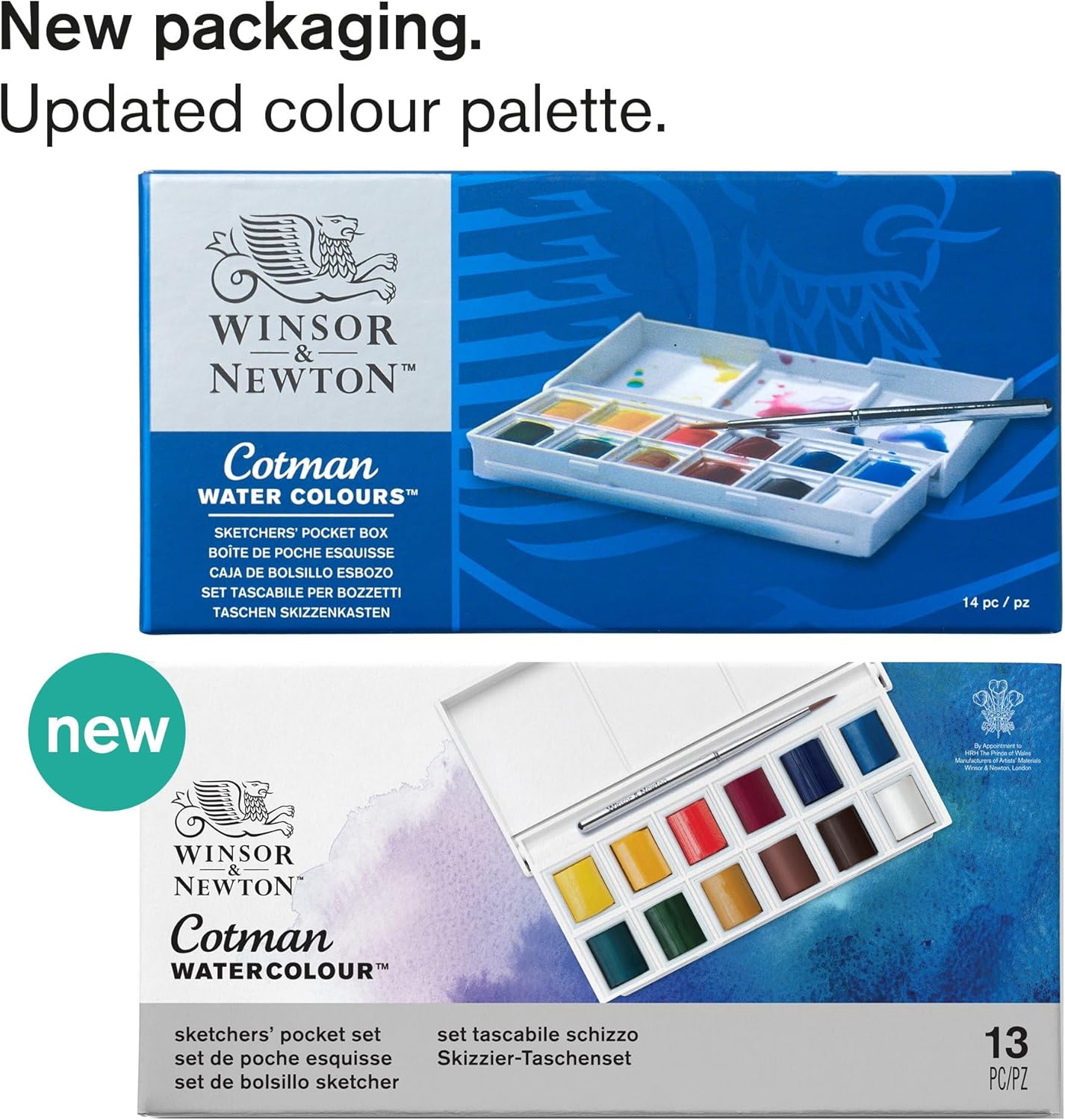
Winsor & Newton Cotman Sketchers’ Pocket Set is the benchmark that every other set on this list gets compared against — often literally, in owner reviews. Cotman is Winsor & Newton’s student-grade line, meaning the pigments are formulated to student-grade lightfastness and some colours use hue replacements (pigment blends that approximate an expensive single pigment). The tin is famously sturdy, the fold-out mixing palette is genuinely well-designed, and the colour selection is conservative and educational. Per Jacksons Art Supplies’ Student Watercolour Comparison Guide, the transparency of student-grade Cotman pigments is a genuine teaching asset — you can see how watercolour is supposed to behave when glazing.
Royal Talens Van Gogh Pocket Box sits in the same student-grade price bracket as Cotman in most Australian markets, but owners who’ve switched between the two consistently report the Van Gogh pigments feel richer and creamier out of the pan — less coaxing required to get a saturated wash. The box includes three more pans than the standard Cotman configuration, and the built-in palette is larger. Per Maker and Student’s Travel Watercolour Sets Reviewed: What Buyers Actually Think, Van Gogh owners often frame it as better value per pan at equivalent retail pricing.
MeiLiang 36-colour travel set is the outlier here: a budget-entry set with 36 half-pans rather than the 12–24 found in the sets above. Owners who also own Cotman sets describe MeiLiang as vibrant and “not chalky” — a meaningful compliment — but flag that it behaves differently, with a slightly more opaque quality (less light-transmitting) that changes how layering works. This isn’t a flaw, but it is a different tool.
Daler Rowney Aquafine Travel Set is the British student-grade option, and owners photograph it alongside Cotman, Van Gogh, and other sets in a way that signals this audience collects and compares rather than buying once. Repeated compliments across aggregated reviews centre on pigment density (the paint feels concentrated, not watery) and smooth application — the paint releases from the pan evenly without dragging.
By the Numbers
| Set | Pan count | Approx. AU retail (2026) | Grade | Brush included |
|---|---|---|---|---|
| Cotman Sketchers’ Pocket | 12 half-pans | ~$45–$55 | Student | Round nylon |
| Van Gogh Pocket Box | 15 half-pans | ~$45–$60 | Student | Round synthetic |
| MeiLiang 36-colour | 36 half-pans | ~$25–$35 | Budget/entry | Round nylon |
| Daler Rowney Aquafine | 12 half-pans | ~$40–$50 | Student | Round nylon |
Pricing sourced from Australian retail aggregates, May 2026. Freight from interstate suppliers can add $8–$15 for orders under a typical free-shipping threshold.
Pigment Quality: Where the Real Differences Live
The single most important variable in any watercolour set is pigment — specifically transparency, saturation, and lightfastness (how resistant a colour is to fading under light exposure over time).
Artists Network’s Understanding Watercolour Transparency and Pigment Ratings notes that transparency is not just an aesthetic preference; it determines whether you can layer colours to create depth or whether you need to leave white paper for highlights. Opaque or semi-opaque paints behave more like gouache — which is fine if that’s your intent, but disorienting if you’re learning classic watercolour technique.
Cotman: Transparent, Teachable, Minimal
Cotman earns its reputation here. Owners consistently report that the pigments are genuinely transparent — you can glaze three or four layers and the paper still reads through. Some colours are hue replacements (the pigment code on the pan identifies these), but the handling qualities are consistent and predictable, which is exactly what a developing practitioner needs. The tradeoff is that the colour range of a 12-pan set is deliberately minimal, pushing you toward mixing skills rather than out-of-the-pan convenience. Per Jacksons Art Supplies’ Student Watercolour Comparison Guide, this restraint is intentional and educationally sound for practitioners building foundational technique.
Winsor
$20.08
In stock on Amazon
Check price on AmazonVan Gogh: Richer Pigment, More Pans
Van Gogh closes the gap on Cotman in pigment richness without obviously sacrificing transparency. Owner reports across multiple platforms consistently describe the paint as “creamy” — a shorthand for pigment that releases easily and moves fluidly on wet paper. The extra three pans in the standard pocket configuration mean more colour flexibility without the same commitment to mixing. Maker and Student’s Travel Watercolour Sets Reviewed: What Buyers Actually Think aggregates owner sentiment placing Van Gogh slightly ahead of Cotman on pigment richness while noting the two sets are close enough that the choice often comes down to palette design rather than paint quality.
Winsor
$20.08
In stock on Amazon
Check price on AmazonMeiLiang: Vibrant but Opaque-Leaning
MeiLiang is the useful wild card. The vibrancy is real — owners who expected a muddy budget set often report surprise at the saturation — but the slightly opaque-leaning quality means it’s a genuinely different medium to work with. For practitioners building layering skills, this matters. For someone who wants to produce bold, graphic sketches quickly, it’s often described as more forgiving. Artists Network’s overview of pigment behaviour in student-grade and budget sets notes that opacity variance between price tiers is expected and not inherently a defect — it reflects different pigment loading and filler ratios.

Daler
$20.00
In stock on Amazon
Check price on AmazonDaler Rowney Aquafine: Dense Pans, Smooth Release
Daler Rowney Aquafine sits closer to Cotman in behaviour — well-behaved, transparent-tending pigments — with slightly denser pan fills that owners report as lasting noticeably longer before pans hollow out. Wirecutter’s The Best Watercolour Paints identifies pan fill depth as an underrated factor in long-term value for frequent travellers, and Aquafine performs well on this measure relative to its price point.
Winsor
$20.08
In stock on Amazon
Check price on AmazonPalette Design and the Mixing Area Problem
Here’s a tradeoff that rarely shows up in marketing copy but dominates owner reviews: the mixing palette included with each set.
Watercolour mixing requires space — a large, clean area of white surface where you can blend colours into a wash without immediately contaminating it. Most pocket sets fail this test badly, squeezing a postage-stamp-sized palette into a corner of the tin lid.
Cotman: Best-in-Class Fold-Out Palette
Cotman is the outlier in a good way. The Sketchers’ Pocket tin unfolds to reveal a mixing area that multiple owners describe as genuinely usable — not generous, but large enough for a proper wash. This is one of the most consistent compliments in Cotman reviews and is a real differentiator for daily practice. Jacksons Art Supplies’ Student Watercolour Comparison Guide specifically calls out the Cotman tin design as the practical benchmark in this price bracket.
Winsor
$20.08
In stock on Amazon
Check price on AmazonVan Gogh: Wider Palette, Different Shape
Van Gogh counters with a larger total palette footprint — the bigger tin required to house 15 pans also provides more lid space — though owner reviews note it’s shaped differently: wider and shallower. This suits some painters’ mixing habits and frustrates others. The consensus from Maker and Student’s aggregated review is that Van Gogh’s palette is adequate to good rather than the standout that Cotman’s fold-out design represents.
Winsor
$20.08
In stock on Amazon
Check price on AmazonMeiLiang: Supplementary Palette Required
MeiLiang’s mixing palette is the weakest point in the set. With 36 pans taking up most of the tin real estate, what’s left for mixing is minimal. In practice, many MeiLiang owners report using a separate ceramic palette tile or a folded paper plate — which is fine, but defeats the purpose of a self-contained pocket kit. Budget buyers should factor in the small additional cost of a ceramic mixing tile when pricing MeiLiang against the other sets.
Daler
$20.00
In stock on Amazon
Check price on AmazonDaler Rowney: Functional but Unremarkable
Daler Rowney lands in the middle — adequate rather than inspired. The palette space is sufficient for single-colour washes but limiting for complex mixes, and owner reviews rarely single it out as either a strength or a weakness.
Winsor
$20.08
In stock on Amazon
Check price on AmazonThe brush situation: Across all four sets, owner consensus is unambiguous. The included brush is functional for testing colours straight out of the tin and essentially useless for serious painting. Every practitioner-level reviewer treats the included brush as disposable and recommends pairing any of these sets with a quality travel brush. This is not a knock on any particular set; it is an industry-wide reality of pocket watercolour kits at this price tier.
Plein Air Reality: Which Set Actually Travels Well?
Plein air painting — painting outdoors, on-location, often standing up or perched on a small stool — imposes different requirements than studio practice. You want a tin that opens one-handed, a palette that functions in direct sunlight without glare, and pans that don’t dry out and crack after a few outdoor sessions.
Cotman and Van Gogh: Built for the Long Haul
Cotman’s metal tin is consistently praised for durability. Owners report years of use without the hinge failing or the tin warping, and the magnetic pan holders keep pans in place during travel. The small colour range is actually an asset for plein air work, where speed of mixing is more valuable than palette breadth. Van Gogh is similarly well-built, and the extra pans are genuinely useful outdoors where mixing time is limited — fewer mixed colours means faster execution. For committed outdoor practice across a full Australian summer, both tins represent reliable long-term investments.
Winsor
$20.08
In stock on Amazon
Check price on AmazonMeiLiang: Lightweight but Fragile
MeiLiang’s plastic construction is the honest tradeoff at its price point. The tin is lighter, which is a genuine advantage on long walks, but multiple owners note the lid mechanism feels less confidence-inspiring over repeated daily use. For occasional outings it is fine. For a committed plein air practice, the Cotman or Van Gogh tin is the more durable choice. Wirecutter’s The Best Watercolour Paints notes that build quality in budget travel sets often reveals itself slowly — through hinge wear and pan retention failure — rather than immediately on first use.
Daler
$20.00
In stock on Amazon
Check price on AmazonDaler Rowney: Underrated for Dry Conditions
Daler Rowney performs solidly outdoors; the denser pan fills mean less frequent reconditioning (misting pans with water before you start) in the dry conditions common across much of inland and northern Australia. It is a quietly capable outdoor companion that owner reviews consistently underrate because it lacks a standout feature to point to.
Winsor
$20.08
In stock on Amazon
Check price on AmazonFrequently Asked Questions
Is MeiLiang good enough to replace Cotman for regular practice?
For vibrant, confident sketching — especially if you work in a bolder, more graphic style — MeiLiang is a legitimate daily driver and the 36-pan range reduces the need for mixing. For classical watercolour technique built on transparent layering and glazing, Cotman’s handling characteristics are more instructive, and the difference matters when you’re actively building skill. The honest answer is: use MeiLiang alongside Cotman rather than instead of it, and let each set teach you something different.
Which of these sets has the most usable mixing area?
Cotman, consistently. The fold-out palette design in the Sketchers’ Pocket tin is the most frequently cited practical advantage in owner reviews, and it’s the first thing practitioners mention when comparing the four sets side by side.
Are any of these sets worth buying if you already own a larger studio set?
Yes — with a specific use case in mind. The value of a pocket set for a studio painter isn’t colour range but friction reduction. A tin that’s always in your bag means you actually paint when inspiration strikes, rather than setting up your studio kit. Cotman or Van Gogh are the strongest choices here because their pigment behaviour is close enough to professional-grade watercolours that skills transfer cleanly, as Artists Network’s Understanding Watercolour Transparency and Pigment Ratings discusses in the context of student-to-professional grade transitions.
How do these compare for plein air painting specifically?
For committed outdoor practice: Van Gogh’s extra pan count and usable palette make it the stronger plein air tool when tin durability is a priority. Cotman’s restricted palette is actually a discipline advantage for rapid plein air work — fewer decisions, faster execution. MeiLiang is best reserved for urban sketching where you’re stationary and can supplement with a separate palette tile. Daler Rowney is underrated for outdoor use; the denser pans perform well in the dry conditions common across much of Australia.
The Decision Rule
If you’re choosing one set and the budget is equivalent across all four options: Van Gogh for pigment richness and pan count, Cotman for palette design and pigment transparency that builds good habits. They’re different enough that many practitioners end up with both — and that’s a reasonable outcome, not a failure of decision-making.
If price is the primary constraint: MeiLiang is the honest recommendation, as long as you know you’re getting a different kind of tool, not a cheaper version of the same one.
If you’re buying for a plein air practice you intend to sustain across years of outdoor painting, the Cotman or Van Gogh tin’s build quality is worth the premium over MeiLiang’s plastic construction. Buy once, paint often.