Acrylic paint — a water-based paint that dries to a flexible, water-resistant film — sits at the centre of more buying confusion than almost any other art supply. The paint itself has not changed much in decades. What has changed is the sheer number of tiers on the shelf, from a $12 Mont Marte set at an Australian craft chain to a $55 single tube of Golden Heavy Body at a specialist supplier. The gap between those two products is real, but it is not always as important as the marketing implies. Grade — the industry shorthand for how much pure pigment (colour particle) is loaded into each tube versus cheaper filler — is the core variable that separates student sets from professional ones. Understanding it means you stop buying the wrong product for the job, at either end of the price scale.
This article is a frank comparison across the main tiers available in Australia as of mid-2026. It names the tradeoffs, shows the math, and ends with a clear decision framework so you can stop second-guessing and start painting.
What the Tiers Actually Mean (and What They Don’t)
The industry broadly divides acrylics into three grades: student, artist/professional, and a contested middle ground often called open stock or good colour. The label on the tube tells you surprisingly little — what matters is pigment load, lightfastness rating, and body (the viscosity or thickness of the paint as it comes from the tube).
Pigment load is the ratio of pigment to binder and filler. A student-grade paint might achieve a particular hue using two or three cheaper pigments blended together; a professional colour usually hits the same hue with a single high-quality pigment. This matters for mixing: fewer pigments in the mix means cleaner, more predictable results when you blend two colours together. It also matters for longevity.
Lightfastness — a rating (usually I or II on the ASTM standard scale) describing how resistant a colour is to fading under light exposure — is where student grades often cut corners on specific colours, particularly fluorescents and some organic hues. The Jacksons Art Acrylic Paint Buyer’s Guide, published by jacksonsart.com, notes that lightfastness ratings vary significantly even within a single student-grade range, and recommends checking individual colour data sheets before purchasing colours destined for sold or exhibited work.
Body describes thickness. Heavy body paint holds the peak of a palette knife stroke. Soft body flows more easily. Most student sets are soft-to-medium body by default; professional ranges offer deliberate choices across the spectrum.
None of this means student grade is categorically inferior for all purposes. It means it is optimised for different things: volume, affordability, and the freedom to experiment without watching the cost per stroke.
The Three Tiers: A Practical Comparison
Student Grade — Mont Marte and ARTEZA
Mont Marte
Liquitex
$19.49
In stock on Amazon
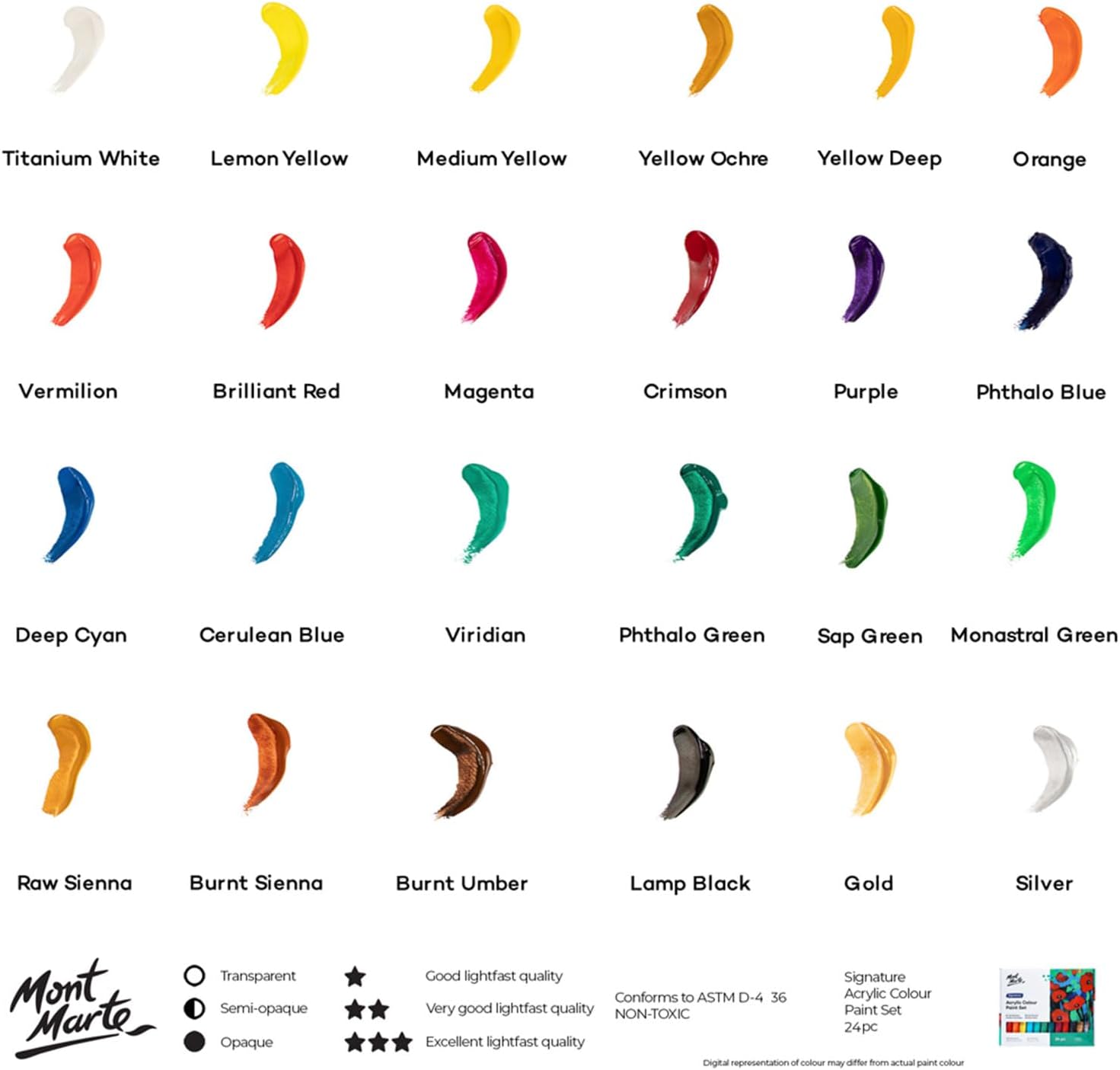
Check price on AmazonMont Marte is an Australian-founded brand (manufactured offshore but headquartered in Brisbane) with wide availability at Spotlight, Riot Art & Craft, and many online Australian retailers. It is the entry point for the majority of Australian hobbyist painters, and for good reason.
One genuinely useful quality noted by working artists — not just students — is the semi-matte finish. Mont Marte’s surface dries with enough tooth (texture) that you can draw on top with pencil, charcoal, or ink without the medium sliding around. Artists Network’s overview of acrylic surface preparation, available at artistsnetwork.com, confirms that a matte or semi-matte ground accepts dry media far more readily than a high-gloss finish, making this a genuine functional advantage for mixed-media work rather than simply a consolation prize.
The limitation is pigment consistency. The reds and organic yellows in student sets almost universally use lower-lightfastness pigments to hit the price point. For practice work, studies, or underpainting — fine. For finished work that needs to last, check the individual colour’s data sheet. The Craft Council of Australia’s Materials and Practice Resources, published at craftcouncil.org.au, recommends that practitioners at any level verify lightfastness before using a colour in exhibition-bound work.
When Mont Marte is the right call: You are building foundational skills, working large, exploring colour mixing without financial anxiety, or using acrylic as a ground layer that will be worked over extensively. Also: mixed-media work where the semi-matte surface is genuinely useful.
Liquitex
$19.49
In stock on Amazon
Check price on AmazonARTEZA 60-Colour Sets
Liquitex
$19.49
In stock on Amazon
Check price on AmazonARTEZA’s large-format sets have built a significant following in Australia. The 60-colour set’s standout quality is its glossy, oil-like sheen and strong single-coat opacity — owners repeatedly cite the ability to lay down a solid colour field in one pass without streaking.
The tradeoff is the same as Mont Marte at the edges: pigment complexity in mixed hues and variable lightfastness across the range. The large colour count also means you are accepting the manufacturer’s mixing decisions rather than building your own palette from primaries — a convenience in the short term, a potential limitation as your colour theory develops.
When ARTEZA is the right call: You want immediate coverage across a wide colour range, work in formats where a glossy finish is an asset (illustration-style work, decorative painting), and are still at the stage of exploring rather than archiving.
Liquitex
$19.49
In stock on Amazon
Check price on AmazonMiddle Tier — Liquitex BASICS
Mont
$23.99
In stock on Amazon
Check price on AmazonLiquitex BASICS occupies a genuinely interesting position. It is marketed as student grade and priced accordingly, but manufactured by a brand (Liquitex, now under Colart) with professional-grade credentials. The BASICS range uses simplified pigment formulas relative to Liquitex’s own Heavy Body and Soft Body professional lines, but the manufacturing standards and quality control are noticeably tighter than the entry-tier sets above.
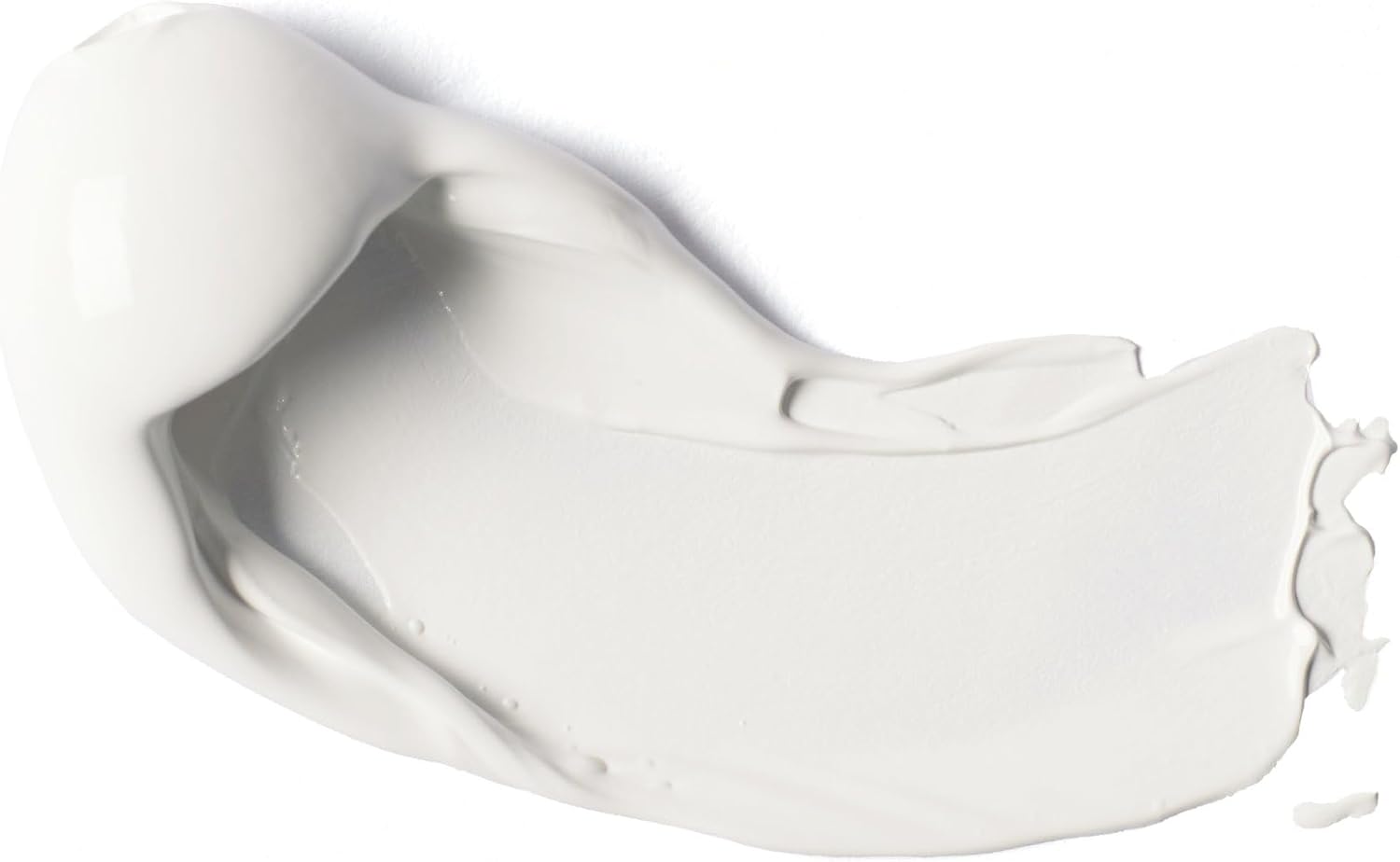
The 250ml Titanium White in the BASICS range has become something of a reference product among intermediate painters in Australia. Owners consistently describe exceptional coverage — white over brown paper without a second coat is a specific claim that appears repeatedly. This reflects a higher pigment load in the white specifically, likely because Titanium White is inexpensive enough to load generously even in a student formula.
The value proposition is volume: BASICS tubes are large. For painters working through significant quantities on larger canvases, the cost-per-millilitre calculation strongly favours BASICS over professional tubes, even accounting for needing slightly more paint per application to achieve equivalent opacity.
The real difference between BASICS and Heavy Body: BASICS is a soft-to-medium body, lower pigment load, simplified colour palette designed for volume work. Heavy Body is a stiff, peak-holding paint with higher single-pigment formulations, consistent lightfastness ratings across the range, and colour mixing behaviour that is more predictable and stable. You use roughly 30–40% less Heavy Body to achieve the same result — a figure that meaningfully closes the price gap per finished painting when you run the math.
When Liquitex BASICS is the right call: You are an intermediate painter working large, not yet at a stage where archival quality is mandatory, and you want the reliability of a major brand at a volume price. Ideal as a base layer under professional colours.
Mont
$23.99
In stock on Amazon
Check price on AmazonProfessional Tier — Liquitex Heavy Body and Golden Heavy Body
Liquitex
$61.89
In stock on Amazon
Check price on AmazonBy the Numbers
| Product | Approx. AU price per 59ml equiv. | Relative pigment load vs. BASICS | Lightfastness |
|---|---|---|---|
| Mont Marte (large set, per-colour) | ~$1–2 | Baseline | Varies — check per colour |
| Liquitex BASICS (per 200ml) | ~$12–16 | 1.2× | Mostly I–II |
| Liquitex Heavy Body (59ml) | ~$18–28 | 1.8–2× | I–II across range |
| Golden Heavy Body (59ml) | ~$22–32 | 2–2.2× | I–II across range |
Price ranges reflect mid-2026 Australian retail. Professional tube prices in Australia run roughly 15–25% above UK RRP due to freight and import margin.
Liquitex Heavy Body
Owners describe a disciplined economy with Heavy Body — the considered approach of someone who knows what the paint can do and measures accordingly. The higher pigment load means smaller quantities go further, the stiff body holds impasto texture reliably, and the colour mixing behaviour is consistent enough to build systematic palettes around.
Artists Network’s guide to acrylic colour mixing, available at artistsnetwork.com, identifies single-pigment formulations as the primary driver of clean mixing results. Heavy Body’s published colour formulas lean heavily on single-pigment colours, which is why intermediate painters making the switch report a noticeable improvement in how secondary and tertiary mixes turn out.
Pebeo’s professional-grade range is also worth noting here. While a smaller presence in the Australian market, Pebeo’s pigment accuracy is cited by colour-focused practitioners as reliable for building systematic colour relationships across a body of work — a calibration consideration that matters to artists working with structured palettes.
Golden Heavy Body
Golden Heavy Body is the reference standard for many professional painters globally and in Australia, stocked through specialist fine art retailers. Owner reviews consistently reflect considered, long-term purchases — people who have researched before committing, who return to specific colours repeatedly, and who cite the consistency between batches as a non-negotiable.
The lightfastness documentation from Golden is among the most transparent in the industry. Every colour in the range carries a published ASTM lightfastness rating, and single-pigment formulations are clearly labelled on the tube. The Jacksons Art Acrylic Paint Buyer’s Guide (jacksonsart.com) summarises Golden’s documentation practices as a benchmark for what professional-grade transparency should look like across a full colour range.
When Golden Heavy Body is the right call: You are making work for sale, exhibition, or archiving. You are mixing colours systematically and need predictable results. You are at a stage where the cost-per-painting math — accounting for smaller quantities needed — genuinely competes with cheaper alternatives.
Is Golden worth it for a beginner? Almost certainly not yet, and that is not a criticism. The benefits of professional paint are only accessible once you have enough brush control and colour knowledge to notice the difference. Buying Golden to learn on is like buying a professional camera to learn photography — the investment runs ahead of where the skill can use it. Wirecutter’s Best Art Supplies for Beginners guide (wirecutter.com) makes a similar point: prioritise volume and practice surface at the learning stage, and upgrade materials as the work demands it.
Liquitex
$61.89
In stock on Amazon
Check price on AmazonCan You Mix Student and Professional Grade Acrylics?
Yes, with one important caveat: you can mix paints across grades in the same session without compatibility problems — they are all acrylic polymer emulsions and will bind together. The issue is colour mixing behaviour. Student-grade paints with multi-pigment formulas will muddy faster when mixed with professional single-pigment colours. The result is not dangerous, just potentially frustrating and less predictable.
A practical approach many intermediate painters use is a professional-grade primary palette (the colours they mix from) and student-grade neutrals and grounds (white, black, grey, and large-format coverage). This hybrid approach is referenced in Artists Network’s intermediate acrylic guides (artistsnetwork.com), which note that keeping your key mixing colours to single-pigment formulations has a disproportionate effect on overall mixing clarity regardless of what other paints are on the palette.
Frequently Asked Questions
Is Mont Marte actually professional quality or just good for the price? Good for the price, with one genuine professional-adjacent quality: the semi-matte finish that accepts drawing media on top. For finished, sold, or exhibited work, the pigment load and lightfastness limitations are real. For practice, studies, teaching, mixed media underpainting, and large-scale exploration, it does the job honestly.
What is the real difference between Liquitex BASICS and Heavy Body? Body (thickness), pigment load, and mixing behaviour. BASICS is softer and more fluid, uses more complex (multi-pigment) colour formulas, and requires more paint for equivalent coverage. Heavy Body is stiffer, more pigment-dense, and mixes more cleanly. The price-per-result gap is smaller than the price-per-tube gap once you account for usage rates.
Can you mix student-grade and professional-grade acrylics together? Yes, they are chemically compatible. The practical limitation is colour mixing predictability — student colours with complex pigment formulas muddy faster. Use professional grades for your primaries if clean mixing matters; student grades are fine for grounds, underpainting, and neutrals.
Is Golden Heavy Body worth the price for a beginner? Not yet. The benefits — consistent single-pigment mixing, archival lightfastness, reliable batch-to-batch colour — only become accessible once you have enough skill to notice and use them. Spend the difference on practice surface and volume paint now; revisit Golden when you are working toward finished pieces.
Why do professional acrylic tube sizes seem so small compared to student sets? Because you use less. The higher pigment load means a 59ml professional tube delivers coverage closer to a 100–150ml student tube in practical use. The perception of small size is real but the per-painting cost is closer than it looks.
The Decision Rule
If you are still building technique and working large: Mont Marte or Liquitex BASICS. Keep the cost per learning session low. The semi-matte finish of Mont Marte has a specific advantage for mixed-media work worth knowing about.
If you are producing finished work at an intermediate level: Liquitex BASICS for grounds and coverage, Liquitex Heavy Body for your primary mixing colours. Pebeo’s professional range is worth evaluating if colour accuracy in mixing is your primary concern.
If you are making work for sale, exhibition, or archival purposes: Golden Heavy Body is the reference standard. The lightfastness documentation alone justifies the price for work that needs to last. The cost-per-painting math, once you account for pigment density, is less painful than the tube price suggests.
The grade of paint you buy signals something about where you are — but it is not a gatekeeping requirement. The best paint is the one that matches what you are actually making today, not what you aspire to make eventually. Start there, and upgrade when the work demands it.