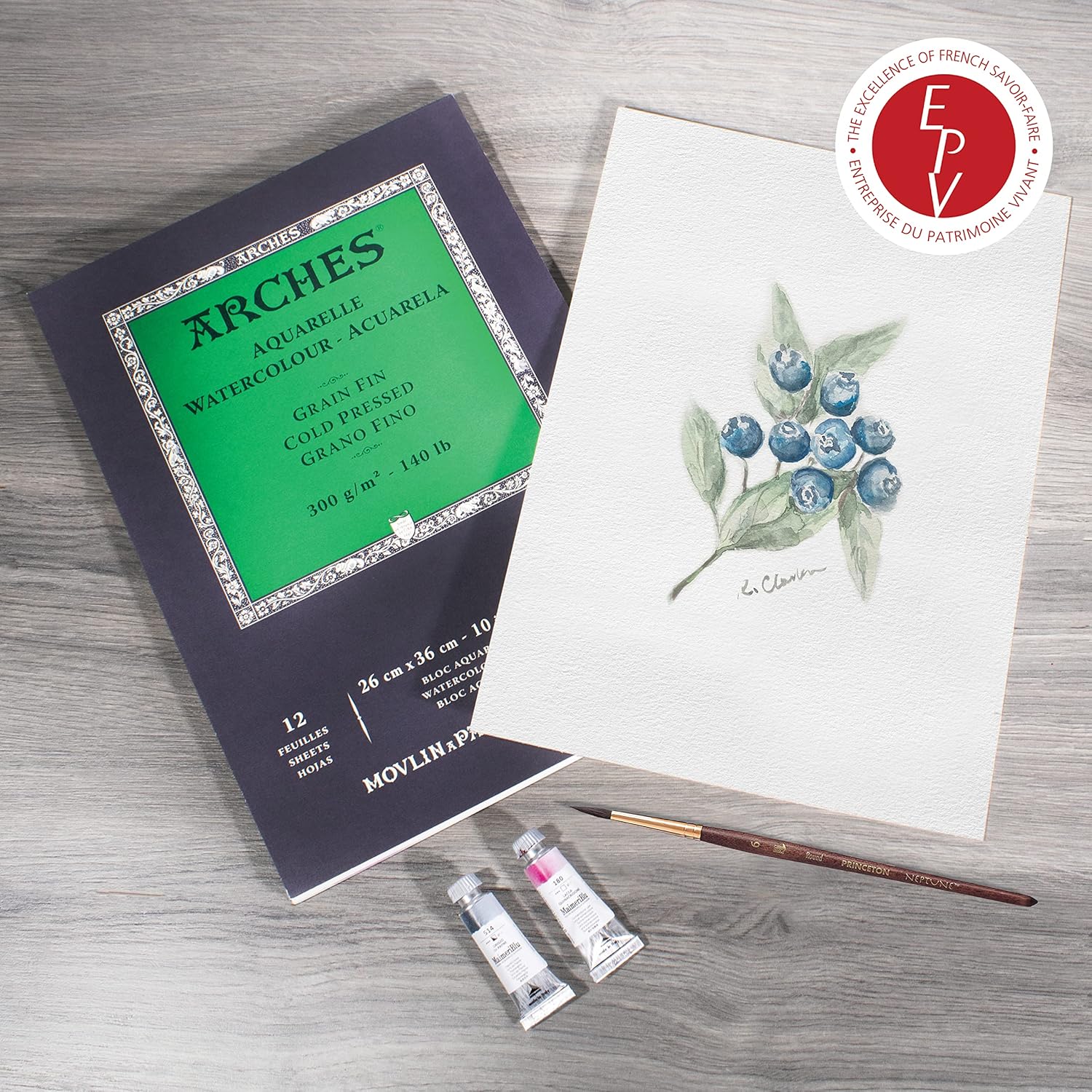
If you’ve ever finished a watercolour painting only to find the paper has warped into a landscape of its own — ridges and valleys where you wanted flat colour — you’ve already discovered why paper weight matters. GSM stands for grams per square metre: it’s simply a measure of how heavy (and therefore how thick and absorbent) a sheet of paper is. The higher the number, the more water it can hold without distorting. Watercolour is an unusually wet medium, and the paper you choose is doing real structural work every time you lay down a wash (a broad, wet stroke of diluted pigment). Choose too light a paper and the water wins. Choose well and the paper becomes an invisible collaborator. This guide will walk you through the core weight and surface options, show you where the meaningful thresholds sit, and tell you exactly what to buy at each stage of your practice — with Australian pricing and local sourcing context throughout.
The GSM Threshold That Actually Matters
The market offers watercolour paper across a wide range — from 190gsm student sheets up to 640gsm heavyweight blocks — but the number that separates frustrating from functional is 300gsm (approximately 140lb in the old imperial system still used on some imported packaging).
Here’s why that threshold is structural, not arbitrary. Below 300gsm, paper fibres don’t have sufficient mass to absorb and release water evenly. A 190gsm or 200gsm sheet will cockle (form irregular ripples) under a single wet wash unless it has been pre-stretched — a process of soaking the paper, taping it to a board, and letting it dry taut before you paint. Stretching works, and many skilled painters still do it, but it adds 30–45 minutes of setup per session and introduces failure points (tape lifting, uneven tension, mould if the paper doesn’t dry fast enough in humid Australian summers).
At 300gsm, most papers have enough body to absorb a moderate amount of water without stretching, especially when used in a block format (sheets glued together on all four edges, which prevents buckling during painting). At 640gsm, you can flood a sheet repeatedly without any prep. For most intermediate practitioners working in A3 or smaller formats, 300gsm is the practical sweet spot: it handles wet-on-wet techniques (applying pigment to a damp surface for soft, diffused edges) without the hassle of stretching, and it’s available from every serious supplier in Australia.
By the numbers:
| GSM | Typical use | Stretch required? | AU price per sheet (approx.) |
|---|---|---|---|
| 190–200gsm | Practice, sketching | Yes, for wet washes | $1–$3 |
| 300gsm | All-purpose, serious work | No (blocks), marginal (loose) | $3–$10 |
| 425gsm | Extended wet work, large format | No | $10–$20 |
| 640gsm | Studio/exhibition, maximum wet | No | $18–$40+ |
Prices current as of mid-2026 for A4–A3 equivalents from Australian specialist retailers; individual sheet pricing varies significantly by brand and whether purchased loose or in a block.
Surface Texture: Cold Press, Hot Press, and Rough — and Why Cold Press Earns Its Reputation
GSM tells you how much water a paper can handle. Surface texture tells you what happens to the paint once it’s there. There are three main surfaces, and the terminology comes from the papermaking process itself.
Hot press (HP) paper is pressed through heated rollers, producing a very smooth, almost plate-like surface. It’s excellent for detailed work, fine line, botanical illustration, and pen-and-wash — but it offers very little tooth (the microscopic texture that grips pigment), so washes can dry unevenly and granulating pigments (those that separate into visible particles, like ultramarine or burnt sienna) will granulate intensely. The smooth surface rewards precision but punishes hesitation.
Cold press (CP), also called NOT surface in British and European papermaking tradition (meaning “not hot pressed”), is the universal workhorse. It has a moderate, even texture — enough tooth to grip and hold a wash, enough smoothness to allow controlled brushwork. According to the Artists Network overview of watercolour paper selection, cold press is the surface recommended for most practitioners because it handles the widest range of techniques: wet-on-wet, wet-on-dry, layered glazing, and dry brushwork (dragging a relatively dry brush across the surface to catch only the raised texture). If you’re building your practice and painting across multiple subjects, cold press at 300gsm is the single best default decision you can make.
Rough paper has a pronounced, irregular texture created by air-drying rather than pressing. The texture creates dramatic dry-brush effects and adds physical energy to loose, expressive work, but it makes fine detail difficult and can feel uncontrollable until you’ve built real intuition for how individual colours settle into the valleys.
The combination of 300gsm + cold press is not an accidental industry default. It’s the result of papermakers and painters collectively landing on what forgives the most errors while still rewarding skill development. Jackson’s Art Supplies’ comprehensive watercolour paper guide makes this pairing the centrepiece of their intermediate-practitioner recommendations, noting that the texture-to-absorbency balance at this spec handles both transparent layering and opaque lifting (removing paint from a wet surface) with consistent results.
Cotton vs Wood Pulp: The Second Decision You Can’t Ignore
Once you’ve decided on 300gsm cold press, the next split is fibre content — and this one has real long-term consequences.
Wood pulp (cellulose) papers are made from processed timber fibres. They’re significantly cheaper to manufacture, which is why student-grade papers like Winsor & Newton Cotman and Canson Montval sit at this end. They’re perfectly adequate for practice, colour mixing experiments, and work you don’t intend to frame. The critical limitation is acid content: wood pulp papers contain lignin, which yellows and becomes brittle over time as it oxidises. For work you care about keeping — or selling — this matters.
Cotton rag papers are made from 100% cotton fibres (historically from textile offcuts; now purpose-grown). Cotton is naturally acid-free and pH-neutral, meaning it won’t self-destruct over decades. The fibre structure is also fundamentally different: cotton fibres are longer, more flexible, and swell more evenly when wet, which is why 300gsm cotton paper genuinely handles wet work differently from 300gsm cellulose at the same weight. The surface feels more responsive; wet-on-wet blooms (where a drop of wet paint spreads into a damp area, creating flower-like diffusion) behave more predictably because the fibre absorbs evenly.
The Hahnemühle product guide for their watercolour range explicitly describes this difference, noting that their 100% cotton papers offer superior wet strength and dimensional stability compared to blended or cellulose alternatives at equivalent weights.
In Australian terms, the price gap is meaningful but not prohibitive:
- Winsor & Newton Cotman 300gsm (cellulose), A4 pad: approximately $18–$24 from Spotlight or Eckersley’s
- Fabriano Artistico 300gsm cold press (100% cotton), 20-sheet block: approximately $55–$75 from Art Scene, Jackson’s AU, or Eckersley’s
- Hahnemühle Britannia 300gsm cold press (100% cotton), 10-sheet block: approximately $38–$52
The Fabriano Artistico is the paper that consistently appears in advanced technique guides for a reason: the Fabriano technical data sheets specify a traditional internal sizing (a gelatin treatment that controls how quickly water penetrates the surface) that gives painters extra working time before a wash dries — critical for wet-on-wet work. Owners and instructors consistently report this makes colour lifting and reworking significantly more forgiving than unsized or lightly-sized alternatives.
Australian Sourcing: What It Actually Costs in 2026
One practical reality for Australian makers: the international brands that dominate professional watercolour practice (Fabriano, Hahnemühle, Arches, Saunders Waterford) are all imported, and the AU dollar’s position against the Euro and GBP in mid-2026 continues to make direct-from-Europe purchasing uneconomical once freight is factored in. The price premium over UK RRP typically runs 30–50% once landed, and that gap hasn’t narrowed meaningfully in the past 18 months.
The practical upside is that Australian specialist retailers have deepened their stocking of professional-grade papers. Eckersley’s Art & Craft, Art Scene, and Oxford Art Supplies (Sydney) all stock Fabriano Artistico blocks and loose sheets in multiple sizes. For those outside capital cities, online ordering from these same retailers typically runs $12–$18 standard freight, which is absorbed on orders over $60–$80 at most stores — meaning a 20-sheet block of Fabriano Artistico effectively ships free if you’re buying alongside other materials.
Arches 300gsm cold press (a French mould-made cotton paper that artists’ network reviews consistently place among the top three professional watercolour papers globally) is less consistently stocked in Australia than Fabriano or Hahnemühle, and tends to command a 15–20% premium over Fabriano Artistico at equivalent sizes. For most Australian practitioners, Fabriano Artistico represents better value-to-quality ratio than chasing Arches through specialty import.
The Decision Framework: If X, Then Y
Here’s the honest summary of what the numbers and sources point to:
If you’re painting regularly but still working through technique fundamentals — wet-on-wet control, basic glazing, understanding how your pigments granulate — buy Winsor & Newton Cotman 300gsm cold press in pad format. You’ll use paper faster than you think while learning, the cellulose surface is actually slightly more forgiving of overworking, and the cost lets you experiment without flinching.
If you’re past fundamentals and working on pieces you want to keep, frame, or sell, the decision is straightforward: move to Fabriano Artistico 300gsm cold press in block format. The cotton fibre, traditional sizing, and acid-free archival quality justify the price jump at this stage. Buy the block over loose sheets — the all-edge gum binding eliminates any cockle risk and removes stretching from your workflow entirely.
If you’re working large (A2 and above), doing extended wet work, or painting in humid coastal conditions where paper takes longer to dry and has more time to move, step up to 425gsm or 640gsm cotton. Hahnemühle’s heavier weights are reliably available through Australian specialist retailers and the dimensional stability at these weights is, per published manufacturer specifications, genuinely different from what 300gsm can offer under prolonged wet conditions.
The one decision that almost never makes sense for a practitioner past their first year: buying 200gsm or 190gsm paper and intending to stretch it. Stretching adds friction to every session. Paper at the right weight removes that friction. Spend the extra $3–$5 per sheet and paint more.