Choosing watercolour paper sounds simple until you’re standing in front of a shelf of pads wondering why a 9x12 and a half-sheet aren’t the same thing, or whether that pocket spiral pad will buckle the moment you lay down a wash. Watercolour paper — the textured, absorbent sheet designed to hold water-based paint without disintegrating — comes in a surprisingly wide range of sizes and bindings, and each format genuinely changes how you paint. The weight (measured in grams per square metre, or GSM — heavier means thicker and less prone to warping) and the binding (how sheets are held together in a pad, which affects whether you can remove a single sheet cleanly) matter just as much as the dimensions. This guide maps the main formats available in Australia, tells you what each is actually good for, and helps you decide when it’s worth cutting paper down versus buying the right size from the start.
| EDITOR'S PICKArches Watercolor Paper Pad | Mid-tierARTISTIC EYE Watercolor Pad 9x1… | Budget pickCanson XL Series Watercolor Pad | |
|---|---|---|---|
| Paper weight | 140 lb | 140 lb (300 gsm) | — |
| Surface | Cold press | — | — |
| Sheet count | — | 60 (2 x 30) | 30 |
| Binding | — | Glue bound | Foldover |
| Acid-free | — | ✓ | — |
| Price | $23.50 | $19.99 | $11.37 |
| See on Amazon → | See on Amazon → | See on Amazon → |
The Format Landscape: What’s Actually Available in Australia
Australian craft retailers stock watercolour pads in roughly four size categories. Understanding what each looks like in practice saves you from buying a pad that fights your workflow.
Pocket pads (approximately 3.5×5.5 inches / 9×14cm) These are genuinely small — smaller than a paperback novel. Reviewers of small spiral-bound pads in this range consistently emphasise compactness and portability, with one reviewer specifically noting they’re “perfect for inspired projects,” suggesting spontaneous, on-the-spot use rather than planned studio sessions. That’s an honest description of what they’re for: catching an idea, practising a colour mix, or painting outdoors when you can’t carry a full kit.
A5 and 5.5×8.5 inch pads (~14×22cm) The middle ground. Large enough to paint something with real compositional structure, small enough to slip into a bag. This is the format intermediate painters most often reach for when building a body of small studies.
9×12 inch pads (~23×30cm) The standard studio workhorse in Australia. This is what most people mean when they say “a watercolour pad” without further qualification. It’s big enough for finished work that can be framed at standard mount sizes, and it’s what most online tutorials assume you’re working on.
Full sheets and blocks (half-imperial, imperial, and beyond) A full imperial watercolour sheet is 56×76cm — significantly larger than a 9×12. Watercolour blocks (sheets glued on all four edges so they can’t warp during painting) are also available at various sizes, including 9×12. These are a different product category from spiral or glue-bound pads.
The Cutting-Down Question: When It Makes Sense and What to Watch For
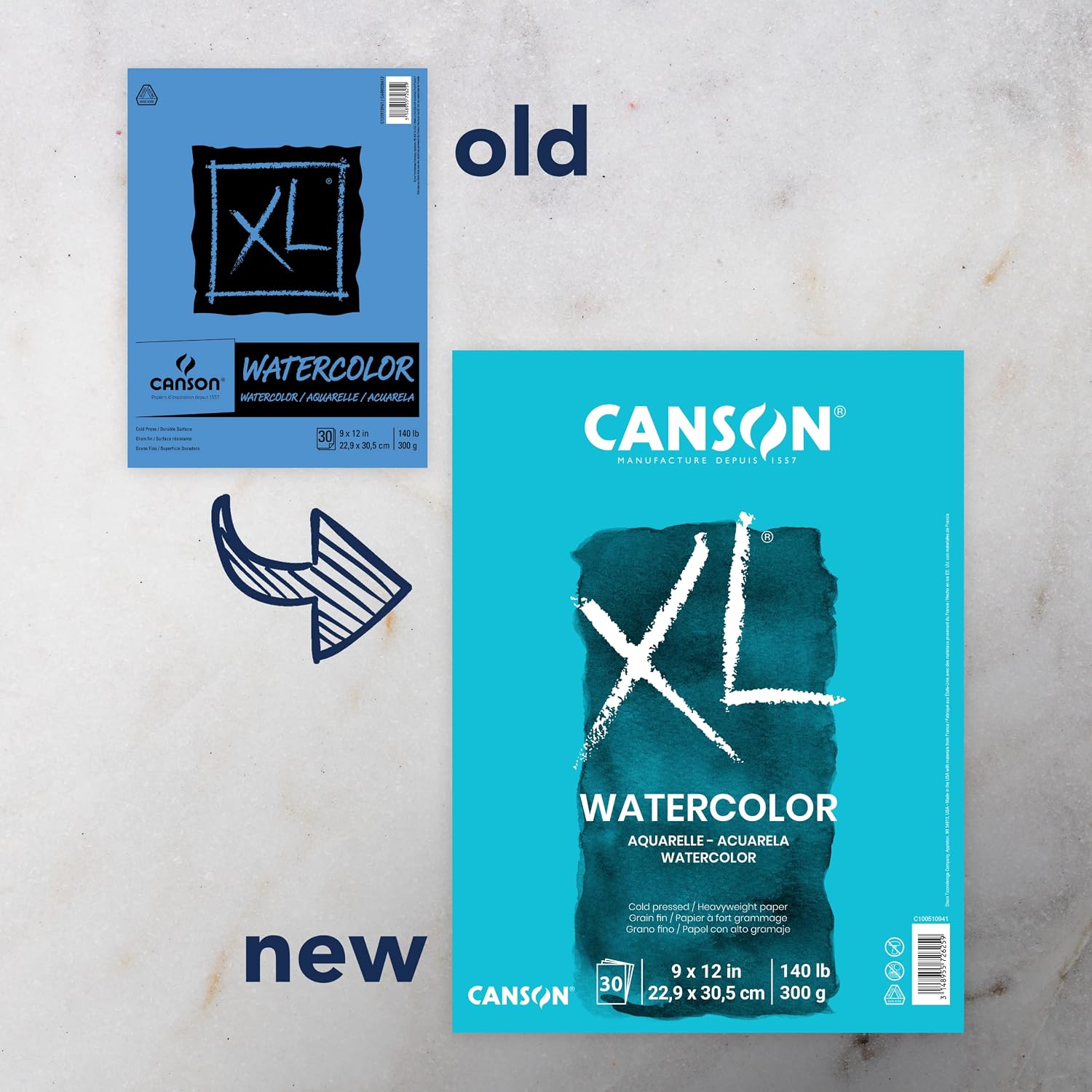
A recurring pattern in buyer reviews — particularly from Canson XL users — is cutting sheets down. Reviewers mention making bookmarks, testing colour swatches, and creating smaller studies from a single 9×12 sheet. One Soucolor pad reviewer specifically describes cutting their pad in half before painting. This isn’t a workaround: it’s a legitimate technique with a real logic behind it.
When cutting down makes sense:
- You want to try a new paper without buying a small pad separately
- You’re making small studies from a larger composition before committing
- You need an unusual size (bookmarks, tags, cards) that no pad format covers
- You’re rationing expensive cotton paper and want to practise on cellulose first
What actually changes at a cut edge: Cutting watercolour paper does not change how the surface accepts paint — the tooth (texture) and sizing (the internal coating that controls absorbency) remain intact across the sheet. The edge itself won’t fray on quality papers. However, cut paper that isn’t in a block needs to be stretched or taped before wet techniques, because it no longer has the tension of being bound. Reviewers of the Artistic Eye pad specifically praise sheets staying flat without tape — that behaviour comes from the block or pad binding holding tension, not from the paper itself. A loose cut sheet loses that advantage.
The honest trade-off: cutting down a 9×12 pad is economical and flexible, but if you’re regularly working small, a dedicated pocket or A5 pad is a better workflow. You spend less time preparing and more time painting.
Cellulose vs. Cotton: The Size Decision Is Really a Paper Grade Decision
The format question and the paper grade question are deeply connected. Here’s why: the paper grade you choose determines whether a given size is practical for your technique.
Cellulose paper (wood-pulp based — Canson XL, Soucolor, and similar entry-to-mid pads) is affordable, widely available in Australia, and perfectly capable for studies, practice, and learning. Reviewers consistently find it sufficient for flat washes and basic wet-on-wet. Its limitation is that it warps more aggressively under heavy water and doesn’t allow much lifting (removing wet paint to recover lights). On a 9×12 sheet with an ambitious wet-on-wet sky, cellulose paper needs to be stretched or used in a block — full stop.
Cotton paper (100% cotton rag — Arches, Fabriano Artistico, and the Fingraspuro cotton sheets that reviewers are increasingly flagging) absorbs and releases water more forgivingly because cotton fibres don’t swell the same way wood pulp does. Fingraspuro cotton paper reviewers specifically contrast it positively against pricier brands, noting it doesn’t pill — that is, the surface doesn’t ball up under repeated brush strokes, which is a critical failure mode when you’re reworking an area. Arches is positioned by reviewers as the unambiguous quality ceiling; no one disputes the result, only the price.
The practical implication for size selection:
| Paper type | Safe for loose 9×12 wet-on-wet? | Needs stretching for heavy washes? |
|---|---|---|
| Cellulose, 300gsm (140lb) | Borderline — warping likely | Recommended |
| Cotton, 300gsm (140lb) | Yes, usually | Often unnecessary |
| Cotton block (all-edge glued) | Yes | No — binding does the work |
Per the Jackson’s Art Supplies guide on understanding watercolour paper, 300gsm (140lb) is the minimum weight for wet techniques without stretching, and this applies more strictly to cellulose than cotton.
When to move from cellulose to cotton: The Artists Network guide on choosing watercolour paper suggests the transition point is when you’re consistently frustrated by the paper — not when you reach a particular skill level. Specific signals: you’re lifting paint and the surface is balling up; your washes are blooming inconsistently in ways you didn’t intend; you’re repainting edges and the paper is disintegrating. If none of that is happening, cellulose is serving you fine and a format upgrade (larger or blocked) will help more than a paper grade upgrade.
Binding Types and What They Mean for Your Practice
Glue-bound pads have sheets affixed at one edge. You paint on the top sheet and tear it off when finished. These are the most common format and the most versatile — they store flat, cost less per sheet, and let you remove work cleanly if the glue line is good quality.
Spiral-bound pads allow the pad to fold fully flat or back on itself, which is useful for painting at an angle (propped on a knee outdoors, for example). Reviewers of spiral pocket pads specifically value this for outdoor and travel work. The trade-off is that the spiral can catch on sleeves or equipment, and the sheets don’t detach as cleanly.
Blocks are sheets glued on all four edges, dried under tension. You paint on the top sheet, then slide a palette knife or letter opener along the gap to release the finished sheet. They genuinely prevent warping under wet-on-wet techniques without stretching. The limitation: you can only paint on one sheet at a time, and they’re heavier and pricier per sheet. For studio use at 9×12, a block is often the cleaner solution than buying a pad and stretching every sheet.
Foldover (or perfect-bound) pads are less common and functionally similar to glue-bound, but with a slightly thicker cover. Reviewers find them adequate for studio use but less portable than spiral.
Decision Rules: If X, Then Y
Here’s the honest decision frame for matching size and format to your current practice:
If you’re painting outdoors or in unpredictable locations → pocket spiral pad (3.5×5.5) for maximum spontaneity, or a bound A5 for slightly more compositional room. Spiral lets you fold the pad back cleanly at an angle.
If you’re building a body of studies → A5 or 5.5×8.5 glue-bound pad on cellulose. You’ll work through paper quickly enough that cotton isn’t cost-effective unless you’re close to the cellulose ceiling (pilling, excessive warping).
If you’re working wet-on-wet or doing anything ambitious with washes at 9×12 → cotton paper in a block. The block does the stretching for you, cotton tolerates the water, and you’re not fighting your materials mid-session.
If you want to cut down for smaller work → buy a 9×12 pad and cut deliberately, but tape cut sheets to a board before painting. Don’t assume a cut sheet will behave like a pad sheet.
If you’re frustrated by warping on your current 9×12 cellulose pad → try the same size in a cotton block before sizing up. The problem is usually paper grade and binding, not format.
Frequently Asked Questions
Does glue-bound watercolour paper need to be stretched or taped before painting? It depends on the paper weight and technique. Reviewers consistently find 300gsm (140lb) glue-bound pads adequate for light washes without taping, but heavy wet-on-wet work causes warping even at that weight on cellulose sheets. If you’re working wet, either tape the sheet to a board, stretch it first (wet the sheet, let it expand, then tape while wet), or switch to a block where all-edge gluing handles tension for you.
Is top-spiral binding or foldover binding better for painting at an angle? Spiral. Foldover pads don’t open flat enough to sit comfortably on a knee or angled board. Reviewers of spiral pads specifically praise the ability to fold the pad fully back — that’s a real workflow advantage when you’re painting outdoors without a table.
Can you cut 9×12 watercolour paper down for smaller projects without it behaving differently at the edges? The cut edge itself is stable — quality watercolour paper doesn’t fray. The surface tooth and sizing remain consistent across the sheet. What changes is that a cut sheet has no binding tension, so it needs to be taped or stretched before wet work. Reviewers cutting Canson XL for bookmarks and small studies are typically doing lighter, drier work where this isn’t a problem.
At what point does it make sense to move from cellulose to cotton paper? When the paper is actively limiting your results rather than your technique. The specific signals: pilling under repeated brushwork, inconsistent wash behaviour you can’t explain by technique, and surface breakdown when lifting paint. The Artists Network guide on watercolour paper frames this as a frustration threshold, not a skill level — and that’s the right way to think about it.
Does 140lb/300gsm paper warp with heavy wet-on-wet techniques? Yes, cellulose 300gsm warps under sustained wet-on-wet work even at that weight. Cotton 300gsm is considerably more stable because cotton fibres absorb and release water differently to wood pulp — Fabriano’s technical data for Artistico Extra White confirms the cotton content specifically reduces cockling. For serious wet-on-wet work, the practical solution is a cotton block, not heavier cellulose.