If you’ve been painting with watercolour for a while, you’ve probably noticed that some paper goes wavy and buckled the moment you lay down a wet wash, while other sheets stay almost perfectly flat. The difference is almost always weight — specifically, the paper’s GSM rating (grams per square metre), which tells you how thick and heavy a single sheet is. The higher the number, the more water the paper can absorb without warping. The industry’s clearest dividing line sits at 300gsm: below it, paper tends to buckle under wet-on-wet techniques (where wet paint is applied to a wet surface); at 300gsm and above, most sheets resist warping well enough to use without taping them down. But the tradeoff isn’t just about flatness — it touches your willingness to practise freely, how well dried paint lifts back off the surface, and whether you can sustain a consistent studio habit without blowing your supply budget. This guide cuts through those tradeoffs with real numbers and a clear decision rule for where you are right now.
| EDITOR'S PICKArches Watercolor Paper Pad | Mid-tierARTISTIC EYE Watercolor Pad 9x1… | Budget pickStrathmore 300 Series Watercolo… | |
|---|---|---|---|
| Weight | 140 lb | 140 lb (300gsm) | 140 lb (300g) |
| Size | 9"x12" | 9x12" | 9x12 inches |
| Surface | Cold Press | — | — |
| Sheets | — | 30 | 24 |
| Binding | — | Glue Bound | — |
| Acid-Free | — | ✓ | — |
| Price | $23.50 | $19.99 | $10.83 |
| See on Amazon → | See on Amazon → | See on Amazon → |
What GSM Actually Governs — and What It Doesn’t
Weight is not the same as quality. That distinction matters more than almost anything else in this conversation.
A 300gsm sheet made from cellulose (wood pulp) and a 300gsm sheet made from 100% cotton rag both resist warping at a similar level — but they behave completely differently once paint hits the surface. Cotton fibre has a more open, absorbent structure. It holds more water in reserve, which gives you a longer working window before the wash starts to dry. It also allows you to lift dried pigment (scrub it back off the surface with a damp brush) far more effectively than cellulose does. Cellulose, by contrast, absorbs colour quickly and permanently — useful when you want crisp, fast-drying edges, not so useful when you want to re-work a section.
The Jackson’s Art Supplies Paper Weight and Surface Guide puts it plainly: weight controls the structural stability of the sheet under moisture; fibre composition controls the surface chemistry that determines how paint moves, sits, and can be corrected.
So when you’re choosing paper, you’re actually making two simultaneous decisions: How heavy? and What fibre? Conflating them is the most common mistake intermediate practitioners make when they feel like a paper “isn’t working” — often it’s not the weight that’s wrong, it’s the surface.
By the numbers — the weight tiers that matter in practice:
| GSM Range | Typical Behaviour | Taping Required? |
|---|---|---|
| 150–185gsm | Warps significantly with any wet wash | Yes, always |
| 200–240gsm | Warps with wet-on-wet; manageable for dry brush | Usually |
| 300gsm | Stays flat for most techniques without taping | Rarely |
| 356–640gsm | Near-flat; handles heavy layering and lifting | Almost never |
The Case for Going Below 300gsm — and Who It Actually Serves
Here’s the argument that gets undersold: cheap, lighter paper isn’t a compromise — it’s a tool with a specific job.
Across aggregated buyer reviews compiled at Maker and Student, one of the most consistent patterns in the lower-weight segment is what reviewers describe as psychological permission to practise. One Canson XL reviewer puts it with unusual clarity: expensive paper made them afraid to waste it, which slowed their learning. When a pad costs $12 instead of $60, you paint more loosely, try riskier compositions, and don’t agonise over every brushstroke. That freedom compounds. It’s not a beginner sentiment — intermediate practitioners returning to a new subject or technique often deliberately drop back to lighter stock to remove the psychological cost of failure.
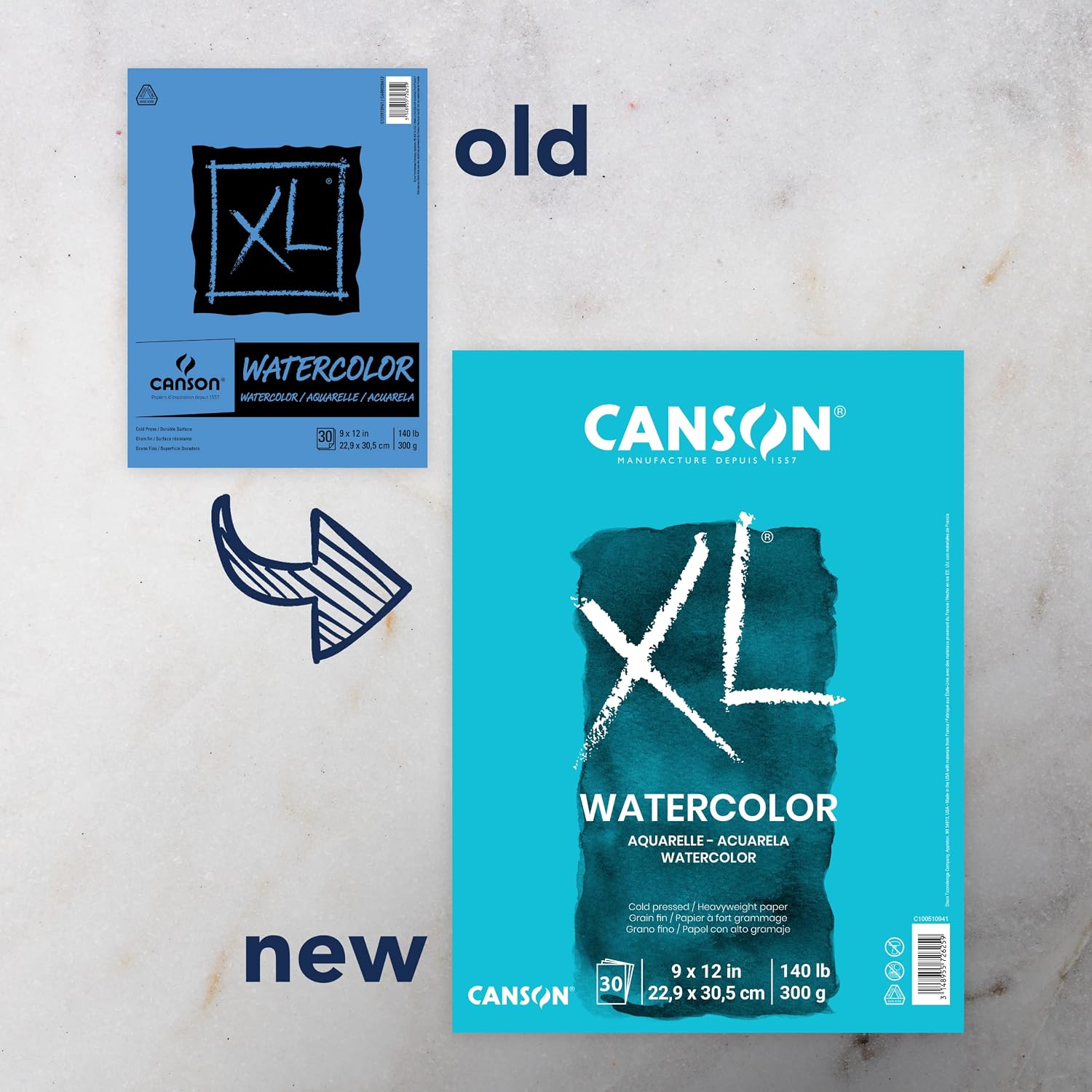
Canson XL at 300gsm cellulose sits in an interesting position: it’s priced in the accessible range but heavy enough to avoid the worst warping. Reviewers consistently note it’s workable for lighter wet washes without taping, though it won’t tolerate the sustained saturation of a dedicated wet-on-wet session. For studies, thumbnails, and colour testing, it earns its place in serious studios.
Fuxi pads — a budget cellulose option available through several Australian online art suppliers — generate specific questions around ink compatibility (addressed in the FAQ below), but their consistent appeal is volume: you get a lot of sheets for the spend, which supports high-frequency practice.
The Artists Network Watercolour Paper Buying Guide frames sub-300gsm paper as “study stock” — not dismissively, but accurately. It’s for the work that makes the finished work possible.
300gsm: The Dividing Line, and Why Cotton Changes the Equation
At exactly 300gsm, you’re at the industry consensus point for “usable without taping in most studio conditions.” But 300gsm cellulose and 300gsm cotton are not the same purchase, and the price gap between them is significant enough to require a deliberate choice.
Artistic Eye 300gsm — a cellulose sheet available through Australian art supply chains — has developed a quiet reputation among watercolour teachers. One teacher who reorders it repeatedly cites a specific practical detail: it stays flat without taping, which matters enormously in a class setting where students lose time and confidence wrestling with bubbling paper. For a teaching context or a high-volume studio practice that doesn’t require serious lifting and reworking, it represents genuine value at its price point.
Strathmore 300 occupies an interesting middle position. Across review aggregations at Maker and Student, Strathmore appears most frequently in commentary from people describing themselves as “beginning students at college” — which signals a paper that handles instruction well, tolerates student-level water saturation, and is priced within institutional supply budgets. It’s not a prestige choice; it’s a reliable one.
The cotton argument arrives with Arches and, in a different price bracket, Finegraspuro (sometimes listed as Fingraspuro in Australian stockist databases). Arches is the paper reviewers reach for superlatives about — but they consistently frame it as for serious artists, not as a default choice. The craft council of Australia’s materials resource library notes that archival-grade cotton papers like Arches carry a price premium justified by their longevity and workability for edition work and finished pieces intended for sale or exhibition.
What’s more interesting editorially is the Finegraspuro cotton story. Owners comparing it directly to more expensive brands consistently report equivalent performance — and the strongest signal of genuine satisfaction is behavioural: multiple owners have moved to monthly subscription reorders. In Australian pricing terms, if Finegraspuro delivers Arches-comparable surface behaviour at a lower per-sheet cost with reliable local availability, the decision-frame tips sharply in its favour for a studio that goes through significant volume.
The Lifting Question — Where Paper Choice Has Real Consequences
Lifting — the technique of removing dried watercolour pigment with a damp brush or clean water — is where cellulose and cotton diverge most dramatically, and where choosing the wrong paper costs you more than money.
On cellulose paper, pigment bonds more tightly to the surface fibres. Lifting works to a degree on fresh paint but becomes increasingly difficult as paint dries. On 300gsm cotton — Arches being the benchmark — dried pigment lifts cleanly with a stiff brush and water, allowing significant correction and glazing over lifted areas. This is not a marginal difference; it’s the difference between a paper that allows you to recover from mistakes and one that doesn’t.
Per the Jackson’s Art Supplies Paper Weight and Surface Guide, cotton’s longer fibre length and higher absorbency create a surface that retains pigment more loosely at the top layer, which is what enables clean lifting. Cellulose fibres are shorter and pack more densely, bonding pigment more permanently.
The practical implication: if your technique relies on lifting — portrait work, botanical illustration, cloud painting — paper fibre matters more than paper weight. A 300gsm cellulose sheet won’t behave like a 300gsm cotton sheet regardless of how carefully you work.
Frequently Asked Questions
Does Canson XL warp badly with wet-on-wet watercolour technique?
Yes, meaningfully so. At 300gsm, Canson XL holds up better than sub-200gsm stock, but wet-on-wet — where you’re saturating the sheet repeatedly — will cause visible buckling. Owners report it’s manageable for limited wet-on-wet passes if you work quickly, but for sustained wet work, taping the sheet to a board is strongly recommended. Think of it as study stock for technique development, not a finished-work surface.
Is 300gsm cotton actually better than 300gsm cellulose, or just more expensive?
For most techniques, genuinely better — not just more expensive. The functional differences (longer working time, superior lifting, paint pooling more naturally in textured areas) are real and consistently reported across owner reviews. Whether those differences justify the price premium depends on what you’re making. For studies and practice, cellulose is rational. For work you’re selling, exhibiting, or archiving, cotton earns its cost.
Will a Fuxi pad handle ink without bleed-through?
Based on owner reports, Fuxi handles light ink washes adequately but is not recommended for heavy ink application or combined ink-and-watercolour work. Reviewers note that sustained ink saturation — particularly alcohol-based inks — can bleed through thinner Fuxi sheets. For ink work, a heavier or more specifically ink-rated surface is the safer choice.
Can you lift dried watercolour paint on Strathmore 300 the same way you can on Arches?
Not to the same degree. Strathmore 300 is a cellulose paper, and as the Artists Network Watercolour Paper Buying Guide notes, cellulose surfaces bond pigment more permanently than cotton. Light lifting on fresh paint is possible; lifting dried paint the way Arches allows — cleanly, with significant colour removal — is not reliably achievable on Strathmore. If lifting is a core part of your technique, this is a meaningful limitation.
Does the Artistic Eye pad really stay flat without taping?
Owner and teacher reports suggest yes, for most standard wet wash techniques, at 300gsm. The teacher who reorders it specifically calls out flat behaviour as the reason she keeps coming back — and in a teaching context, she’d notice if that claim didn’t hold. Very heavy wet-on-wet saturation may still cause some movement, but for the majority of beginner-to-intermediate techniques, taping appears unnecessary.
The Decision Rule
If you’re building practice volume and working through technique — buy lighter or cellulose-weight stock and paint without hesitation. Canson XL or Fuxi at scale gives you the sheet count to improve faster than any premium paper will.
If you’re producing finished work, working in wet-on-wet, or relying on lifting as a technique — 300gsm cotton is the minimum surface you should be working on. Finegraspuro’s owner-reported equivalence to Arches at a lower entry cost makes it the rational first choice before committing to Arches pricing.
If you’re teaching — Artistic Eye 300gsm’s flat behaviour without taping solves a real classroom logistics problem, and the price point supports bulk purchasing.
The weight number on the label matters. The fibre content below it matters more.