Watercolour paint — pigment suspended in a water-soluble gum arabic binder — is one of the most beginner-friendly painting mediums on paper. You need very little equipment to start, cleanup is just water, and the translucent, layered effects you can achieve are genuinely beautiful from your first session. But walk into any art supply aisle in Australia and you’ll face a wall of sets ranging from $12 to $280, with very little on the packaging to explain why one costs twenty times the other. The short version: cheaper sets use low-quality or synthetic pigments that fade, granulate unpredictably, and fight you instead of cooperating. The colours you mix look muddy. You blame yourself and give up — when the real problem was always the paint. This guide cuts through that confusion. Whether you’re spending $40 or $150, you’ll leave knowing exactly which set to buy and why.
Why Student Grade vs Artist Grade Actually Matters (and When It Doesn’t)
The single most important distinction in watercolour is the grade split between student-grade and artist-grade (sometimes called professional-grade) paints. This isn’t marketing snobbery — it reflects a real difference in how the paint is made.
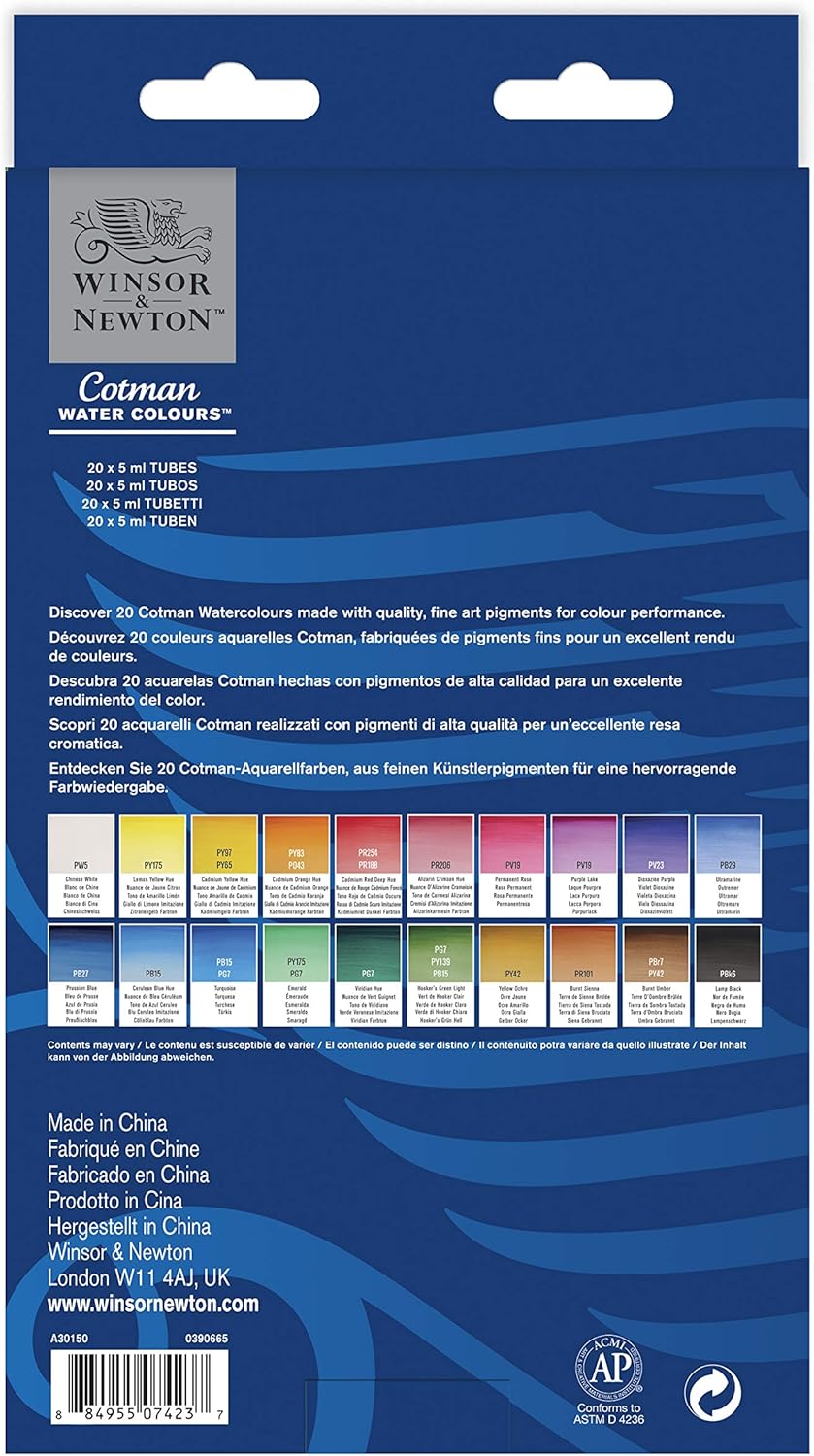
Student-grade sets use a smaller pigment load (less actual colouring matter per volume of paint) and frequently substitute cheaper synthetic fillers or hues — paints labelled “Cadmium Hue,” for instance, contain no actual cadmium but attempt to approximate its colour with a cheaper pigment mixture. The result is paint that’s less vibrant, less transparent, and often less predictable to mix. Winsor & Newton’s own technical documentation on their student-grade Cotman line is refreshingly candid about this: Cotman substitutes a proportion of the professional pigment with a less expensive equivalent to keep the price accessible.
Artist-grade sets use single-pigment or high-pigment-load formulations, and every colour is rated for lightfastness (resistance to fading under light exposure, measured on a scale from I–Excellent to IV–Poor). Jackson’s Art’s watercolour buying guide emphasises that lightfastness ratings are one of the most important factors a new painter should check, because student sets routinely include colours rated III or IV — colours that will visibly fade within months if displayed near a window.
The practical tradeoff: For a complete beginner who genuinely doesn’t know yet if watercolour will stick, starting with a quality student set (the Winsor & Newton Cotman 12-pan or 24-pan, or the Daler-Rowney Aquafine) is entirely defensible. You’ll learn the medium’s fundamentals without committing $200. But — and this matters — if you’ve already done a class, watched tutorials, and bought this guide, you’re probably not that person. The intermediate maker who researches before spending is almost always better served by a small, high-quality artist-grade set than a large, mediocre student set.
The Numbers: What You’re Actually Paying For
| Price point | What you typically get | Who it’s right for |
|---|---|---|
| $15–$30 | 12–24 pan student set, hue substitutes, lightfastness III–IV common | Absolute first-timer; gift for a child |
| $40–$80 | Quality student-grade 12–24 pan set (Cotman, Aquafine) or entry artist set | Beginner testing commitment; class supply list |
| $90–$160 | Small artist-grade set, 6–12 pans (Winsor & Newton Professional, Daniel Smith, Schmincke Horadam) | Intermediate practitioner — the sweet spot |
| $180–$300+ | Full artist-grade 24-pan set or tube + palette setup | Serious practitioner, studio setup, ongoing production |
AU prices as of May 2026; sourced from Jacksons Art and Australian retail listings. Note: artist-grade tubes from Daniel Smith and Schmincke at AU$30–$60 per 15mL tube are widely stocked by Eckersley’s, Jacksons Art (with AU freight from the UK), and Oxford Art Supplies.
The Pigment Principle: Single-Pigment Colours Are Worth Seeking Out
Here’s the decision framework that separates intermediate practitioners from beginners: learn to read the pigment code on the label.
Every watercolour tube or pan carries a pigment designation — codes like PY150 (Pigment Yellow 150), PB29 (Pigment Blue 29, also known as Ultramarine), or PR122 (Pigment Red 122). A paint labelled with a single pigment code is a single-pigment colour. A paint labelled with three or four codes is a mixture, pre-mixed at the factory.
Why does this matter? Single-pigment colours mix more cleanly and predictably. When you mix two single-pigment paints, you control exactly what you’re combining. When you mix two factory blends, you might be combining six or eight pigments — and the result is frequently muddy brown. Artists Network’s guide on choosing watercolour paints consistently flags this as the most commonly overlooked factor by new buyers.
For your first artist-grade set, prioritise a palette built around single-pigment colours. A 6–10 pan set of genuine single-pigment paints will serve you better than a 24-pan set of hues and blends. The Winsor & Newton Professional Watercolour Sketcher’s Pocket Box (12 half-pans, RRP AU$130–$160 depending on retailer) is a strong shortlist pick on this basis — the majority of its colours carry single-pigment designations, and every colour in the range is rated lightfast I or II.
Australian Sourcing: What You Need to Know Before You Buy
Freight and price parity are real concerns for Australian buyers, and this is where the decision gets locally specific.
The UK import consideration: Jackson’s Art in the UK carries a genuinely excellent range of artist-grade watercolours — Daniel Smith, Schmincke Horadam, Sennelier — often at prices 20–30% below Australian retail even after shipping. For a single-item order under $100, the freight math doesn’t favour the import. For a larger studio order of $300+, it often does. Factor in 4–10 business days delivery and occasional customs delays when comparing.
Australian retail options worth knowing:
- Eckersley’s (national chain, physical stores in VIC, NSW, QLD, WA and online) stocks a solid mid-range — Winsor & Newton Professional, Daler-Rowney Georgian, Liquitex — and frequently runs 30% off member sales. Worth timing a first purchase around these events.
- Oxford Art Supplies (Sydney-based, strong online catalogue) carries Daniel Smith and Schmincke Horadam — the two most-requested artist-grade lines among intermediate practitioners — at competitive AU pricing with good stock levels.
- Jacksons Art (AU site) runs a parallel Australian operation with local warehousing for some lines, reducing freight times compared to the UK-direct order.
- Walker Ceramics and specialist stores: Less relevant to watercolour, but worth knowing that very niche pigments and professional mediums sometimes require specialist supplier ordering in Australia, with 2–4 week lead times.
The GST reality: All imported goods over AU$1,000 attract GST at the border. Single-set purchases almost never hit this threshold, but studio-scale orders building toward a full professional kit should factor it in.
If X, Then Y: Your Decision Rules
The intermediate practitioner doesn’t need more options — they need a clear call. Here it is.
If you’ve painted fewer than five times and aren’t certain you’ll continue: Buy the Winsor & Newton Cotman 24-pan set (AU$55–$70, widely available at Eckersley’s and most art supply stores). It’s the best-made student set in wide Australian distribution. Accept the limitations, use it to build the habit, then upgrade.
If you’ve done a class or worked through a beginner tutorial series and know you want to continue: Skip another student set entirely. Buy a small artist-grade set — 6–12 half-pans — and spend your budget on quality rather than quantity. The Winsor & Newton Professional Watercolour Pocket Box or a custom-selected 6-colour Daniel Smith set built around single-pigment primaries (a warm and cool yellow, a warm and cool red, a warm and cool blue) will outperform any 24-pan student set in mixing versatility and longevity.
If you’re equipping a home studio for regular, ongoing use: Move to tubes. A set of 10–15 artist-grade tubes (Daniel Smith, Schmincke Horadam, or Winsor & Newton Professional) loaded into a ceramic or porcelain mixing palette gives you larger paint volumes, more flexible colour mixing, and better value per millilitre than pans. Budget AU$200–$350 for a functional starter tube kit at this level.
If you’re buying as a gift for a serious maker: The Winsor & Newton Professional Watercolour Sketcher’s Pocket Box or a curated Schmincke Horadam 12-pan set sits in the AU$130–$200 range and reads immediately as a considered, quality gift. Both are stocked by Oxford Art Supplies and Eckersley’s. Avoid any set without visible lightfastness ratings on the packaging — the Craft Council of Australia’s materials literacy guidance for emerging practitioners identifies unrated pigments as a persistent problem in gifted art supplies that undermines long-term maker development.
The One Thing Beginners Consistently Get Wrong
Most first buyers optimise for colour count. More pans, more colours, more range — the logic feels right. But across aggregated reviews on platforms like Jackson’s Art’s blog and Artists Network’s community resources, the consistent pattern is the opposite: experienced watercolourists use fewer colours and mix more. A 6-colour artist-grade palette built around the three primaries (in warm and cool variants) can mix a wider and cleaner range than a 36-colour student set, because the single-pigment colours stay clear through mixing rather than turning grey-brown.
Buy fewer colours. Buy better pigments. Learn to mix. That’s the entire argument.
Quick Reference: What to Check Before You Buy
Before you add any watercolour set to your cart, run through this:
- Grade: Is it student or artist/professional grade? Check the manufacturer’s own product line naming.
- Lightfastness: Does the packaging show ratings? Look for I (Excellent) or II (Very Good). III and IV fade.
- Pigment codes: Can you see the pigment codes (PY, PB, PR, PG etc.) on the label or product page? Single-code colours are generally preferable.
- Retailer stock: Is this available from an Australian retailer, or does it require UK/US import with added freight and lead time?
- Price per pan or per mL: Compare artist-grade sets on cost per pan, not total set price. A 6-pan artist set at $90 ($15/pan) often represents better value than a 24-pan student set at $55 ($2.30/pan) for a committed practitioner — because you’ll actually use and finish the artist-grade paint.
Get those five checks right and you won’t fall into the cheap-set trap. The paint you buy in the next fortnight will either fight you or cooperate with you for the next two years. Choose the one that cooperates.