Watercolour is one of those mediums you can pick up after a decade away and still remember the feel of — the way wet pigment blooms across damp paper, the small miracle of a clean wash. But if you’re returning to the craft after a gap, your old Winsor & Newton Cotman set (a student-grade paint line, meaning it uses some synthetic pigment fillers to keep costs down) might feel different than you remember. Not worse, exactly — but perhaps a little chalky, a little flat. That’s not nostalgia playing tricks. Student-grade paints use pigment extenders called fillers that reduce vibrancy and transparency compared to professional paints. The good news: you don’t need to spend $300 on artist-grade tubes to feel a genuine upgrade. Several sets in the $30–$90 range — Van Gogh, Daler Rowney Aquafine, MeiLiang, and Gansai Tambi — offer different answers to the question every returning maker faces: is what I have good enough, or is something else worth the switch?
This guide runs those comparisons honestly, anchored to what real reviewers who’ve made exactly this transition report. The decision framework at the end tells you which set matches your actual situation.
| EDITOR'S PICKKuretake GANSAI TAMBI Watercolo… | Mid-tierWinsor & Newton Cotman Watercol… | Budget pickDaler Rowney Half Pan Travel Set | |
|---|---|---|---|
| Colour Count | 48 | 12 | 25 |
| Format | — | Half Pan | Half Pan |
| Brush Included | — | ✓ | — |
| Made In | Japan | — | — |
| Non-Toxic | ✓ | — | — |
| Price | $58.99 | $20.08 | $20.00 |
| See on Amazon → | See on Amazon → | See on Amazon → |
The Cotman Baseline: What You’re Actually Working With
Before evaluating alternatives, it helps to understand what Cotman is doing well and where it falls short. Cotman is Winsor & Newton’s student line — pigments are extended with fillers, lightfastness ratings are generally good but not universal across the range, and pan sizes in the pocket sets are small (half-pan format, roughly 1.9 ml of paint). For someone learning washes and basic technique, that’s fine. For someone returning with more ambitious intentions — layering glazes, building up luminous transparent shadows — the filler content becomes the limiting factor.
One reviewer who specifically bought MeiLiang as a Cotman companion described the colour quality difference as “dramatic — omfg, there is a huge difference” and noted, candidly, that the Cotman’s lack of chalkiness wasn’t actually the problem they’d assumed — the chalkiness was the problem, and they hadn’t had the comparison to see it. That’s a useful framing: you don’t know what you’re missing until you put something richer next to it.
The Jacksons Art guidance note on student vs artist grade watercolour confirms the mechanism: extenders increase opacity and reduce the glowing transparency that makes watercolour distinctive. That’s the technical backbone behind what that reviewer experienced viscerally.
Van Gogh: The Most Direct Cotman Upgrade
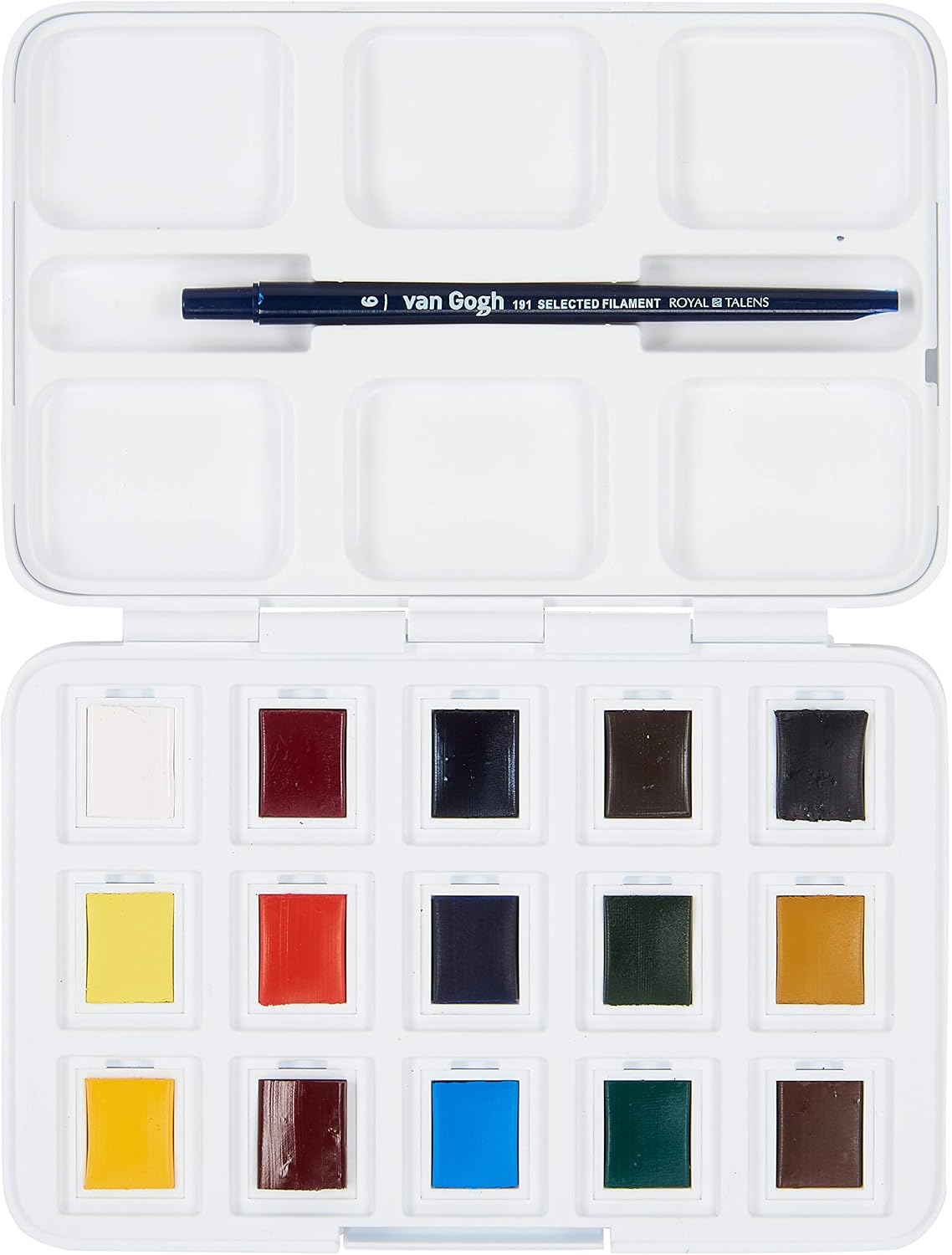
Van Gogh (made by Royal Talens, Netherlands) sits in an interesting tier — marketed as student grade but using single-pigment formulations across most of its range, which is a significant quality marker. Single-pigment means each paint contains only one type of pigment rather than a blend; this matters because single-pigment paints mix more cleanly and produce less muddy results when you layer colours.
Reviewers doing direct price-matched comparisons consistently rate Van Gogh ahead of Cotman at equivalent or only slightly higher price points. One reviewer who laid out a price comparison explicitly noted that for the same spend, Van Gogh delivered noticeably more vibrant, less chalky results — and rated it ahead without hesitation. The Artists Network overview of watercolour selection corroborates the single-pigment advantage as a key differentiator between mid-tier sets.
The Van Gogh 12-pan and 24-pan sets are available through Australian art suppliers, and at current (mid-2026) retail, the 12-pan set sits around $35–$45 AU depending on the retailer. That’s a modest step up from Cotman pricing, and for the returning maker who wants a familiar pan format with meaningfully better pigment quality, it’s the most friction-free upgrade path.
The tradeoff: Van Gogh pans are standard half-pan size, so if you’re used to Cotman’s pan dimensions, the fit feels similar. But the range depth is narrower than Daler Rowney’s Aquafine line, and the sets don’t include a water brush.
Daler Rowney Aquafine: The Travel-Focused Comparison
Daler Rowney Aquafine has a dedicated following among travel sketchers specifically because the sets are compact and the palette design is genuinely considered. One reviewer who owns multiple travel sets photographed their Aquafine, Cotman, Gansai Tambi, and Van Gogh side by side — the most thorough visual comparison in recent buyer reviews — and noted that Daler Rowney’s lid doubles as a more useful mixing palette than Cotman’s equivalent offering.
For returning makers who sketched en plein air (outdoors, on location) before their break, that lid-as-palette detail is meaningful. You’re not just buying paint; you’re buying a workflow.
Pigment quality sits in a similar bracket to Cotman — this is student-grade, not a Van Gogh-level upgrade in pigment specification — but the palette ergonomics and the slightly larger pan volume in some sets give you more working paint before you’re scraping. Australian retail pricing for the Aquafine sets generally tracks within a few dollars of Cotman equivalents.
The honest tradeoff: If pure pigment quality is your driver, Daler Rowney Aquafine is a lateral move, not an upward one. Where it earns its place is workflow: better mixing space, thoughtful compact format, and a set design that reviewers consistently describe as more pleasant to use in the field.
MeiLiang: The Budget Wildcard That Earns Its Place
MeiLiang is a Chinese-manufactured set sold at a price point well below Cotman — typically $15–$25 AU for the 36-colour set — that has generated outsized enthusiasm in online communities of watercolour beginners and returning makers. The reviewer who described the Cotman-to-MeiLiang difference as “dramatic” is not an outlier; the pattern repeats across aggregated reviews.
Why does a cheaper set produce that reaction? The working theory, consistent across reviews, is that MeiLiang uses less filler relative to its price point, producing richer colour than Cotman’s equivalent — not because MeiLiang uses premium pigments, but because Cotman’s fillers actively suppress the vibrancy that MeiLiang retains. At the absolute budget end, that’s a real difference you can see on paper.
The honest tradeoff: Lightfastness data for MeiLiang is limited and the manufacturer doesn’t publish the kind of pigment transparency information that Winsor & Newton provides for Cotman. If you’re making work you want to last decades — editions, pieces for sale, commissions — MeiLiang’s archival credentials are unverified. For sketchbooks, studies, and practice work where longevity isn’t the point, it’s a genuinely strong option at its price.
The Craft Council of Australia’s 2024 Survey of Visual Arts Practice noted that returning hobbyists consistently cited cost of materials as a barrier to re-engagement — MeiLiang directly addresses that.
Gansai Tambi: A Different Tool, Not a Straight Upgrade
Gansai Tambi (made by Kuretake, Japan) deserves its own framing because reviewers who own it consistently make the same observation: this is not a transparent watercolour in the Western tradition. Gansai is a Japanese-style water-based paint with a different opacity profile — richer, more saturated, with a slight luminosity that comes from its formulation rather than from pigment transparency. One 18-colour set reviewer explicitly compared the quality favourably to Daniel Smith and Winsor & Newton Professional at a much lower cost — high praise — while noting the opacity difference.
The pan size is also physically larger than Cotman half-pans, which reviewers consistently flag as a practical advantage: you can load a brush properly without scrubbing at the pan.
The honest tradeoff: If you’re returning to watercolour specifically to work with transparent glazing techniques — building up luminous layers of transparent colour — Gansai Tambi works differently and will require you to adjust your approach. It’s not better or worse than transparent watercolour; it’s a different medium with different strengths. The Maker and Student review of Gansai Tambi describes this clearly: “the opacity changes what’s possible, in both directions.”
By the Numbers
| Set | Approx. AU Price (mid-2026) | Grade | Pigment Type | Pan Size |
|---|---|---|---|---|
| Cotman 12-pan | $25–$35 | Student | Multi-pigment + filler | Half-pan |
| Van Gogh 12-pan | $35–$45 | Student+ | Single-pigment (most) | Half-pan |
| Daler Rowney Aquafine | $28–$40 | Student | Multi-pigment | Half-pan |
| MeiLiang 36-colour | $15–$25 | Student | Multi-pigment | Half-pan |
| Gansai Tambi 18-colour | $30–$45 | Student+ | Opaque/semi-opaque | Full pan |
The Decision Framework
If your goal is the cleanest upgrade from Cotman with minimum friction, Van Gogh is the answer. Same format, better pigment, single-pigment formulations across most of the range — and reviewers doing direct price comparisons consistently rate it ahead.
If you want the best travel palette ergonomics and don’t mind a lateral pigment-quality move, Daler Rowney Aquafine earns its place for the lid-as-mixing-palette design and considered compact format.
If budget is the primary constraint and you’re working in sketchbooks or studies rather than archival pieces, MeiLiang at its price point consistently surprises reviewers who arrive from Cotman. The vibrancy difference is real. The archival uncertainty is also real — know which matters more to you.
If you’re curious about Japanese water-based painting or want a larger pan size and richer saturation for illustration or mixed-media work, Gansai Tambi is worth investigating — but go in knowing it will shift your technique, not just your materials.
Frequently Asked Questions
Can Van Gogh or MeiLiang pans be refilled or replaced individually when they run out? Van Gogh sells individual half-pans and replacement colours through art suppliers, making it a viable long-term system — you can buy the set and gradually replace depleted pans with individual tubes squeezed into empty pan casings, or buy replacement pans directly. MeiLiang is primarily sold as a complete set; individual pan replacement isn’t well-supported, and most reviewers treat it as a disposable system rather than a long-term palette investment.
Is Gansai Tambi suitable for traditional transparent watercolour techniques, or does its opacity change the approach? It changes the approach. Gansai Tambi is semi-opaque to opaque depending on the colour, which means the classic transparent glazing technique — building luminous depth by layering thin washes — works differently and often less predictably. It’s excellent for illustration, bold flat washes, and mixed-media use. For traditional botanical or landscape watercolour built on transparency, it requires adjustment and is not a direct substitute.
How does the Daler Rowney palette size compare to the Cotman Sketchers pocket set for actual travel use? The Daler Rowney Aquafine Travel set is broadly comparable in footprint to the Cotman Sketchers pocket palette — both fit in a jacket pocket or small bag. The Daler Rowney lid provides a more generous mixing area, which reviewers who photograph both side by side note as a practical advantage for field use. Neither set is substantially smaller or larger in the hand.
If I already own a Cotman 12-pan set, is it worth buying a second set or should I just buy individual replacement pans? Cotman sells individual replacement half-pans across its full colour range through Australian art suppliers, which is a more cost-effective approach than buying a second complete set. If you’re happy with the Cotman range and just need to replenish depleted colours, replacement pans are the logical move. If you’re considering this article’s alternatives, a new set rather than a Cotman refill reflects a considered decision to move on from the system — both choices are legitimate.
Do any of these sets include a water brush or usable brush, or should a separate brush always be bought? Some sets — particularly MeiLiang’s larger configurations — include a basic brush, and a small number of Daler Rowney sets include a water brush. Reviewers are consistent on this point: the included brushes in student sets are generally adequate for testing paint behaviour but not for serious work. A separate round brush in a size 6 or 8 (a standard round watercolour brush shape, good for both detail and broader washes) will meaningfully improve results regardless of which set you choose. Treat any included brush as a bonus, not a reason to choose one set over another.